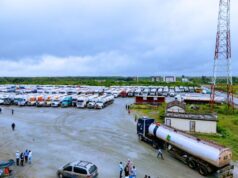


…Strong refining margins and disruption to global fuel supplies boost earnings ahead of planned $1.6bn stock market flotation
WED OCT 14 2026-theGBJournal| Dangote Petroleum Refinery has swung to a $4.73 billion net profit in the first nine months of 2026, as higher production, stronger refining margins and disruption to global fuel supplies helped transform Africa’s largest refinery into a major earnings generator ahead of its planned stock market debut.
The company reported revenue of $22.48 billion for the nine months to September 30, up 144 per cent from $9.2 billion in the same period last year, according to unaudited results released on Tuesday.
The performance marks a sharp reversal from a net loss of $117.2 million a year earlier.
Earnings before interest, taxes, depreciation and amortisation, a measure of operating profitability, rose nearly ninefold to $5.52 billion from $627.6 million.
The EBITDA margin expanded to 24.56 per cent from 6.83 per cent, reflecting higher refining throughput, improved operational reliability and stronger refining economics.
The results underline the rapid commercial transformation of the 700,000-barrel-a-day facility, built at a cost of about $20 billion near Lagos.
After a prolonged commissioning and production ramp-up, the refinery is increasingly converting its capacity into earnings, while emerging as a significant supplier to international fuel markets.
The business has also benefited from disruptions to Middle Eastern oil-product supplies linked to the Iran war, which have increased demand for alternative sources of fuel.
Dangote has expanded exports to Europe, including jet fuel, as supply shortages have tightened regional markets.
The strength of the earnings has coincided with preparations for a planned $1.6 billion initial public offering that could become Africa’s largest.
The proposed flotation is expected to widen investor access to the refinery while providing a potential source of capital for its expansion programme.
Cash generation strengthens balance sheet
The improvement in profitability has been accompanied by a substantial increase in cash generation.
Operating cash flow climbed to $3.68bn in the first nine months, from $364.7 million a year earlier, while cash balances rose to $6.69 billion from $809.5 million.
The refinery moved from a net debt position of $1.73 billion in September 2025 to net cash of $650.8 million a year later, an improvement of about $2.38 billion.
The shift gives the company greater financial flexibility as it pursues expansion and prepares to enter the capital markets.
The third-quarter figures point to an acceleration in earnings.
Revenue increased from $13.91 billion at the end of June to $22.48 billion at the end of September, implying third-quarter revenue of approximately $8.57 billion.
EBITDA rose from $2.60 billion at the half-year stage to $5.52bn at the end of September, suggesting third-quarter operating earnings of about $2.92 billion.
Net profit increased from $1.82 bn at the half-year mark to $4.73 billion, implying an additional $2.91bn in the third quarter.
David Bird, the refinery’s chief executive, said the latest performance demonstrated a successful transition from commissioning and production ramp-up to sustainable commercial operations.
He attributed the improvement to higher throughput, greater operational reliability and stronger gross refining margins, adding that the results provided a foundation for the company’s planned flotation and its longer-term expansion strategy.
Dangote’s performance highlights the growing influence of the refinery on international petroleum-product markets and Nigeria’s efforts to reduce its dependence on imported refined fuels.
Its scale gives the company the potential to supply domestic demand while exporting surplus products to markets across Africa and beyond.
But its growing profitability also reflects favourable conditions in international fuel markets, making the durability of current refining margins an important consideration for investors.
The planned expansion programme is intended to increase capacity and broaden the refinery’s product portfolio.
The company has also pledged to strengthen its distribution network across Africa as it seeks to establish a larger role in regional energy supply.
X-@theGBJournal|email:gbj@govbusinessjournal.com|govandbusinessj@gmail.com