
…The G&B Journal examines President Bola Tinubu’s latest external borrowing proposal which once again raises questions about the projects to be financed, the economic returns expected and the country’s capacity to meet its growing obligations.
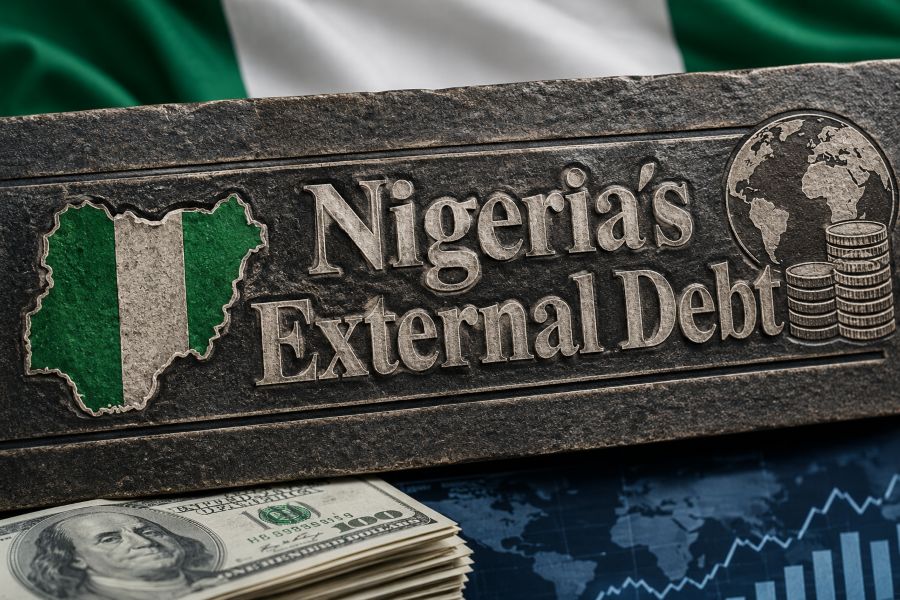
THUR OCT 29 2026-theGBJournal| President Bola Tinubu wants Nigeria to borrow another $21.7 billion from external sources to finance infrastructure and development projects.
But as the Federal Government seeks legislative approval for the financing, a fundamental question confronts the country: what measurable economic benefits will Nigerians get in return for the additional debt?
The proposal, comprising $20.518 billion and €1.045 billion, is intended to finance projects and programmes across power, transportation, healthcare, agriculture, education, water supply and security during the 2026–2027 period.
In a letter read by Senate President Godswill Akpabio during plenary on Tuesday, October 27, Tinubu argued that Nigeria’s infrastructure deficit and the financial resources required to address it had made additional external borrowing necessary.
“In light of the need for significant infrastructure investment in the country and the vast financial resources needed to address this gap, it has become essential to pursue prudent external borrowings to close the financing shortfall,” the President said.
He maintained that the projects had undergone technical and economic evaluations and were designed to generate employment, promote skills acquisition and entrepreneurship, reduce poverty and strengthen food security.
Most of the proposed interventions, he said, would be implemented across Nigeria’s 36 states and the Federal Capital Territory.
The Senate subsequently referred the request to its Committee on Local and Foreign Debts, with the Appropriations and Finance committees expected to participate in the scrutiny.
On Wednesday, October 28, the House of Representatives also received the President’s request and referred it to the relevant committees for consideration.
The proposal therefore presents an opportunity for lawmakers to examine not only the government’s financing requirements but also the economic case for taking on additional foreign-currency obligations.
For a country with substantial infrastructure needs, borrowing to invest is not inherently problematic. Properly structured loans can finance assets that increase productivity, expand economic activity and generate benefits over many years.
The difficulty arises when the public cannot clearly establish what the money will finance, what the investments are expected to deliver and how the resulting obligations will be met.
Those questions are particularly important as Nigeria manages a growing public debt stock and continues to confront constraints affecting electricity supply, agricultural production, manufacturing and the cost of moving goods.
Nigeria’s total public debt stood at N166.79 trillion as of June 30, 2026, according to the Debt Management Office (DMO).
The figure represented an increase of N7.44 trillion, or 4.7 per cent, from N159.35 trillion at the end of March 2026. Compared with the N152.40 trillion recorded at the end of June 2025, the debt stock had increased by N14.39 trillion, or 9.4 per cent.
Of the June 2026 total, domestic debt accounted for N91.59 trillion, while external debt stood at N75.20 trillion.
The external component represented approximately 45.1 per cent of the total public debt stock.
In dollar terms, the DMO put Nigeria’s total public debt at $120.93 billion as of June 2026, using the applicable exchange rate for the conversion.
These figures provide the backdrop against which the proposed borrowing must be assessed.
However, the proposed $20.518 billion and €1.045 billion should not simply be added to the existing debt stock as though the money has already been borrowed.
Legislative approval, the signing of financing agreements, the disbursement of funds and the recognition of resulting debt obligations are distinct stages.
The precise additional debt arising from the proposal will depend on the facilities covered, their existing approval status and the amounts ultimately drawn.
There is already a question about the relationship between the new request and earlier borrowing authorisations.
During Tuesday’s Senate proceedings, Akpabio indicated that the borrowing plan had featured in an earlier government borrowing and budgetary framework, although he acknowledged uncertainty about the exact period of the previous approval.
That raises an important issue for lawmakers: how much of the latest proposal represents new borrowing authority, and how much relates to facilities already approved under an earlier programme?
The distinction matters because Nigerians need to know whether the government is requesting approval for an entirely new financing package or seeking to activate, amend or supplement an existing arrangement.
A clear reconciliation of previous approvals, signed facilities, disbursements and outstanding balances would help establish the true additional borrowing being contemplated.
The question of what previous borrowing delivered
The latest request has also revived questions about the implementation of previously approved borrowing programmes.
On October 28, Senator Victor Umeh questioned the Federal Government’s handling of earlier loans, arguing that repeated borrowing approvals had not resolved concerns about budget funding and payments to contractors executing capital projects.
“The truth is that we have approved so much funds to be borrowed in the past, and on each occasion we’ve been told that this borrowing would be able to fund the budgets and these budgets have remained unfunded up till this day,” Umeh said in an interview reported by Premium Times.
He questioned why contractors were still awaiting payments despite previous borrowing approvals.
His comments are a challenge that requires a documentary answer from the government. They do not, on their own, establish that the funds from the earlier facilities were diverted or that the loans failed to achieve their intended purposes.
But they point to a central issue that lawmakers should resolve before committing the country to another substantial borrowing programme.
How much of the previously approved financing has been accessed? Which projects received the money? What proportion of the projects has been completed? How much remains undisbursed, and what obligations remain outstanding to contractors?
Without a reconciled account, the public cannot adequately assess whether the latest proposal addresses genuinely new financing needs or whether weaknesses in the implementation of existing programmes are contributing to the demand for additional funds.
The Federal Government should publish a consolidated record of its external borrowing since President Tinubu assumed office in May 2023, identifying each facility, its purpose, financing terms, disbursements, implementing agency and project status.
That would allow lawmakers and the public to distinguish between money approved, money borrowed, money spent and results delivered.
Electricity provides one of the clearest examples of why the economic value of the proposed loans matters.
Nigeria’s electricity constraints affect manufacturers, food processors, small businesses and service providers, many of which must supplement grid supply with alternative sources of power.
The Nigerian Electricity Regulatory Commission’s operational reporting offers a starting point for examining the gap between installed generation capacity and electricity available to the grid.
Its August 2026 operational factsheet reported average available grid-connected generation capacity of 4,758 megawatts.
The economic significance of power investment, however, depends on the specific constraint being addressed.
Additional generation capacity may not translate into more dependable electricity for businesses if transmission infrastructure, distribution networks or other system constraints remain unresolved.
For manufacturers, the consequences of unreliable electricity extend beyond the cost of fuel. Businesses must also consider generator maintenance, equipment damage, interruptions to production, idle workers and the cost of maintaining alternative power systems.
A factory operating below capacity because of electricity constraints may struggle to compete with producers operating in countries with more reliable power.
The proposed borrowing should therefore be examined against specific questions.
How much has been allocated to generation, transmission, distribution and decentralised electricity projects? Which facilities will be financed? How much additional dependable capacity is expected? When will it become operational?
And, crucially, what reduction in electricity costs or interruptions can businesses reasonably expect?
The government should be able to identify the projects, their costs and their expected contribution to electricity supply.
Without that information, the public cannot determine whether the proposed investment will remove the constraints holding back production or simply add another set of projects to an already extensive infrastructure programme.
X-@theGBJournal|email:gbj@govbusinessjournal.com|govandbusinessj@gmail.com