
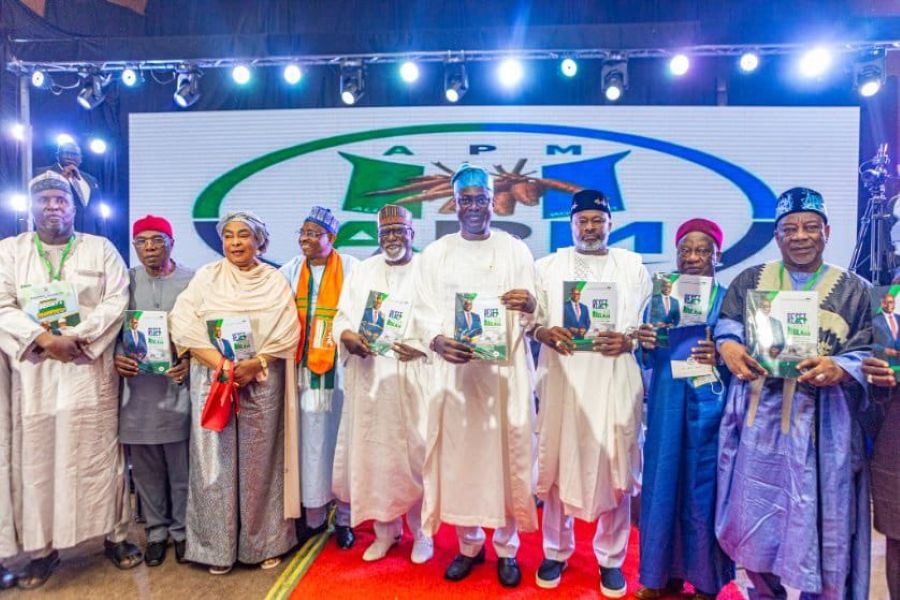

…From a proposed citizen energy credit and state policing to guaranteed foundational learning and a review of federal responsibilities, the manifesto of the Allied Peoples Movement (APM) presidential candidate, HE Engr. Seyi Makinde, seeks to move Nigeria’s development conversation beyond policy announcements to measurable outcomes, writes CHARLES IKE-OKOH.

THUR NOV 05 2026-theGBJournal| The Allied Peoples Movement (APM) presidential candidate, HE Engr. Seyi Makinde, has unveiled an ambitious policy blueprint for Nigeria, proposing far-reaching reforms of the economy, security architecture, education system and political institutions as part of a national agenda to reset the country.
The Reset Nigeria Manifesto, presented on Wednesday, November 4, outlines a four-pillar development framework for 2027–2031, built around the argument that Nigeria’s challenge is not merely a shortage of resources but the inability of existing institutions and policies to translate the country’s potential into tangible improvements in citizens’ lives.
At the heart of the manifesto is a proposition that economic growth must be measured beyond conventional indicators to include the cost of living, household purchasing power, employment opportunities, public safety and access to quality education and healthcare.
The document identifies four priority areas: resetting the economy, restructuring security, reforming education and resetting the socio-political system.
Under the economic pillar, Makinde proposes a shift towards productivity, domestic value addition and reducing the cost of doing business. Among the notable proposals is a Domestic Energy Value Credit, designed to give Nigerians a more direct stake in the economic value generated from crude oil refined and consumed within the country.
The manifesto also proposes the development of priority freight corridors to reduce transportation costs, particularly for agricultural produce and manufactured goods, alongside the completion of agricultural value chains to improve processing, storage and market access.
It further advocates an independent assessment of government-owned refineries to establish their operational and economic performance, while proposing technology-driven reforms to reduce bureaucratic bottlenecks for businesses and citizens.
The underlying economic argument is that Nigeria must move beyond an economy driven largely by consumption and resource extraction towards one that supports production, enterprise and job creation.
On security, the manifesto advocates a more intelligence-led and community-driven approach, with particular emphasis on preventing attacks rather than relying predominantly on responses after incidents have occurred.
A major proposal is the completion and implementation of the constitutional framework for state policing, alongside improved coordination among security agencies and stronger community intelligence networks.
The document also proposes a Threat-to-Action Standard to ensure that intelligence gathered by security institutions translates into timely operational responses.
Under this arrangement, security agencies would be expected to establish clearer processes for acting on early warnings, sharing intelligence and reviewing failures following major security incidents.
The manifesto further envisages coordinated security and economic recovery programmes for communities affected by persistent violence, recognising that insecurity has consequences beyond the immediate loss of lives, including disrupted farming activities, displacement and declining commercial activity.
Education reform constitutes the third pillar, with the proposed National Foundational Learning Guarantee standing out as one of its central commitments.
The initiative seeks to ensure that children acquire basic literacy and numeracy skills by the end of Primary Three, shifting the emphasis from school enrolment and infrastructure to demonstrable learning outcomes.
The manifesto also proposes improvements in teacher training and professional development, stronger learning assessments, interventions for out-of-school children and expanded technical and vocational education.
It argues that education must be more closely connected to the productive economy, with learning pathways providing young Nigerians with skills that translate into employment, entrepreneurship and sustainable livelihoods.
The fourth pillar addresses the structure and performance of Nigeria’s political and governance institutions, with particular emphasis on making federalism more functional.
Makinde proposes a Federal Responsibilities Review to reconsider the division of responsibilities between the federal and state governments, with a view to devolving functions to the level of government best positioned to deliver them.
The manifesto also advocates stronger institutional accountability, electoral reforms and a review of the country’s political transition arrangements.
Among its proposals are a transitional government of national unity, a national conference on Nigeria’s political future and a presidential electoral threshold requiring a candidate to secure at least 50 per cent plus one vote.
It further proposes a unified social protection gateway and an essential primary healthcare guarantee as part of efforts to strengthen the country’s social safety net.
Beyond the individual policy proposals, the manifesto places considerable emphasis on implementation and accountability.
It proposes the publication of a consolidated Reset Delivery Plan within the first 100 days of an incoming administration, setting out institutional responsibilities, timelines, measurable targets and reporting mechanisms for the various commitments.
The proposed framework is intended to make government performance more transparent and enable citizens to assess progress against clearly defined objectives.
The manifesto also draws on selected initiatives undertaken in Oyo State under Makinde’s administration, including the Fasola Agribusiness Industrial Hub, the state’s emergency response system, investments in primary healthcare and interventions in the education sector.
These experiences provide some context for the thinking behind the national proposals, although their implementation at the federal level would require broader institutional coordination, financing and adaptation.
The scale of the proposed reforms nevertheless raises important questions about funding, constitutional requirements, institutional capacity and the coordination necessary to translate the commitments into practical outcomes.
For instance, implementing state policing would require clear constitutional safeguards, sustainable funding and effective accountability arrangements, while the proposed energy credit would depend on a transparent framework for determining and distributing the value accruing to citizens.
Similarly, the proposed foundational learning guarantee would require sustained investment in teachers, learning materials and reliable assessment systems.
The manifesto’s central proposition, however, is that Nigeria’s development challenge must be approached as an interconnected problem involving economic productivity, security, human capital and the effectiveness of public institutions.
Rather than treating these areas as separate policy concerns, the Reset Nigeria agenda presents them as mutually reinforcing conditions for national development.
For a country grappling with economic pressures, insecurity, educational challenges and questions about the effectiveness of its federal structure, the manifesto places a fundamental question at the centre of the 2027 political conversation: how can government move from making promises to consistently delivering results?
X-@theGBJournal|email:gbj@govbusinessjournal.com|govandbusinessj@gmail.com