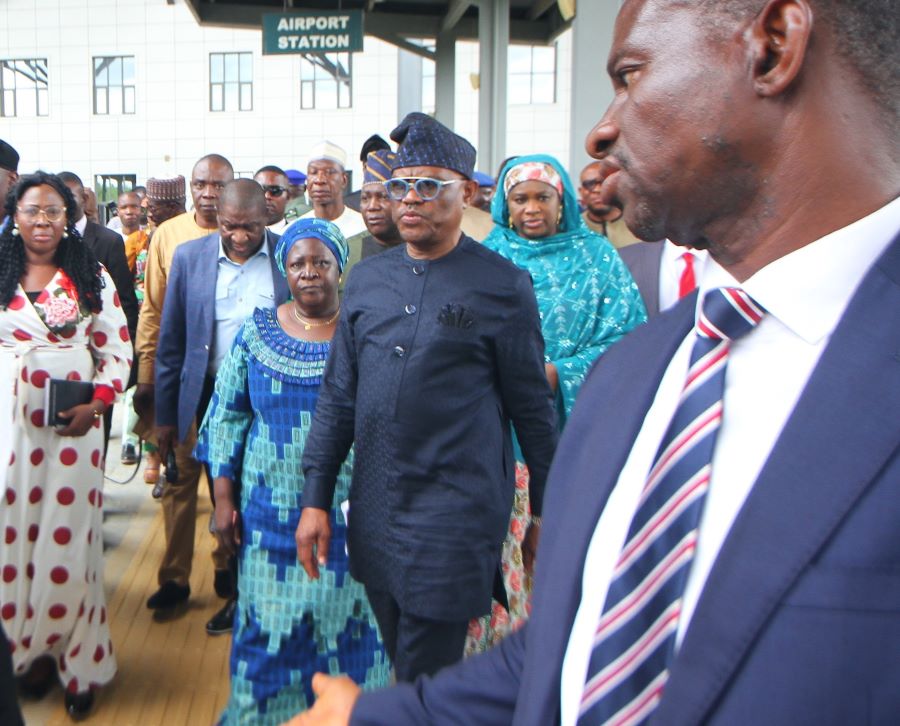

…Wike represents a particular kind of Nigerian political actor: one who prioritizes results, commands loyalty, and is unafraid of confrontation.
By Igwebuike Okoh
WED APRIL 15 2026-theGBJournal| Politics in Nigeria has long been shaped by a mix of strong personalities, shifting alliances, and a constant struggle between public service and personal ambition.
Among the many political actors in recent years, Nyesom Wike stands out as one of the most consequential—and controversial—figures.
There is little doubt that Wike’s tenure as Minister of the Federal Capital Territory (FCT) has brought visible transformation to Abuja. For many residents and observers, the city has begun to reflect the promise of a true national capital.
Improved access roads have eased movement and boosted economic activity, while renewed attention to housing development has addressed some long-standing urban challenges. Security, often a critical concern in Nigeria’s major cities, has also seen relative improvement under his watch, contributing to a sense of stability.
Furthermore, his push for increased revenue generation has demonstrated a level of administrative seriousness that many believe was lacking in previous administrations.
These achievements are particularly striking when compared to the performance of some ministers before him, who struggled to leave a lasting imprint on the capital. Wike’s approach appears more hands-on, more forceful, and arguably more results-driven.
In a political environment where promises are often made and quickly forgotten, his ability to deliver tangible outcomes has earned him both praise and a reputation for effectiveness.
His track record as the former governor of Rivers State reinforces this image. During his time in office, Rivers witnessed significant infrastructural development. Projects such as the construction of multiple flyovers in Port Harcourt, alongside extensive road rehabilitation and public building projects, helped reshape the state’s urban outlook. These developments are often cited as concrete evidence of his capacity to execute large-scale projects and leave visible legacies.
Another defining aspect of Wike’s political persona is his loyalty. In Nigeria’s often fluid political space, where alliances shift quickly and betrayal is not uncommon, Wike has cultivated an image of consistency.
He is widely perceived as a politician who stands by his allies and fulfills his commitments. This trait has made him both dependable to his supporters and formidable to his adversaries.
His readiness to confront perceived betrayal—often with intensity—has further cemented his reputation as a fiercely loyal actor who does not take political opposition lightly.
However, this same intensity also feeds into one of the major criticisms against him: his demeanor. Wike’s public conduct is frequently described as combative and, at times, arrogant. His tendency to openly mock opponents can come across as unbecoming of a public office holder. Yet, this behavior does not exist in isolation—it reflects a broader culture within Nigeria’s democratic space.
Contrary to the ideal of democracy as a system that encourages respectful discourse and reasoned debate, the Nigerian political arena often rewards the opposite. There is a strong propensity to diminish, discredit, and ridicule opponents rather than engage them constructively.
Political strength is frequently measured not by the quality of one’s ideas but by the ability to outmaneuver and outshout rivals. In such an environment, sharp rhetoric and personal attacks become tools of survival rather than exceptions.
This culture is closely tied to the nature of political opposition in Nigeria, which is often filled with exaggerations, distortions, and, at times, outright falsehoods. Claims against opponents are dramatized and presented as facts, creating a political climate where perception can overshadow reality. As a result, public figures like Wike operate within a system that both provokes and rewards aggressive engagement.
Seen from this perspective, Wike’s confrontational style may be less of a personal anomaly and more of an adaptation to the system he operates in. While it remains fair to critique his arrogance and public mockery of opponents, it is equally important to recognize that such behavior is, to a large extent, normalized within the political culture.
Ultimately, Wike represents a particular kind of Nigerian political actor: one who prioritizes results, commands loyalty, and is unafraid of confrontation. His achievements in infrastructure and governance are evident, but so are the challenges posed by his style of engagement.
More broadly, his career highlights a deeper issue within Nigerian democracy—the need to move beyond a politics of ridicule and misinformation toward one grounded in accountability, substance, and truth.
Mr. Igwebuike Okoh writes from Cologne, Germany
X-@theGBJournal|Facebook-the Government and Business Journal|email:gbj@govbusinessjournal.com|govandbusinessj@gmail.com