
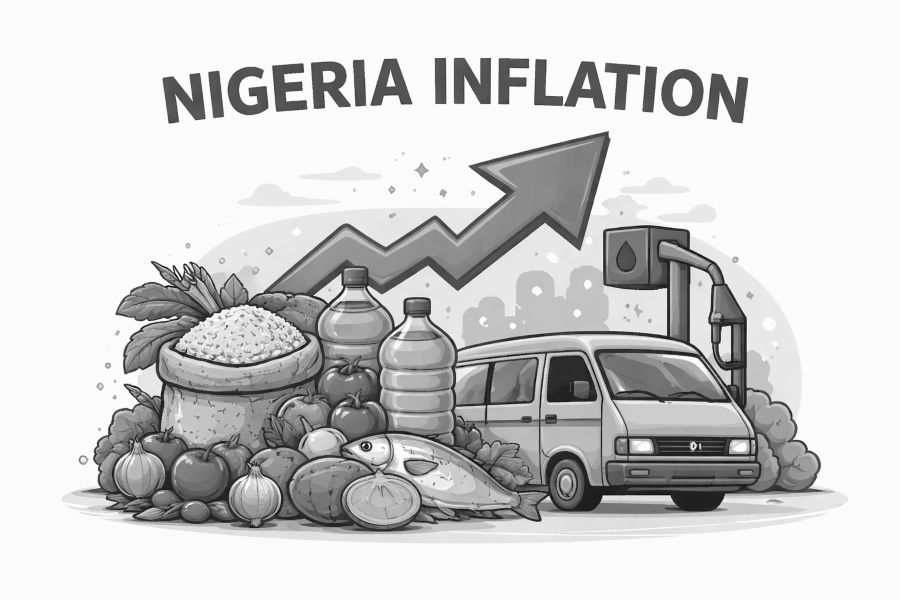

WED APRIL 15 2026-theGBJournal| Against the backdrop of persistent insecurity, global economic uncertainties, and rising fuel costs, Nigeria’s inflation rate ticked up in March 2026, underscoring renewed pressure on household incomes and the broader economy.
Data released today by the National Bureau of Statistics (NBS) for March 2026 show that headline inflation rose to 15.38% year-on-year, up from 15.06% recorded in February 2026, reflecting a modest but notable uptick in the general price level across the country.
On a month-on-month basis, inflation accelerated sharply to 4.18% in March, representing a 2.17 percentage point increase compared to the 2.01% recorded in February.
The spike signals a faster pace of price increases within the month, driven largely by rising transportation, energy, and supply chain costs.
Food inflation, a critical component of Nigeria’s consumer basket, also recorded a significant increase on a year-on-year basis, climbing to 14.31% in March from 12.12% in February.
The rise highlights continued pressures in the food supply chain, exacerbated by insecurity in key agricultural regions and higher logistics costs.
However, on a month-on-month basis, food inflation eased slightly to 4.17% in March, compared with 4.69% in February, suggesting a marginal slowdown in the rate of increase in food prices despite underlying structural challenges.
Core inflation, which excludes volatile agricultural produce and energy prices, rose to 16.21% year-on-year in March, up from 15.88% in February. This increase indicates that underlying inflationary pressures remain strong beyond food and energy components.
On a month-on-month basis, core inflation surged to 4.03% in March, a significant jump from 0.89% recorded in February, pointing to broad-based price increases across goods and services.
The latest figures reinforce concerns about sustained inflationary pressures in the Nigerian economy, with cost-push factors—particularly fuel prices, exchange rate pressures, and insecurity—continuing to drive price instability and erode consumer purchasing power.
X-@theGBJournal|Facebook-the Government and Business Journal|email:gbj@govbusinessjournal.com|govandbusinessj@gmail.com