
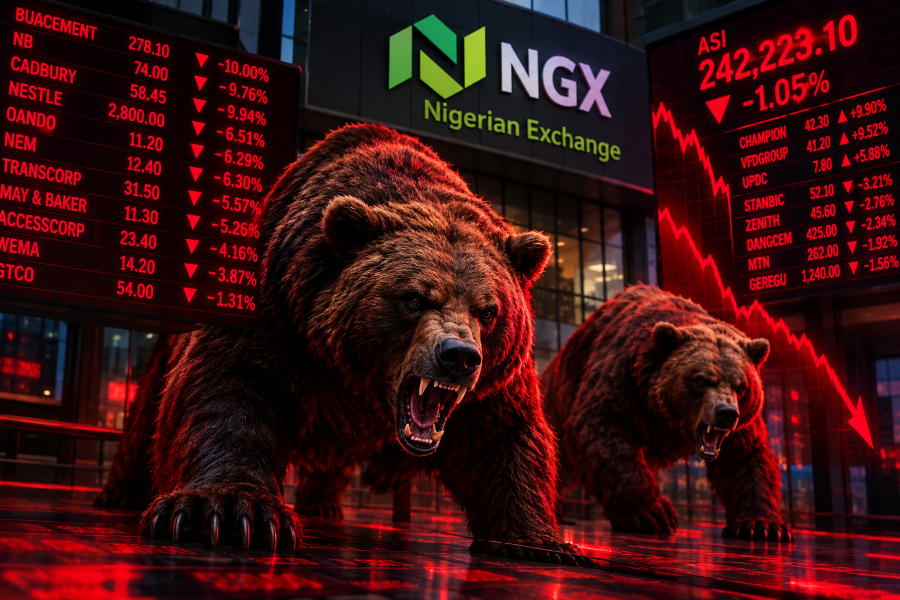

…At the centre of the rout were some of the Exchange’s more heavily capitalised and liquid stocks.
…The latest selloff means the market has surrendered roughly N3.57 trillion in capitalisation in just two sessions, following Tuesday’s N1.9 trillion loss.
THUR SEPT 10 2026-theGBJournal| The Nigerian Exchange (NGX) endured another bruising session on Wednesday as aggressive selling across heavyweight consumer, industrial and financial stocks wiped out about N1.67 trillion in market value, extending the market’s losing streak to three consecutive sessions.
The NGX All-Share Index (ASI) fell 2,579.01 points, or 1.05 per cent, to close at 242,223.10 points, from 244,802.11 points on Tuesday.
Market capitalisation consequently declined from about N158.72 trillion to N157.05 trillion.
The latest selloff means the market has surrendered roughly N3.57 trillion in capitalisation in just two sessions, following Tuesday’s N1.9 trillion loss.
The combined reversal has sharply reduced the market’s year-to-date return to 55.66 per cent, from 57.31 per cent at the end of Tuesday.
The intensity of Wednesday’s decline was underscored by market breadth. Forty-nine stocks closed lower against only 11 gainers, leaving the breadth ratio at a deeply negative 0.19x. The breadth confirms that the selloff was not confined to a handful of counters but represented a broad retreat from equities.
At the centre of the rout were some of the Exchange’s more heavily capitalised and liquid stocks.
BUA Cement plunged 10 per cent, the maximum daily decline, falling from N309 to N278.10.
Nigerian Breweries dropped 9.76 per cent, from N82 to N74, while Cadbury Nigeria shed 9.94 per cent, falling from N64.90 to N58.45. Nestlé Nigeria, which attracted the highest transaction value for the session, fell 6.51 per cent, from N2,995 to N2,800.
Other significant casualties included Oando, down 6.29 per cent; NEM Insurance, down 6.30 per cent; Transcorp, down 5.57 per cent; May & Baker, down 5.26 per cent; AccessCorp, down 4.16 per cent; Wema Bank, down 3.87 per cent; and GTCO, down 1.31 per cent.
The losses in the heavyweight counters were particularly damaging because declines in large-capitalisation stocks exert a disproportionate influence on the benchmark index.
The scale of the move in BUA Cement and Nestlé, for example, meant that the market was absorbing significant valuation losses even without exceptionally heavy trading volumes.
The selling pressure was so widespread that the handful of strong performers offered little protection. Champion Breweries led the gainers with a 9.90 per cent advance, followed by VFD Group, which gained 9.52 per cent, and UPDC, up 5.88 per cent.
Selling pressure intensifies
The selloff was accompanied by a notable slowdown in trading activity, suggesting that Wednesday’s weakness was driven more by persistent price pressure than by an outright surge in turnover.
Total volume traded fell 29.04 per cent to 534.45 million units, while transaction value declined 19.94 per cent to N22.28 billion.
SterlingNG was the most actively traded stock by volume, with 78.11 million units, followed by other heavily traded counters.
Nestlé led the value table with transactions worth N3.20 billion, despite its 6.51 per cent decline.
The combination of falling prices, extremely weak breadth and declining turnover points to a market in which buyers have become increasingly reluctant to absorb offers at prevailing valuations.
What is driving the bloodbath?
The immediate explanation is profit-taking and a broad reassessment of equity valuations after the market’s powerful 2026 rally.
The NGX had delivered exceptionally strong gains earlier in the year, leaving investors with substantial paper profits.
As the market began losing momentum, investors appear to have moved to lock in gains, particularly in stocks that had experienced strong price appreciation.
That selling has increasingly become self-reinforcing. Once major counters begin hitting their daily downside limits, sentiment deteriorates across the broader market, encouraging investors to reduce exposure rather than wait for a deeper correction.
There is also a currency factor.
The official foreign-exchange rate depreciated by 0.7 per cent to N1,329.03/$, adding another layer of uncertainty for investors.
For companies with significant imported inputs or foreign-currency obligations, a weaker naira can raise costs and pressure margins. For foreign investors, meanwhile, currency movements can reduce the dollar value of naira-denominated equity gains.
The Wednesday decline therefore came at the intersection of profit-taking, stretched valuations, currency uncertainty and deteriorating market sentiment.
There is an important signal beneath the headline ASI loss. Proshare’s market measures showed the cap-weighted index falling 1.41 per cent, significantly more than the float-adjusted total-return index, which declined only 0.17 per cent.
That divergence reinforces the conclusion that the day’s damage was concentrated particularly heavily in large-capitalisation stocks.
In other words, this was not simply a broad retreat by small speculative stocks. Some of the market’s most influential companies were being marked down sharply.
N3.57 trillion erased in two days
The significance of Wednesday’s session is best understood against the backdrop of Tuesday’s selloff.
The market had already lost approximately N1.9 trillion on Tuesday as the ASI dropped 1.17 per cent.
Wednesday added another N1.67 trillion to the destruction in market value.
Together, investors saw approximately N3.57 trillion wiped from the quoted equity market in two trading sessions.
That represents a sharp change in tone for a market that had spent much of the year delivering spectacular returns.
The ASI remains up 55.66 per cent year-to-date, but the speed with which investors have moved from accumulation to profit-taking shows how vulnerable the market can become when sentiment turns.
NASD moves in the opposite direction
The bearish mood on the NGX was not replicated on the NASD OTC market.
The NASD Security Index gained 0.84 per cent to 4,533.41 points, while market capitalisation rose by the same margin to N2.72 trillion. Its year-to-date return consequently improved to 27.93 per cent, from 26.87 per cent.
Trading activity strengthened considerably, with volume surging 364.59 per cent to 998,890 units, while transaction value increased 84.04 per cent to N61.18 million.
The number of trades rose 78.95 per cent to 34.
SDCSCSPLC led the gainers with a 4.32 per cent advance, while SDNASDPLC emerged as the biggest loser, declining 11.06 per cent.
The divergence between the two markets reinforces the point that Wednesday’s bloodbath was primarily an NGX equity-market phenomenon rather than a wholesale flight from Nigerian quoted securities.
X-@theGBJournal|email:gbj@govbusinessjournal.com|govandbusinessj@gmail.com