
…Opposition politician says APC council raises questions over neutrality of officials overseeing public revenue and national finances
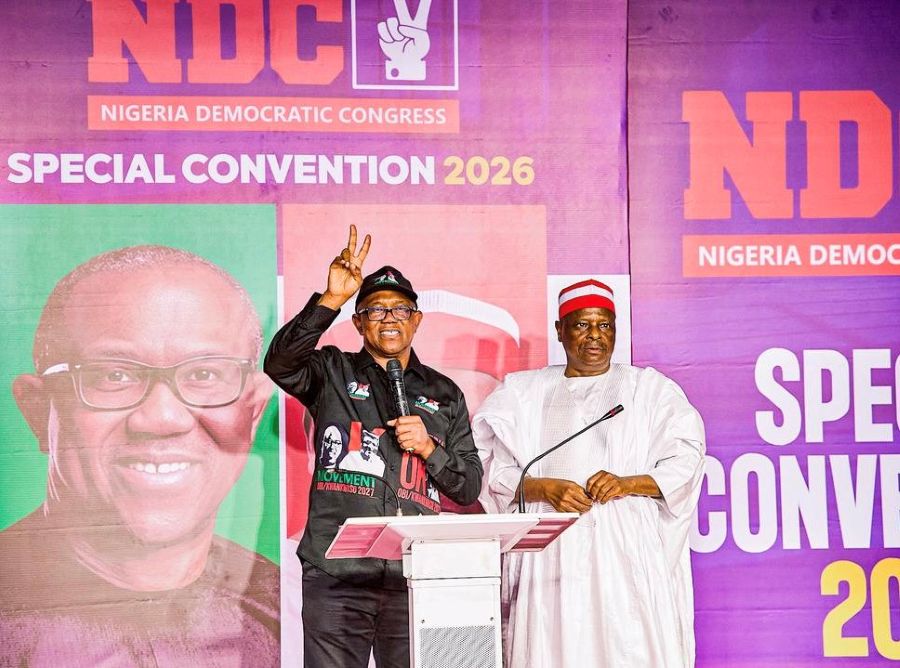
MON AUG 24 2026-theGBJournal|Rabiu Musa Kwankwaso, a former Kano governor and vice-presidential candidate of the New Democratic Congress, has challenged the composition of President Bola Ahmed Tinubu’s 2027 re-election campaign council, arguing that the structure illustrates the political choice facing Nigerian voters while raising more fundamental questions about the role of senior public officials in partisan politics.
The All Progressives Congress campaign council, approved by Tinubu last week, is headed by former Zamfara governor Abdul’aziz Yari as director-general, with Imo governor Hope Uzodimma as secretary.
The council includes a number of serving political officeholders and senior figures in the administration.
But Kwankwaso, who will contest the election as the running mate to Peter Obi on the NDC ticket, said the composition amounted to a choice between continuing the current administration and pursuing a political alternative.
“The council brings together many of the same political actors who have supported, defended or participated in the present administration,” Kwankwaso said.
“Their coming together raises a fundamental question: what exactly are they asking Nigerians to vote for in 2027, a new beginning, or the continuation of the same system that has brought severe hardship to our people?”
Kwankwaso said the election would take place against a backdrop of rising living costs, unemployment, insecurity and pressure on public services.
He framed the contest as one between Nigerians struggling with the consequences of the country’s economic and security problems and political interests he accused of benefiting from the existing system.
His sharper criticism, however, focused on the participation of officials whose institutional responsibilities are closely tied to public finances.
The APC campaign structure names Zacch Adedeji, executive chairman of the Nigeria Revenue Service, as deputy director of fundraising, while Tanimu Yakubu Kurfi, director-general of the Budget Office of the Federation, is listed as secretary of finance/treasurer.
Kwankwaso said their inclusion raised an institutional question that extended beyond the immediate electoral contest.
“The leadership of critical public institutions demands neutrality, integrity and public confidence,” he said.
“It is therefore legitimate to ask whether the responsibilities of senior officials entrusted with managing public revenue and national finances can appropriately coexist with senior partisan campaign roles.”
The concern is significant because the two positions sit close to the core of the federal government’s financial machinery.
The revenue service is responsible for a critical part of the state’s revenue collection architecture, while the Budget Office plays a central role in the preparation and management of federal budgetary processes.
For Kwankwaso, the issue is therefore not merely whether civil servants or public officials can support a political party.
It is whether officials occupying positions that require public confidence should simultaneously assume prominent responsibilities in a campaign seeking to retain the government whose finances they help administer.
“The government and the APC should explain how such arrangements are consistent with institutional neutrality and public trust,” he said.
The challenge could put pressure on the APC and the government to distinguish more clearly between the political machinery campaigning for Tinubu and the institutions whose officials are expected to serve the Nigerian state.
Kwankwaso also appealed directly to Yari to reconsider his decision to lead the campaign.
“As a former governor of Zamfara State and a prominent leader from the North-West, I believe Senator Yari has a clear understanding of the devastating consequences of insecurity, poverty, unemployment, displacement and the destruction of livelihoods in the region and the country at large,” he said.
He questioned whether Yari could reconcile that experience with leading a campaign whose objective is to secure another term for the Tinubu administration.
The criticism comes as Nigeria’s presidential campaign season gathers pace.
Tinubu enters the contest with the advantages of incumbency and an extensive political structure, but his administration is also facing criticism over economic hardship and insecurity.
Recent reporting has highlighted the political risks posed by the cost-of-living crisis and the government’s controversial economic reforms.
Kwankwaso said Nigerians should use the election to demand more accountable and people-centred government.
“We must use it come 2027 election to reject continued oppression and demand accountable, people-centred governance,” he said.
He concluded with a broader message aimed at the electorate rather than the campaign machinery: “Ultimately, no campaign council is more powerful than the Nigerian people.”
By Charles IKE-OKOH
X-@theGBJournal|email:gbj@govbusinessjournal.com|govandbusinessj@gmail.com