

…Oyedele says benefits must reach factories, farmers and households as government launches major rehabilitation of Apapa, Tin Can ports
THUR NOV 26 2026-theGBJournal| Nigeria has begun a $1 billion modernisation of its two principal Lagos seaports, in a major infrastructure intervention aimed at reducing trade costs, improving business productivity and strengthening the country’s competitiveness in international markets.
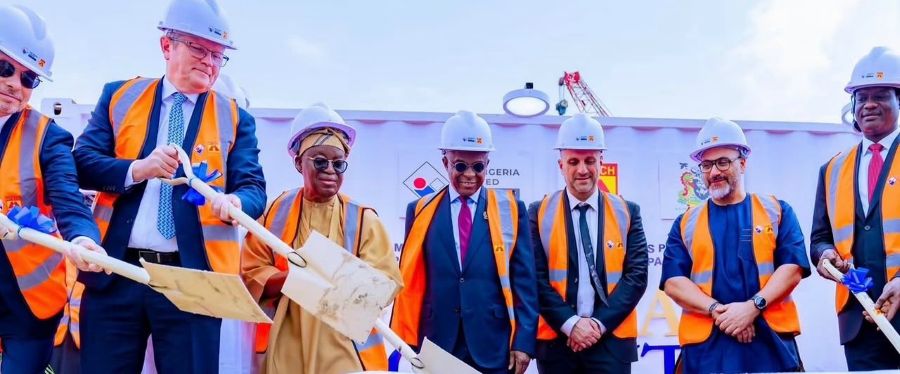
The groundbreaking ceremony, held on Wednesday at Tin Can Island Port, brought together senior government officials and international financing partners, including the Minister of Finance and Coordinating Minister of the Economy, Taiwo Oyedele, as the Federal Government seeks to address longstanding infrastructure constraints at the Apapa and Tin Can Island port complexes.
“When a berth is slow, the cost does not stay at the quayside. It reaches the factory that waits for its inputs, the farmer whose export is delayed and the family that pays more at the market,” Oyedele said at the ceremony.
The $1 billion investment, equivalent to approximately £746 million, is backed by UK Export Finance (UKEF), with Poland’s export credit agency, KUKE, providing reinsurance for almost half of the financing.
Citibank’s London branch arranged the financing through a consortium of lenders.
Oyedele described the transaction as Nigeria’s largest sovereign export credit transaction since 2009 and KUKE’s first project in the country, highlighting it as evidence of growing international confidence in Nigeria’s economic reform programme.
But he cautioned that securing international financing was only the beginning of the process.
“Financing is only a promise until it becomes delivery,” he said, stressing the importance of effective implementation and measurable economic outcomes.
The Finance Minister reaffirmed the Federal Government’s commitment to timely approvals, a stable and predictable operating environment, and transparency in the project’s financing and execution.
He also emphasised that the investment must generate benefits beyond physical infrastructure, calling for local employment, skills development and procurement from Nigerian suppliers throughout the construction and implementation phases.
The rehabilitation will cover the Lagos Port Complex at Apapa and the Tin Can Island Port Complex, two strategic maritime gateways that handle a substantial share of Nigeria’s international cargo.
The project will cover 20 berths across the two port complexes and involve extensive rehabilitation of quay walls, berths, dredging and navigation channels, access facilities, cargo-handling equipment and operational systems.
The intervention is designed to address ageing infrastructure, operational bottlenecks and capacity constraints that have affected the efficiency of Nigeria’s maritime trade over the years.
The Minister of Marine and Blue Economy, Adegboyega Oyetola, who led the groundbreaking ceremony, said the project would help reposition Nigeria as a major maritime hub in Africa, attract international shipping lines and stimulate industrial growth.
The government expects the project to generate at least 20,000 direct and indirect jobs across construction, engineering, dredging, logistics, transportation and port operations.
Construction will be undertaken by Hitech Nigeria and ITB Nigeria, while the Nigerian Ports Authority is responsible for the port development initiative.
The ports’ modernisation represents an attempt to address a structural weakness in Nigeria’s trade infrastructure rather than simply improve port facilities.
Faster vessel turnaround, more efficient cargo handling and improved access infrastructure could reduce the time and cost involved in moving goods into and out of the country.
The benefits could also extend to small businesses, agro-processors and manufacturers seeking to compete in regional and international markets, particularly under the African Continental Free Trade Area framework.
The financing arrangement also highlights the role of international export credit agencies in supporting large-scale infrastructure development in emerging economies.
Under the arrangement, UK Export Finance provides financing support, while KUKE’s reinsurance participation helps underpin the transaction. Citibank coordinated and arranged the financing.
The agreement, announced in March 2026, forms part of broader economic cooperation between Nigeria and its international partners.
British suppliers are also expected to benefit from contracts associated with the project, including the supply of specialised materials and services.
The government has also acknowledged the need to maintain cargo movement during construction, given the importance of the Lagos ports to the country’s commercial activities.
The rehabilitation of Apapa and Tin Can Island forms part of a wider maritime modernisation agenda that includes proposed interventions at Onne, Warri and Calabar.
As Oyedele’s remarks at the groundbreaking made clear, the ultimate measure of the $1 billion investment will not be the financing secured or the infrastructure unveiled, but the economic value Nigerians derive from it.
X-@theGBJournal|email:gbj@govbusinessjournal.com|govandbusinessj@gmail.com