


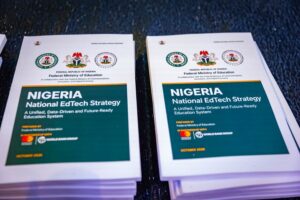
WED NOV 18 2026-theGBJournal| Nigeria has launched a 168-page National Educational Technology (EdTech) Strategy aimed at integrating technology into teaching, learning and education management, as the government seeks to improve learning outcomes and expand access to quality education.
The strategy, launched on Tuesday, provides a national framework for deploying technology across schools and education institutions, strengthening digital infrastructure, developing teachers’ capacity and improving the use of data in education planning and governance.
Minister of Communications, Innovation and Digital Economy, Dr Bosun Tijani, said the strategy represented an opportunity to bring government, private businesses, civil society and development partners behind a common agenda for using technology to improve education.
“Today’s launch of Nigeria’s EdTech Strategy marks an important step towards transforming education through technology,” Tijani said.
He said Nigeria could draw lessons from the financial services sector, where interoperability, enabling infrastructure and a thriving innovation ecosystem had helped drive significant growth.
“I believe we have a similar opportunity in education: to intelligently deploy technology to leapfrog traditional barriers to learning, while simultaneously building a vibrant Nigerian EdTech ecosystem,” he said.
Tijani stressed that the strategy was not simply about introducing technology into classrooms but about fundamentally improving how Nigerians teach, learn and access educational opportunities.
The framework seeks to establish an integrated, data-driven education system that enables evidence-based decision-making, improves service delivery, reduces duplication and maximises the impact of public and private investments in education technology.
It also places emphasis on strengthening education data systems, improving coordination among government institutions and ensuring that technology investments translate into measurable improvements in learning outcomes.
Minister of Education, Dr Tunji Alausa, described the strategy as a demonstration of the Federal Government’s commitment to building a unified, data-driven and future-ready education system.
In the foreword to the document, Alausa said the strategy aligned with President Bola Tinubu’s Renewed Hope Agenda and his ministry’s vision of making education a catalyst for national development, innovation and global competitiveness.
“The success of this Strategy will depend on our collective commitment to implementation,” Alausa said.
The strategy was developed through collaboration between the education and communications ministries, with contributions from federal and state government institutions, education agencies, development partners, academia, the private sector and civil society.
The Mastercard Foundation and the World Bank Group were among the development partners acknowledged for supporting its development.
Tijani said the strategy provided a common framework for aligning investments, encouraging innovation and improving learning outcomes, adding that its success would ultimately depend on effective implementation.
He also acknowledged Alausa’s leadership, as well as the contributions of Mastercard Foundation, particularly Suraj Shah, and Wura Junaid, who led the work, alongside the World Bank Group and officials from both ministries.
Among its expected outcomes is the establishment of a trusted and interoperable national education data ecosystem, which the government hopes will improve the availability, quality and timeliness of education information.
The framework also seeks to strengthen education planning, financing and resource allocation, integrate teacher workforce information through the National Teacher Digital Competency Framework (NTDCF), and improve monitoring, evaluation and accountability.
It further envisages better coordination across federal, state and local government institutions, alongside stronger data protection and governance arrangements to build public confidence in education information systems.
The strategy argues that reliable education data will provide the foundation for implementing its other pillars, enabling policymakers to identify gaps, track progress and direct resources more effectively.
Tijani said Nigeria now had a framework around which stakeholders could coordinate investments and innovation, but urged them to move beyond the launch and focus on delivery.
“The real opportunity now lies in implementation,” he said.
He encouraged stakeholders interested in the future of Nigerian education to study the document, engage with its recommendations and contribute to putting the strategy into practice.
X-@theGBJournal|email:gbj@govbusinessjournal.com|govandbusinessj@gmail.com