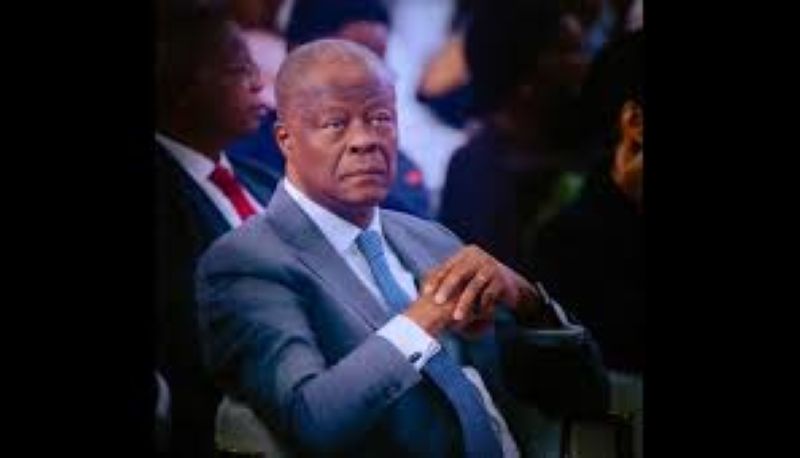

…At the National Assembly, Edun reportedly laid bare the revenue gaps confronting the federal government. While transparency is commendable, the tone and substance of his presentation appeared to underscore a troubling lack of control
WED APRIL 22 2026-theGBJournal| The moment a finance minister begins to sound more like a narrator of problems than a solver of them, his tenure is already on borrowed time.
That moment appeared to arrive for Wale Edun at the National Assembly. What should have been a routine fiscal briefing instead became a revealing window into the widening gap between Nigeria’s revenue ambitions and its economic reality.
His candid admission of persistent revenue shortfalls—amid mounting debt obligations and an increasingly strained budget—did not just unsettle lawmakers; it likely sealed his fate. In a government under pressure to deliver economic stability, such signals can be politically fatal.
To be fair, Edun did not inherit an easy portfolio. Nigeria’s public finances have long been hobbled by structural weaknesses: an overreliance on oil revenues, chronic underperformance in tax collection, and a bloated expenditure framework.
Add to this the volatility of global oil prices and domestic production challenges, and any finance minister would be navigating a minefield. Yet, leadership in such moments demands not just acknowledgment of problems, but the articulation of a credible path forward.
That was the missing piece.
At the National Assembly, Edun reportedly laid bare the revenue gaps confronting the federal government. While transparency is commendable, the tone and substance of his presentation appeared to underscore a troubling lack of control.
He painted a stark picture of Nigeria’s fiscal constraints, stressing that government revenues remain critically low relative to expenditure obligations.
He highlighted that despite recent reforms, including fuel subsidy removal and efforts to unify the foreign exchange market, the country is still grappling with a narrow revenue base, weak tax compliance, and heavy reliance on oil receipts that are both volatile and underperforming.
As a result, a significant portion of federally generated revenue continues to be absorbed by debt servicing, leaving limited fiscal space for capital investment and social spending.
He also warned that without urgent structural adjustments, Nigeria’s fiscal position would remain fragile.
Investors, lawmakers, and citizens alike are not merely interested in hearing that revenues are falling short—they want assurance that there is a coherent, actionable strategy to reverse the trend.
Instead, what emerged was a picture of a government struggling to meet its own projections.
This matters because fiscal credibility is the bedrock of economic confidence. When revenue targets are persistently missed, borrowing becomes the fallback. Nigeria is already walking a tightrope, with debt servicing consuming a significant share of government income.
Any indication that revenues will continue to lag only heightens concerns about sustainability. In that context, Edun’s remarks may have inadvertently amplified fears rather than calmed them.
Politics, inevitably, filled the vacuum.
President Bola Tinubu’s administration has staked much of its legitimacy on economic reform. From subsidy removal to exchange rate adjustments, the government has asked Nigerians to endure short-term pain for long-term gain. But such a bargain requires visible progress. When key economic managers appear unable to demonstrate that progress, accountability becomes unavoidable.
Edun’s exit, then, can be interpreted as a signal—a message that the administration is willing to recalibrate in pursuit of results. Yet, symbolism alone will not fix Nigeria’s fiscal challenges.
The incoming finance leadership faces a daunting task. First, there must be a decisive shift from optimistic projections to realistic budgeting. Overstating revenues only creates a cycle of disappointment and reactive policymaking.
Second, revenue generation must move beyond rhetoric. Expanding the tax base, improving compliance, and plugging leakages are no longer optional—they are urgent imperatives.
Third, expenditure discipline must be enforced with far greater rigor. Without it, even improved revenues will struggle to make a meaningful impact.
Perhaps most importantly, communication must evolve.
Nigerians can endure hardship, but they are less tolerant of uncertainty. Clear, consistent, and credible messaging about the state of the economy—and the plan to fix it—is essential.
Edun’s tenure will likely be remembered as a cautionary chapter: one that highlights the limits of technocratic optimism in the face of structural realities. His appearance at the National Assembly did more than explain revenue shortfalls; it exposed the fragility of the government’s fiscal narrative.
In the end, his removal is less about one man and more about a system under strain. The real question is whether his successor will merely inherit the same challenges—or finally begin to confront them with the urgency and clarity they demand.
X-@theGBJournal|Facebook-the Government and Business Journal|email:gbj@govbusinessjournal.com|govandbusinessj@gmail.com