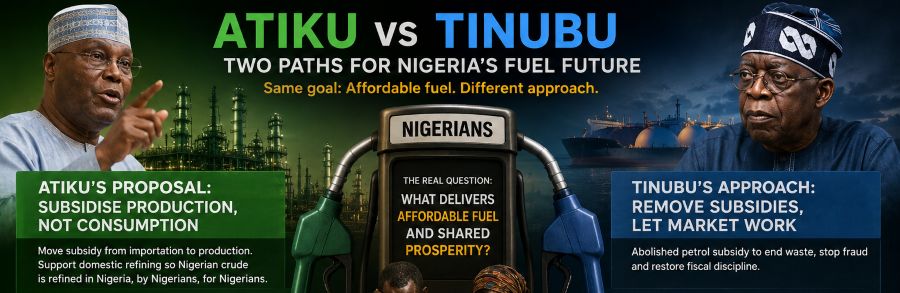

…Atiku’s proposal to subsidise domestic refining, rather than petrol consumption, challenges Tinubu’s clean break with subsidies as the cost-of-living crisis deepens
By Charles IKE-OKOH
MON AUG 24 2026-theGBJournal| Nigeria’s debate over petrol subsidies is entering a more consequential phase.
Three years after President Bola Tinubu declared that the subsidy regime was over, the question is no longer simply whether subsidies are good or bad economics.
It is whether Nigeria has chosen the right point in the oil value chain at which to absorb the cost of making petrol affordable.
That is the significance of Atiku Abubakar’s proposal for a production subsidy under his Atiku Economic Recovery Plan (AERP).
The former vice-president and African Democratic Congress presidential candidate argues that Nigeria should move support away from imported petrol and towards domestic refining — making preferentially priced crude available to qualifying Nigerian refineries, in naira, subject to strict production, efficiency, transparency and domestic-supply requirements.
The distinction is important.
Tinubu’s reform removed the state from the business of subsidising consumption.
Atiku is proposing that the state instead subsidise production — and only where the benefit can be traced from a barrel of Nigerian crude to petroleum products delivered to Nigerian consumers.
In principle, that is a much more defensible proposition than the old subsidy regime.
Nigeria’s former system was notoriously opaque, expensive and vulnerable to fraud. It rewarded importation and created enormous fiscal liabilities while leaving the country, paradoxically, dependent on imported petrol despite being one of Africa’s largest oil producers. Tinubu was right to confront that contradiction.
But the economic success of subsidy removal cannot be measured only on the government’s balance sheet.
For households, transport operators and businesses, petrol is not merely another commodity. It is an input into almost every other price in the economy.
Higher fuel costs feed into transport, food distribution, electricity generation and manufacturing.
The reform may have improved public finances, but it also shifted a substantial part of the adjustment from government accounts to household budgets at a time when Nigerians are already struggling with the cost of living.
That creates the uncomfortable question at the centre of the emerging debate: could Nigeria preserve the fiscal gains of subsidy removal while using its crude resources more deliberately to lower the cost of domestic refining?
Atiku’s answer is yes.
His proposal would make subsidised crude conditional on independently verified domestic supply.
Crude allocations, refinery intake, production yields, inventories and deliveries would be reconciled so that every supported barrel could, in theory, be traced to the pump.
The annual fiscal exposure would be capped and appropriated by the National Assembly, while the support would decline as domestic refining capacity expands and production costs fall.
That is very different from writing cheques to marketers for imported petrol.
The proposal also speaks directly to one of the most important structural problems exposed by Nigeria’s attempt to develop a domestic refining industry: the difficulty of securing crude on commercially viable terms.
The dispute surrounding Dangote Refinery illustrates the problem. Nigeria can allocate crude to domestic refiners and still fail to create an economically attractive market if the price, volume or terms of supply do not work for both producers and refiners.
Recent regulatory data show that domestic crude supply to refineries has improved, but also highlight continuing gaps between allocations and actual deliveries, with pricing and commercial terms remaining significant obstacles.
This is where Atiku’s proposal has its strongest economic logic.
If Nigeria’s crude is being produced domestically, why should the country necessarily price every barrel purely as an export commodity when the strategic objective is to establish a competitive domestic refining industry?
But the answer cannot be another opaque subsidy.
A preferential crude price creates a new rent, just as a petrol subsidy created an old one.
The beneficiaries would simply change: instead of importers competing for government-backed petrol payments, producers and refiners could compete for discounted crude.
Without transparency, Nigeria would have moved the subsidy problem upstream rather than solved it.
The conditions Atiku proposes are therefore more important than the word “subsidy”. Any such programme would need independently verified production and delivery data, transparent pricing, equal access for qualifying refineries, public disclosure of allocations and a hard sunset clause.
Most importantly, the government would need to demonstrate that the fiscal cost of supporting domestic refining is smaller than the economic benefit generated by cheaper and more reliable fuel supplies.
Tinubu’s government has an equally strong argument to make. The 2023 reform broke a fiscal dependency that had survived for decades.
Restoring subsidies in another form could undermine investor confidence and recreate the expectation that government will intervene whenever market prices become politically uncomfortable.
Nor is there an obvious reason why taxpayers should subsidise private refineries.
The answer can only be that the intervention delivers a wider public benefit that the market, left alone, cannot provide — greater domestic refining, lower logistics costs, more secure fuel supply and, ultimately, lower prices for consumers.
If it merely increases refinery margins, it would be difficult to justify.
This is why Nigeria’s fuel-subsidy debate should move beyond the ideological binary of “subsidy” versus “no subsidy”.
The more useful question is where in the petroleum value chain should Nigeria deploy its scarce fiscal resources?
Tinubu has placed the emphasis on fiscal discipline and market pricing. Atiku is arguing for a temporary industrial-policy intervention that uses Nigeria’s crude endowment to build domestic refining capacity and reduce the cost of supplying the Nigerian market.
There is a plausible middle ground.
Nigeria could retain the core of Tinubu’s reform — no open-ended subsidy on petrol consumption — while considering a tightly controlled, temporary production incentive for domestic refining. It would apply equally to qualifying refineries, be independently audited, carry a predetermined fiscal ceiling and decline automatically as efficiency and domestic capacity improve.
The objective would not be to make petrol artificially cheap. It would be to ensure that Nigerians benefit more directly from the country’s comparative advantage as an oil producer.
That distinction may become increasingly important as the 2027 election approaches.
Tinubu can legitimately argue that abolishing the old subsidy was necessary to prevent another fiscal crisis.
Atiku can equally argue that the reform left Nigerian consumers bearing too much of the adjustment before domestic refining had matured sufficiently to cushion them.
The real test is therefore neither whether Nigeria has abolished subsidies nor whether it has restored them.
It is whether the country can build a petroleum market in which Nigerian crude is refined competitively in Nigeria, Nigerian consumers receive the benefit, and government support has a clear beginning, measurable purpose and predetermined end.
That is a much harder policy challenge than simply declaring a subsidy regime dead. It is also the debate Nigeria now needs.
CHARLES IKE-OKOH, Publisher, The Government and Business Journal
X-@theGBJournal|email:gbj@govbusinessjournal.com|govandbusinessj@gmail.com