
…After the launch, the hard part begins: NSIA-Africa50 vehicle must convert capital into bankable mini-grids, solar systems and new electricity connections
MON OCT 05 2026-theGBJournal| Nigeria has spent years trying to close an electricity gap that the national grid alone has proved unable to solve.
Now, a new $300 million investment vehicle is putting a different proposition to the market: that the country’s chronic shortage of reliable power can itself become a large, investable business.
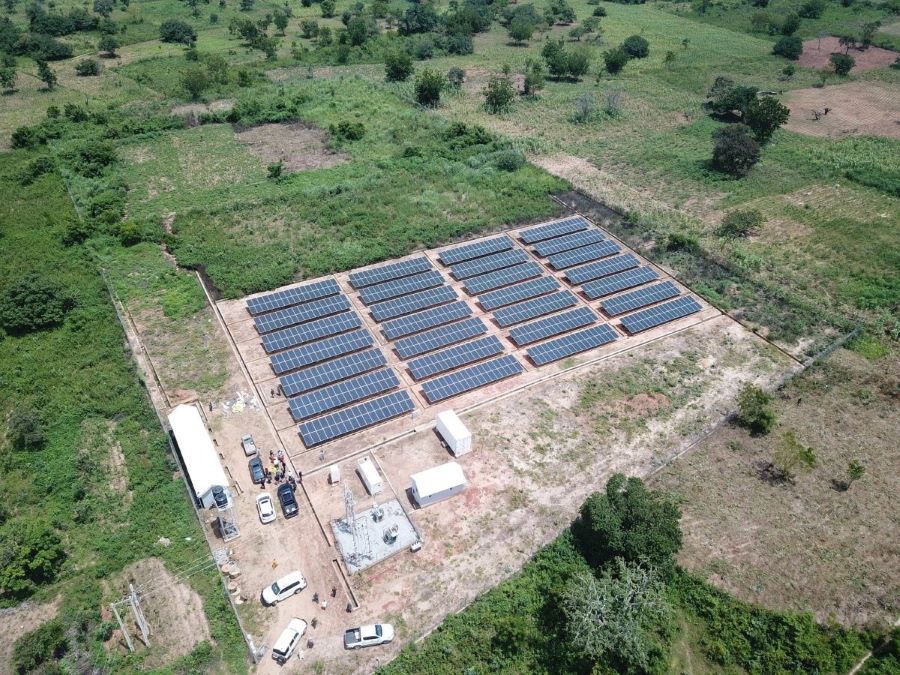
The Nigeria Distributed Renewable Energy (DRE) Fund, co-managed by the Nigeria Sovereign Investment Authority (NSIA) and Africa50, has moved from structuring to commercial deployment, targeting mini-grids, solar home systems, storage and commercial and industrial renewable power for communities and businesses poorly served by the national grid.
That makes the next phase more consequential than the launch itself.
The question is no longer whether Nigeria can assemble a multilateral partnership around distributed renewable energy.
It is whether the fund can identify enough viable projects, persuade private developers to build them and ultimately turn investment dollars into electricity connections and productive economic activity.
Nigeria’s electricity access rate stood at 62.5 per cent in 2024, according to World Bank data, leaving a substantial portion of the population without access.
For investors, the opportunity is obvious. For project developers, it is more complicated.
A solar system can be technically sound without being commercially viable. A mini-grid can connect a community and still struggle if demand is too low, tariffs cannot cover costs, equipment financing is expensive or customers cannot reliably pay.
Currency risk adds another layer of difficulty for developers whose equipment and financing may be priced in dollars while their revenues are largely in naira.
The new fund is therefore being tested against the less glamorous part of the energy transition: project preparation, risk allocation, financing structure and execution.
The money is not the project
Nigeria already has evidence that distributed power can work.
Under the World Bank-backed Nigeria Electrification Project, 180 solar hybrid mini-grids were installed across 23 states, enabling 19.2MW of new renewable capacity by April 2025.
The challenge now is to move from individual projects and development interventions to a repeatable commercial market.
That is where the DRE Fund is intended to play a different role.
Rather than simply paying for electricity infrastructure, the vehicle is designed to provide investment capital that can help developers reach financial close and attract additional private money.
NSIA managing director Aminu Umar-Sadiq described the commercial launch as a signal that Nigeria’s distributed renewable energy market is “investable, credible and ready to operate at scale.”
Africa50 chief executive Alain Ebobissé said the partnership was designed to turn Nigeria’s energy needs into investable opportunities and create a model that could be replicated elsewhere in Africa.
Those claims will now face a much tougher test in the market.
The fund needs developers with credible pipelines, accurate load assessments, appropriate storage systems, reliable equipment and the capacity to maintain installations after commissioning.
It also needs a regulatory and tariff environment that allows those projects to generate predictable cash flows.
In other words, capital is necessary but not sufficient.
A market waiting for scale
The World Bank’s initial $25 million contribution through the International Development Association (IDA) provides an important catalytic element, but it represents only about 8.3 per cent of the stated $300m fund size.
The structure is therefore intended to draw on a much broader pool of capital than development finance alone.
That is consistent with the fund’s original conception.
When the partners first announced the initiative in March 2025, they described a $500 million DRE Nigeria Fund and explicitly said it was intended to attract private capital while tackling currency volatility, tariff structures and the shortage of local-currency financing.
The planned investments included mini-grids, solar home systems, commercial and industrial power, embedded generation and energy storage.
The commercial launch in September, however, puts the fund at $300 million.
The partners have not publicly explained in the launch material why the figure differs from the $500 million originally announced.
It is therefore too early to conclude whether $300 million represents an initial close towards a larger target or a revised fund size.
That distinction will matter to investors assessing how much capital is actually available for deployment.
For Nigeria, the distinction is more than a technicality. The country needs investment at a scale far beyond a single fund if distributed energy is to become a meaningful substitute for unreliable grid supply.
From electricity access to economic productivity
The strongest case for distributed renewable energy is not simply that it can put lights in homes.
For businesses, dependable electricity can change the economics of production.
A solar-plus-storage system can allow a small manufacturer to operate beyond the hours when the grid is available.
A mini-grid can support refrigeration, irrigation, telecommunications, healthcare facilities and small enterprises in communities where extending the national grid would be expensive or slow.
That creates a potentially important second-order effect for investors: electricity becomes not merely an infrastructure product but an enabler of economic activity.
This is particularly relevant in Nigeria, where businesses routinely spend money on diesel and petrol generators to compensate for unreliable grid supply.
The opportunity for distributed renewable energy is therefore to compete not only with the grid but with the cost of self-generation.
But that competition will depend on financing.
Developers must recover the upfront cost of solar panels, batteries, inverters and distribution infrastructure over years of operation.
If capital costs are too high, projects become unaffordable. If tariffs are too low, developers cannot recover their investment.
This is why the fund’s ability to structure equity and other forms of patient capital may be more important than the headline $300 million.
The real scorecard
The fund’s success should ultimately be measured in less impressive numbers than its launch valuation.
How much of the $300 million is actually committed?
How much additional private capital does each dollar of catalytic funding attract?
How many mini-grids and solar systems reach financial close?
How many are commissioned?
How many households and businesses are connected?
And, crucially, how many of those projects remain financially viable several years after the ribbon-cutting?
Those are the metrics that will determine whether Nigeria has created another development-finance programme or something more valuable: a functioning market for decentralised electricity.
The stakes extend beyond Nigeria.
The initiative forms part of the broader Mission 300 effort to connect 300 million people in Africa to electricity by 2030.
The International Solar Alliance has described the Nigerian vehicle as a country-level demonstration that could feed into a wider continental financing model.
If Nigeria can demonstrate that private developers can build, finance and operate distributed power assets at scale, other African countries facing similar grid constraints could replicate the model.
If it cannot, the fund risks becoming another large financing announcement measured more by the size of its commitment than by the electricity it delivers.
For now, Nigeria has crossed the first threshold: the money has a commercial vehicle through which it can move.
The harder question — and the one investors, developers and millions of electricity-starved Nigerians will be watching — is how quickly that money turns into power.
By Charles IKE-OKOH
X-@theGBJournal|email:gbj@govbusinessjournal.com|govandbusinessj@gmail.com