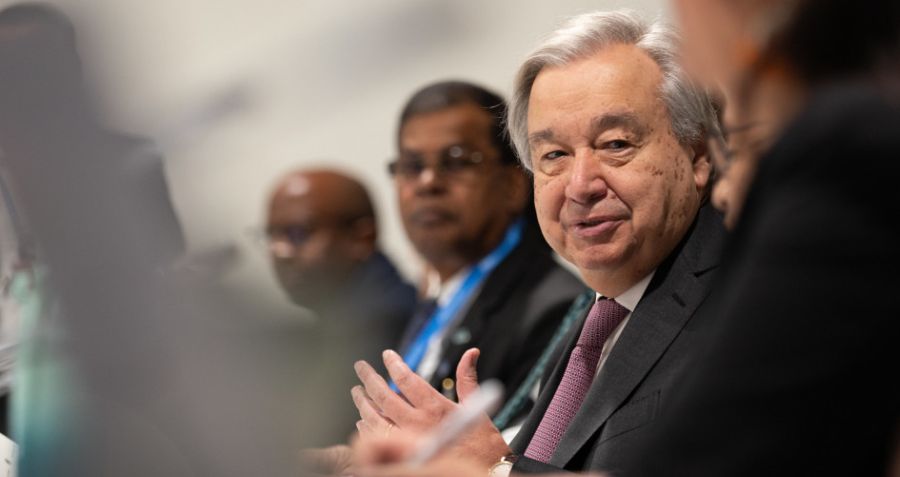

WED NOV 11 2026-theGBJournal|UN Secretary-General António Guterres warned on Wednesday that the world was certain to overshoot the critical 1.5 degrees Celsius global warming threshold, urging governments to accelerate the transition away from fossil fuels and confront what he called a climate crisis that was “outrunning us”.
Addressing the COP31 Leaders’ Summit in Antalya, Turkey, Guterres said the latest scientific evidence pointed to an inevitable breach of the temperature limit agreed under the 2015 Paris climate accord, but insisted the world could still prevent the overshoot from becoming permanent.
“Science tells us an overshoot above that level is now inevitable. But science is not telling us to surrender. It’s telling us to fight harder,” he said.
“The truth is that we have the power to determine how high, how long and how devastating that overshoot will be.
“We have the power to make sure the overshoot is a temporary breach, not a permanent sentence.”
The UN chief painted a grim picture of the climate emergency, saying greenhouse gas emissions reached record levels in 2025, temperature records continued to fall and the last four years were the hottest ever recorded.
“Heat records keep shattering. The last four years were the hottest ever. And fossil fuel interests keep making a killing … while killing our planet,” he said.
“Climate disasters are pounding lives, livelihoods and economies across the globe. This is the path to mutually assured destruction.”
Guterres called for urgent political leadership, arguing that climate action was no longer simply about meeting a numerical temperature target but about protecting humanity’s future.
“We are in the fight for our lives and our children’s future,” he told world leaders.
He identified three major lessons from the past decade, beginning with the rapid expansion of renewable energy and electric vehicles, which he said demonstrated that fundamental economic transformations could happen much faster than previously anticipated.
A decade ago, solar energy accounted for just one percent of global electricity generation. Last year, it met nearly three-quarters of the growth in worldwide electricity demand, he said.
Similarly, electric vehicles, which represented one in every 100 cars sold a decade ago, were expected to account for nearly one in three sales this year.
“Clean energy is now the cheapest source of new electricity across most of the world,” Guterres said, adding that the sector was advancing even in countries facing political resistance.
His second lesson was that the economic and strategic case for fossil fuels was increasingly untenable, particularly for countries dependent on imported oil and gas.
Three-quarters of humanity live in countries that import fossil fuels, leaving them vulnerable to price shocks and geopolitical conflicts, he said.
“Hostage to price shocks they did not create and they cannot control,” Guterres said.
“Recent conflicts make clear that this is a recipe for chronic insecurity and a cost-of-living meltdown.”
He called for a “science-aligned, just, orderly and equitable transition to renewables”, warning, however, that powerful fossil fuel interests were actively obstructing the process.
“Fossil fuels must go the way of the dinosaurs. But that won’t happen on its own,” he said.
“The dinosaurs did not have a lobby. But fossil fuels do.”
He accused the industry of pursuing a deliberate strategy to undermine climate action.
“And their strategy is simple: Distort the science. Delay the policy. Delay the action. Delay the accountability,” he said.
“It’s time to kick the habit — and end the fossil-fuel addiction.”
Guterres said the third and most difficult lesson was that global action remained far below what was required to contain dangerous warming.
Global emissions must fall by approximately six percent annually, but existing national climate commitments, including conditional pledges, would deliver at best only a third of the required reductions, he said.
Even if fully implemented, current national plans would leave the world facing warming of more than 2.5 degrees by the end of the century, crossing dangerous and potentially irreversible climate tipping points.
“We need an extraordinary acceleration. Our planet is heating up. The clock is winding down. It’s make or bake time,” he said.
Climate justice and financing
The UN chief made climate justice a central demand of his address, insisting that developing countries must receive substantially greater financial and technological support to transition to cleaner energy and protect vulnerable populations.
He said emerging and developing economies outside China accounted for nearly two-thirds of humanity but received less than one-fifth of global clean-energy investment.
Many also faced borrowing costs two to three times higher than those paid by wealthier countries, making the transition to renewable energy more difficult.
“We cannot demand that countries transform their economies while denying them the means to do so,” he said.
Guterres proposed a new “Climate Justice Compact” based on shared responsibility, security and benefits, arguing that wealthy nations must reduce emissions faster and fulfil their financial commitments, while emerging economies accelerate their transition away from fossil fuels.
He outlined four pillars for the proposed compact: a faster and fairer transition away from fossil fuels, stronger protection for vulnerable populations, adequate climate financing and greater international cooperation.
On energy transition, he called for an end to new coal development and warned against new oil and gas infrastructure that would undermine the 1.5-degree target.
He also urged governments to expand renewable energy, electricity grids and storage, cut methane emissions and protect forests, oceans and biodiversity.
“We have a choice: Either plan this just transition — or pay for it in chaos and lost livelihoods,” he said.
On adaptation, Guterres called for every person on earth to be covered by an early warning system and for communities to receive greater protection against floods, droughts and rising sea levels.
He also demanded swift and accessible support for countries suffering climate-related losses and damage when adaptation measures were no longer sufficient.
On financing, he urged developed countries to deliver at least $300 billion annually by 2035 and establish concrete plans to at least triple adaptation finance by that year.
He said the broader $1.3 trillion climate finance goal must translate into actual funding reaching developing countries.
Multilateral development banks, he added, should expand lending, mobilise private investment and take greater risks to support vulnerable economies.
But Guterres reserved some of his strongest criticism for oil companies, arguing that fossil fuel producers should contribute more towards the cost of climate damage.
He cited figures showing that nine of the world’s largest oil companies had made $95 billion in profits in the previous quarter, while the Loss and Damage Fund had received approximately $600 million.
“That is what these companies made in about 14 hours,” he said.
“It’s time for governments to tax these windfall profits — and use them to help vulnerable countries recover.”
“Polluters must pay,” he declared.
‘I will not stop telling the truth’
Guterres also called for international cooperation, warning that trade barriers, technological monopolies and geopolitical rivalries could make the energy transition more expensive and leave billions of people behind.
He said climate negotiations should increasingly be judged by tangible results rather than diplomatic agreements alone.
“Negotiations matter — but success must be measured on the ground. Implementation is essential,” he said.
The UN chief praised young people, scientists, Indigenous communities, civil society organisations and small island developing states for challenging powerful economic interests and keeping climate action on the international agenda.
“They are the conscience of this struggle,” he said.
Guterres, whose second term as UN secretary-general ends next year, used the closing moments of his address to pledge that his departure from office would not end his climate advocacy.
“Starting next year, I will no longer be Secretary-General. But you can count on this: I will not stop telling the truth. And I will not stop fighting for it,” he said.
“I will be standing side-by-side with you. As an advocate and an ally.”
He urged world leaders and climate campaigners to maintain pressure for stronger action, insisting that a sustainable future remained achievable if governments acted with sufficient urgency.
“Let’s keep telling the truth about the climate crisis. Let’s keep demanding the action that truth requires. And let’s keep fighting for the sustainable future we know is in our hands.”
“I will be with you every step of the way,” he said.
X-@theGBJournal|email:gbj@govbusinessjournal.com|govandbusinessj@gmail.com