
…Presidential aide says investment reforms are beginning to unlock stalled projects, but insists Nigeria must turn increased oil and gas production into industrial growth, reliable power and better living conditions.
WED NOV 11 2026-theGBJournal| Nigeria must move beyond celebrating oil and gas discoveries to translating its natural resources into industrial development, economic opportunities and improved living standards, the Special Adviser to the President on Oil and Gas, Olu Arowolo Verheijen, has said.
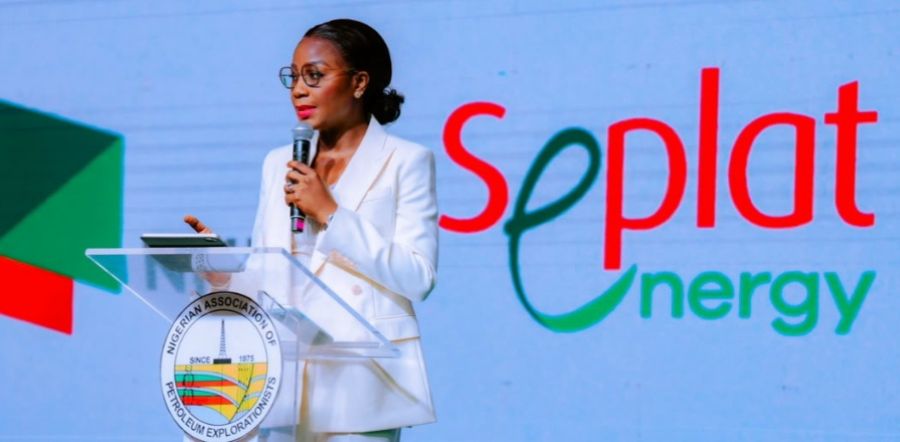
Verheijen made the call on Tuesday while delivering the keynote address at the 44th Nigerian Association of Petroleum Explorationists (NAPE) Annual International Conference and Exhibition, where she identified the development of the IMA gas field, 53 years after its discovery, as a powerful illustration of the investment challenges Nigeria is beginning to overcome.
The IMA gas field, discovered in 1973, reached a Final Investment Decision (FID) in September 2026, marking the culmination of more than five decades of waiting for the conditions necessary to develop the resource.
Drawing attention to the extraordinary timeline, Verheijen said the delay demonstrated that Nigeria’s challenge was not necessarily a shortage of hydrocarbon resources but the failure to create an investment environment capable of bringing them into production.
“Consider the IMA gas field. Discovered in 1973, it reached a final investment decision in September 2026. More than half a century. A child born when that gas was discovered could have finished school, entered the workforce and raised a family before the decision to develop it was taken,” she said.
She added: “The gas did not suddenly appear in 2026. The conditions for investing in it changed.”
According to her, Nigeria had for too long depended on its favourable geology while failing to address structural weaknesses in its investment environment, including unclear responsibilities, slow contracting processes, uncompetitive fiscal arrangements and unreliable access to paying customers.
“For too long, Nigeria asked excellent geology to compensate for weaknesses elsewhere in the investment proposition: uncertain responsibilities, slow contracting, uncompetitive economics and unreliable routes to paying customers,” she stated.
Verheijen said the administration of President Bola Ahmed Tinubu had embarked on reforms to change the country’s investment proposition, with the President providing the political mandate and backing for the process.
She explained that the work involved developing the reform blueprint, redesigning fiscal terms, negotiating with investors and addressing implementation challenges in collaboration with government ministries, regulators, the Nigerian National Petroleum Company Limited (NNPC), operators and other industry stakeholders.
The fiscal reforms, she said, were designed to reward production, protect existing government revenues, establish workable regulations and provide incentives suited to different categories of oil and gas resources.
“Incentives could support development; access to customers and prices that justified investment could make it financeable,” she explained.
She particularly highlighted the opening of opportunities for third-party gas supply to Nigeria LNG Limited (NLNG), saying fiscal incentives and commercial arrangements needed to work together to make gas projects bankable.
Verheijen identified the Ubeta and Bonga North projects, which reached FIDs in 2024, and IMA, which achieved its investment decision in September 2026, as evidence that the country’s investment environment was beginning to change.
“These decisions move projects into execution, commit capital and begin the work that will support future production,” she said.
However, she warned that securing investment decisions was only the beginning, insisting that the government and industry must now concentrate on delivering projects, raising production and ensuring that increased output generates wider economic benefits.
“We have begun to change the investment story. We must now change the production story, and through it, the economic story,” she declared.
THREE PRIORITIES FOR NIGERIA’S NEXT OIL AND GAS CHAPTER
Speaking against the backdrop of the conference theme, “Unlocking More Barrels”, Verheijen outlined three priorities she said would determine the success of Nigeria’s next phase of oil and gas development: exploration, local capability and adaptive technology.
On exploration, she warned that Nigeria could not sustain production growth without replenishing its reserves through fresh discoveries, appraisal activities and the development of existing resources.
“A country cannot produce tomorrow what it does not discover, appraise or develop today. Nor can it sustain growth by celebrating the same discoveries for another generation,” she said.
She called for reliable geological data, credible exploration programmes and development plans that incorporate infrastructure and market considerations from the outset.
She also encouraged operators to improve production from existing assets through better reservoir understanding, infill drilling and enhanced recovery techniques.
But she cautioned against allowing gains from mature fields to replace investment in new discoveries and developments.
“Better reservoir understanding, infill drilling and improved recovery can deliver nearer-term gains. But those gains must finance ambition, not replace it,” she said.
Verheijen challenged operators to present concrete exploration and development programmes, identify government interventions required to advance them and demonstrate the financial and technical capacity to execute their proposals.
On local capacity, she said the growing participation of Nigerian independent oil companies presented an opportunity to accelerate production growth, particularly in onshore and shallow-water assets, while international oil companies concentrated on deepwater and integrated gas developments.
However, she stressed that Nigerian ownership must be accompanied by strong corporate governance, sound financial management, technical competence and responsible operations.
“Local content should leave Nigeria more capable after a project than before it began,” she said.
She explained that the true measure of local content should go beyond the percentage of contracts awarded to indigenous companies to include the development of Nigerian engineers, technical professionals, fabrication companies and other service providers capable of competing internationally.
“It should mean engineers who can lead the next development and fabrication companies that can win work beyond our borders. It should give a young Nigerian the chance to master difficult work, not simply stand beside someone else doing it,” she said.
“We should be proud of Nigerian ownership. We should be ambitious enough to demand Nigerian excellence.”
On technology, the presidential adviser identified improved seismic interpretation, reservoir modelling, digital monitoring, artificial intelligence and methane measurement as critical tools for improving operational performance.
She said technology adoption must produce measurable improvements in the industry, including lower costs, reduced operational uncertainty, improved recovery, reduced downtime and safer operations.
“The test is what changes in the field: uncertainty reduced, costs lowered and operations made safer,” she stated.
She also urged NAPE to strengthen knowledge-sharing and professional development across companies and generations, noting that artificial intelligence would expand the capabilities of industry professionals but could not replace reliable data and sound technical judgement.
VERHEIJEN LINKS OIL AND GAS REFORMS TO JOBS, ELECTRICITY AND INDUSTRIALISATION
Moving beyond the immediate concerns of the petroleum industry, Verheijen argued that Nigeria’s oil and gas ambitions must be understood within the broader objective of building a productive and industrialised economy.
She warned that energy poverty remained a major obstacle to industrialisation, pointing out that unreliable electricity undermined manufacturing, agricultural processing, storage, transportation and job creation.
“Energy poverty is also an industrialisation problem. Factories cannot compete without dependable power. Farmers cannot realise the full value of their harvest without processing, storage and transport. Young people cannot find enough productive work in an economy constrained by unreliable energy,” she said.
According to her, oil, gas and electricity must therefore be treated as interconnected components of one national economic strategy.
“Oil can strengthen export earnings and public finances. Gas can supply industry, electricity and export markets. But a gas field is only as bankable as the customer at the other end of the pipe,” she said.
She identified the resolution of legacy debts in the power sector, improved metering and targeted support for vulnerable electricity consumers as essential to strengthening the commercial viability of the entire energy value chain.
Verheijen said gas suppliers needed confidence that they would receive payment for their products, while electricity consumers deserved accurate bills and reliable services.
She called for a more integrated energy system that combines oil and gas development with renewable energy, stronger electricity networks and improved energy efficiency.
“We should manufacture more of what we consume, process more of what we produce and supply more of what our neighbours need,” she said.
She maintained that the ultimate measure of success should be the ability to trace the benefits of oil and gas investments through the economy, from increased production to business expansion, skills development and improved public services.
“We should be able to trace the connection from a well to a business that grows, from a project to a skill that endures, from public revenue to public value,” she added.
‘NIGERIANS ARE ENTITLED TO ASK WHEN REFORMS WILL MAKE THEIR LIVES BETTER’
Acknowledging the economic difficulties facing households and businesses, Verheijen cautioned that government must not measure the success of reforms solely by investment announcements, projected revenues or policy changes.
She said Nigerians were entitled to demand tangible improvements in their daily lives and that government must provide honest answers about when the benefits of reforms would become visible.
“A family struggling with the cost of living cannot spend a forecast. A business cannot run on a policy announcement. Nigerians are entitled to ask when reform will make their lives better. We owe them honest answers and sustained delivery,” she said.
She also stressed the importance of ensuring that the reforms introduced under President Tinubu’s administration outlive individual political officeholders and investment cycles.
“President Tinubu’s mandate has opened the way for difficult changes. Government and industry must now make them endure beyond any one officeholder or investment cycle,” she said.
The presidential adviser further challenged Nigeria to strengthen its competitiveness as investors increasingly consider alternative destinations for oil and gas investments across Africa and other emerging petroleum markets.
Citing new developments in Guyana and elsewhere on the continent, she said Nigeria could not assume that its resource base alone would guarantee investment inflows.
“Investors have choices. New developments in Guyana and across Africa remind us that Nigeria must compete through the quality of its proposition,” she said.
She warned against building the country’s investment strategy around temporary disruptions in competing markets, arguing that Nigerian projects must remain commercially attractive even when international oil prices decline or new supplies enter the market.
“A disruption elsewhere may create an opening. It cannot be our business plan. Our projects must remain competitive when prices fall and new supply arrives,” she added.
A CHALLENGE TO THE NEXT GENERATION
Concluding her address, Verheijen returned to the story of the IMA gas field, using its 53-year journey from discovery to investment decision to challenge the next generation of Nigerian oil and gas professionals.
She said young Nigerians entering the industry should not have to wait decades to see the country’s natural resource potential translated into economic opportunities.
“More than half a century separated the discovery of IMA’s gas from the investment decision to develop it. The young professionals here should not wait a working lifetime to see their country’s promise put to work,” she said.
She urged the industry to build institutions, technical capabilities and an investment environment that would enable future generations to develop the country’s resources more efficiently and responsibly.
“Let them inherit more than a catalogue of resources: an industry with the competence to develop them, institutions with the discipline to steward them, and an economy in which their talent has a future,” she said.
Verheijen concluded by reiterating that the objective of unlocking more oil and gas production must extend beyond increasing barrels and expanding export earnings to creating a stronger economy and a better future for Nigerians.
“Let us unlock more barrels, and with them, a greater future for Nigeria.”
X-@theGBJournal|email:gbj@govbusinessjournal.com|govandbusinessj@gmail.com