
…AfCRA to provide independent, Africa-focused assessment of sovereign risk as continent seeks lower cost of capital and greater influence over global financial architecture
THUR OCT 08 2026-theGBJournal| Africa has taken a major step toward reshaping how its economies are assessed in global financial markets with the official launch of the Africa Credit Rating Agency (AfCRA), a continental initiative aimed at bringing African data, expertise and economic realities more fully into credit-risk analysis.
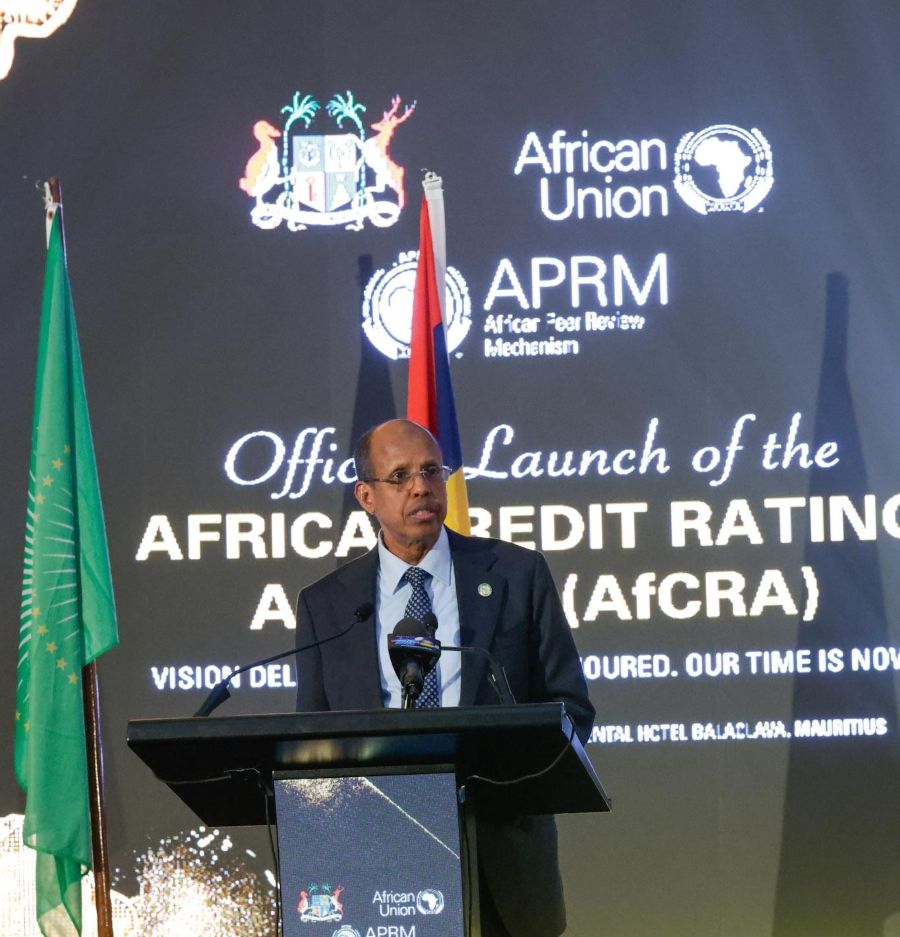
The launch, held in Mauritius Wednesday, brought together African Union Commission Chairperson H.E. Mahmoud Ali Youssouf, senior Mauritian government officials, the Prime Minister of Burundi, United Nations officials, African financial institutions, private-sector representatives and members of the diplomatic community.
Youssouf described the creation of AfCRA as a “watershed moment” in Africa’s economic history and a significant step toward strengthening the continent’s financial sovereignty.
“Africa is building a stronger and more resilient financial architecture, with AfCRA set to become an important pillar.”
The new agency comes at a critical time for African economies, many of which are confronting high debt-servicing costs, limited access to affordable capital and persistent concerns over how sovereign risk is assessed by international markets.
Speaking to the media ahead of the launch, Youssouf said credit ratings have a direct impact on both the cost and availability of capital.
Where ratings do not sufficiently capture African data, economic structures and country-specific realities, he said, African nations can face higher borrowing costs — potentially reducing the resources available for infrastructure, healthcare, education, energy and industrial development.
The AU Commission Chairperson stressed that AfCRA is designed to address those information and analytical gaps.
But he was equally clear about what the new agency is not.
“AfCRA is not about seeking favourable ratings.”
The agency, he explained, will not replace established international credit-rating agencies, shield governments from scrutiny or guarantee better ratings for African borrowers.
Instead, it will provide the market with an additional, independent and Africa-focused perspective on sovereign credit risk.
“Africa must meet global standards while ensuring that its economies are assessed through greater access to African data, expertise and economic realities.”
That distinction is likely to be central to AfCRA’s credibility as it seeks to establish itself in global capital markets.
Youssouf said AfCRA’s success will ultimately depend on its ability to demonstrate independence, professionalism, transparency and technical rigour.
Its ratings, he said, must be evidence-based, free from political interference and protected from conflicts of interest.
At the same time, African governments cannot use the creation of an African rating agency as a substitute for sound economic management.
Countries must continue to strengthen fiscal responsibility, macroeconomic management, transparency and debt sustainability, he said.
The message from the AU is therefore twofold: Africa wants its economic realities better reflected in international risk assessments, but it must also take responsibility for improving the fundamentals underlying those assessments.
MAURITIUS POSITIONED AS AFRICAN FINANCIAL GATEWAY
Mauritius is at the centre of the initiative, with Youssouf praising the country’s decision to host AfCRA.
He said the choice was not accidental, pointing to Mauritius’ financial and economic development, established international financial centre, regulatory environment and connectivity with African and global markets.
Mauritius’ Minister of Financial Services and Economic Planning, H.E. Dr. Jyoti Jeetun, described the launch as a landmark moment for both the country and the continent.
“AfCRA represents an important opportunity to reinforce Africa’s financial architecture, deepen capital markets and strengthen the continent’s capacity to mobilise capital for development.”
Jeetun said Mauritius is committed to serving as a platform connecting international capital with African investment opportunities in sectors including infrastructure, renewable energy, telecommunications, healthcare and agribusiness.
But she also underscored a critical condition for success: AfCRA must earn market confidence through independence, professionalism and a robust methodology.

APRM: CREDIBILITY WILL BE THE AGENCY’S GREATEST ASSET
The institutional foundations of AfCRA were outlined by H.E. Amb. Marie-Antoinette Rose Quatre, CEO of the African Peer Review Mechanism (APRM).
The African Union endorsed the establishment of AfCRA in 2017, with the APRM subsequently entrusted with supporting the process of transforming that political decision into an operational institution.
According to Rose Quatre, the APRM’s work has included documenting limitations and potential biases in the assessment of African sovereign risk, developing AfCRA’s technical and institutional framework, improving Member States’ understanding of credit-rating methodologies and establishing governance arrangements designed to protect the agency’s analytical and operational independence.
Her central warning was straightforward:
“Credibility will be AfCRA’s greatest asset.”
Ratings must be transparent, evidence-based, technically rigorous and independent, she said.
African governments, meanwhile, must provide accurate and timely information to enable high-quality assessments.
Rose Quatre also called on investors, financial institutions and the media to scrutinise AfCRA’s work rigorously.
A NEW VOICE IN GLOBAL CAPITAL MARKETS
At the official launch, Youssouf said AfCRA would help Africa become a stronger participant in shaping the global economic and financial order.
The agency is expected to strengthen African analytical capacity, improve understanding of economic trends and provide objective assessments of risks associated with African economies.
It will also contribute to the work of Africa’s shared financial institutions.
The AU Commission Chairperson acknowledged the leadership of AfCRA, the APRM team, AU policy organs, African financial institutions, the African Development Bank, the United Nations and other partners whose support helped bring the initiative to fruition.
He also praised Mauritius for providing the institutional and financial environment necessary to host the new continental agency.
BEYOND RATINGS: A FIGHT OVER AFRICA’S FINANCIAL NARRATIVE
For African policymakers, the significance of AfCRA extends beyond the mechanics of issuing credit ratings.
Youssouf argued that perceptions of African risk have real consequences for the continent’s ability to attract and mobilise capital.
Higher perceived risk can translate into a higher cost of borrowing, limiting governments’ ability to finance development priorities and private-sector investment.
African institutions, he said, therefore have a responsibility to advocate for African economies while addressing structural weaknesses in global financial markets.
The ultimate objective is not preferential treatment.
It is greater accuracy.
“Africa must become a leading participant in shaping the evolving global economic and financial order.”
AfCRA is intended to become one of the instruments through which that ambition is pursued.
Its establishment is closely aligned with the objectives of Agenda 2063, particularly Africa’s drive toward greater self-reliance, economic integration and financial sovereignty.
THE BOTTOM LINE
The launch of the Africa Credit Rating Agency marks a significant institutional development in Africa’s long-running effort to reshape its relationship with global capital markets.
The agency now faces the harder task: proving that an Africa-focused rating institution can combine independence with African context, technical rigour with local expertise, and credibility with global investors.
For Youssouf, the destination is clear — an Africa that is increasingly confident in its economic institutions and better positioned to influence how its economies are understood and financed.
AfCRA, he said, is another step toward an Africa that is “more confident, economically sovereign and better positioned to shape its own narrative and destiny.”
X-@theGBJournal|email:gbj@govbusinessjournal.com|govandbusinessj@gmail.com