
…Dangote is raising N2.15 trillion, but potentially bringing a N65.2 trillion corporate giant into Nigeria’s public equity market.
…Dangote, Popoola, Rewane, NGX leaders make case for a new era of mass ownership
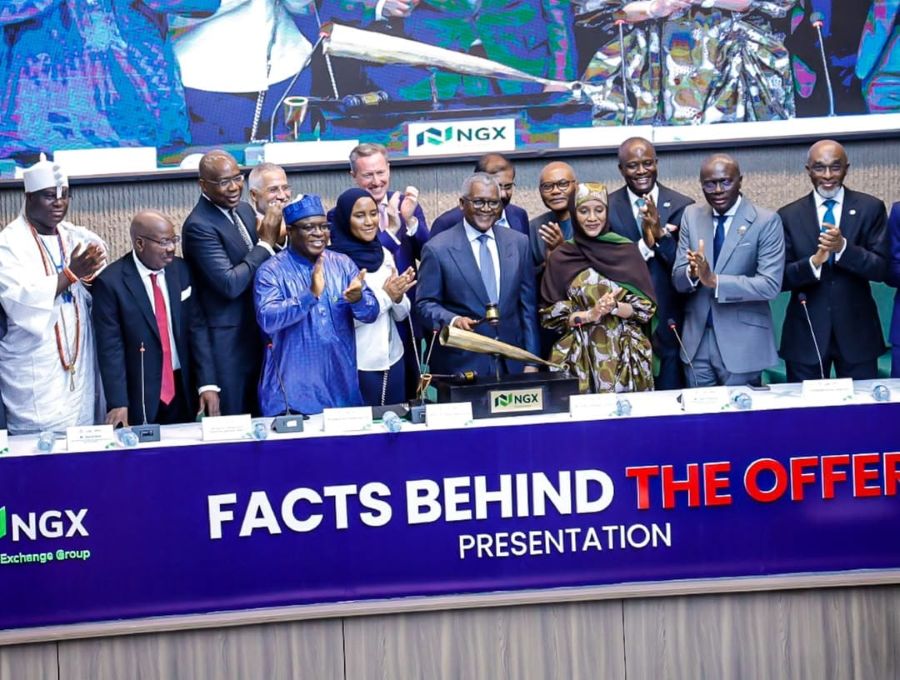
MON SEPT 14 2026-theGBJournal| The Nigerian Exchange entered a new chapter on Monday as Aliko Dangote formally opened the Initial Public Offering of Dangote Petroleum Refinery and Petrochemicals, a transaction that could transform not only ownership of Africa’s biggest refinery but the size and structure of Nigeria’s stock market.
The headline fundraising target is N2.15 trillion.
But the bigger number for the Nigerian Exchange is N65.22 trillion.
That is the implied valuation of Dangote Refinery at the IPO price of N525 per share.
If that valuation is sustained when the company is admitted to the NGX, the refinery could push the exchange’s total equity market capitalisation towards the N225 trillion mark, depending on movements in other listed stocks.
In other words, Dangote is raising N2.15 trillion, but potentially bringing a N65.2 trillion corporate giant into Nigeria’s public equity market.
That makes the transaction more than Africa’s biggest IPO.
It is potentially one of the largest market-capitalisation events in the history of the NGX.
The N65.2 trillion effect
The IPO involves 4.1 billion new ordinary shares at N525 each. If fully subscribed, the offer will raise approximately N2.15 trillion, with a greenshoe option potentially taking the proceeds higher.
But the shares represent only a small minority stake in the refinery. The offer price therefore implies a total company valuation of about N65.22 trillion, or roughly $49 billion.
That valuation is what gives the transaction its extraordinary market significance.
At that level, Dangote Refinery would immediately rank among the largest companies on the NGX by market value and could substantially alter the weighting of the Nigerian equity market.
The refinery’s public debut is therefore effectively a test of whether Nigeria’s capital market can absorb and support a company of global industrial scale.
Dangote: “Democratise wealth creation”
For Dangote, however, the significance of the transaction goes beyond market capitalisation.
He described the IPO as an opportunity to turn Nigerians from consumers of the refinery’s products into owners of the business.
“The aim of the share sale was to democratise wealth creation.”
The billionaire industrialist said the public offering was about giving ordinary Nigerians an opportunity to participate in the success of the refinery.
At the NGX launch, Dangote also disclosed that he intends eventually to list all the companies in his conglomerate, signalling that the refinery IPO could be the beginning of a much broader transition by the Dangote Group towards public-market ownership.
He also said the refinery could pursue a secondary listing in the United States within three to four years.
The ambition is therefore larger than today’s share sale.
Dangote is effectively testing whether Nigerian and African capital markets can become a meaningful source of ownership and long-term capital for the continent’s largest privately built industrial enterprises.
Popoola: Building an “ownership economy”
For NGX Group CEO Temi Popoola, the transaction represents precisely the kind of capital-market deepening the exchange has been seeking.
“The launch of the Dangote Petroleum Refinery IPO is an important moment for Nigeria’s capital market, not simply because of the scale of the transaction, but because of what it represents.”
Popoola said the exchange increasingly needed to become a place where Nigerians could participate directly in the value created by the country’s major businesses.
“Our capital market must increasingly become a place where Nigerians can participate in the value created by our country’s most important businesses.”
He pointed to the infrastructure being developed by NGX, including NGX Invest and more than 50 distribution channels spanning stockbrokers, banks and fintech platforms.
The objective, he said, was to build an “ownership economy” in which strong Nigerian companies access long-term capital while more Nigerians participate in their growth.
That makes the Dangote IPO an important test of whether the concept can move from rhetoric to reality.
Rewane: From consumers to shareholders
Economist Bismarck Rewane has placed the retail-investor dimension at the heart of the transaction.
He believes the IPO can help shift Nigerians from short-term consumption towards investment in productive assets.
His message to prospective investors was unusually direct:
“You are better off with your N5,000 share than selling your PVC for N10,000 or N15,000 and consuming it.”
Rewane sees the proposed mass participation as potentially transformative.
The IPO is targeting as many as 10 million investors, and Rewane said that if that ambition is achieved, Dangote Refinery could have one of the largest shareholder bases in the world.
“The reality is that targeting 10 million investors is also a milestone.”
He went further:
“If you can get 10 million shareholders to participate in the IPO, the Dangote Refinery will have the largest number of shareholders in the world.”
For Rewane, the significance is not merely the number of shareholders but the economic behaviour that widespread ownership could encourage.
He described it as “democratising the market and economic process”, distinguishing it from political democratisation.
And he sees a potentially powerful economic multiplier: shareholders receive dividends and capital gains, the company expands production and government receives more tax revenue.
“It is a compelling investment opportunity which puts revenue and profits and dividends into the pockets of consumers and investors, [and] puts a lot of tax revenue in the pockets of the government.”
Elumelu: A landmark for Nigeria and Africa
The enthusiasm is not limited to the refinery’s promoters.
Tony Elumelu has described the flotation as “a landmark moment for Nigeria and a huge milestone for Africa.”
That description reflects the unusual convergence of industrial scale and capital-market participation.
The refinery was built at a cost of about $20 billion and currently processes around 700,000 barrels of crude per day, with plans to increase capacity to 1.4 million barrels per day by 2029.
Its emergence has already altered Nigeria’s petroleum market, reducing the country’s dependence on imported refined products and enabling the country to become a net exporter of refined petroleum products.
A global investor sees “African self-reliance”
International investors are also taking notice.
Charles Robertson, head of macro strategy at FIM Partners, described the IPO as a “huge event for Nigeria” and a symbol of African self-reliance.
“Nigerian equities have boomed on the back of retail interest since 2024 and there’s evident excitement among domestic investors,” Robertson said.
That retail enthusiasm is already showing itself.
Reuters reported unusually heavy traffic on investment platforms on the opening day, with Bamboo saying demand was high enough to prevent some users from logging in.
The minimum subscription is only 10 shares, making the entry cost relatively low for retail investors.
But N65.2b trillion comes with a valuation question
The euphoria does not remove the biggest question confronting investors:
Is N65.22 trillion the right valuation?
That question is particularly relevant because institutional investors who participated in Dangote Refinery’s July private placement effectively entered at a lower valuation.
The $2.5 billion private placement for a 6% stake valued the refinery at approximately $40 billion. The IPO valuation is closer to $49 billion.
The company says the earlier investors accepted conditions, including a lock-up period, which helped explain the discount.
But the difference gives public-market investors an important valuation benchmark.
They will ultimately have to decide whether the refinery’s earnings and expansion prospects justify the higher IPO valuation.
The earnings story
There is, however, a substantial operating story behind the valuation.
The refinery has reached full operating capacity of about 700,000 barrels per day and reported $1.82 billion in net profit in the first half of 2026, reversing a loss in the previous year.
Revenue exceeded $13 billion during the period.
The company wants to double capacity to 1.4 million barrels per day by 2029.
That expansion is one of the main reasons for the IPO.
The company is therefore asking investors to look beyond today’s refinery and place a value on the much larger industrial platform it intends to build.
But that also means investors must assess refining margins, crude supply, operating costs, foreign-exchange exposure, capital expenditure and the sustainability of current profits.
N2.15 trillion versus N65.2 trillion.
This is where the arithmetic of the IPO becomes particularly important.
N2.15 trillion is the amount Dangote Refinery is seeking from investors.
N65.22 trillion is the implied value of the entire company at the offer price.
Those are two very different numbers.
The first determines how much new capital the company receives.
The second determines the size of the company entering the stock market.
And it is the second number that could have the bigger impact on the NGX.
If the N65.22 trillion valuation is maintained at listing, the refinery could push Nigeria’s equity market towards N225 trillion in total capitalisation.
That would represent a dramatic increase in the size of the exchange and immediately make Dangote Refinery one of its most consequential stocks.
The real test comes later
Today’s gong ceremony is therefore only the beginning.
The IPO is open for subscription, but the real market verdict will come when the shares eventually begin trading and thousands—or potentially millions—of investors decide what Dangote Refinery is actually worth.
The market will have to determine whether the N525 offer price represents value, fair pricing or an aggressive premium for one of Africa’s most strategically important industrial assets.
For Dangote, the goal is clear: democratise ownership.
For Rewane, it is about creating an investment culture.
For Popoola, it is about building an ownership economy.
For the NGX, it is about absorbing a company with an implied value of N65.2 trillion.
And for investors, the question is ultimately much simpler:
Can Dangote Refinery grow into the N65.2 trillion valuation that Nigeria’s stock market is being asked to absorb?
If the answer is yes, Monday’s IPO could mark the beginning of a new era for the NGX.
If the answer is no, the market will have to learn a very different lesson about the price of industrial ambition.
Either way, Dangote Refinery has already changed the Nigerian capital market before its first share begins normal secondary-market trading.
This version gives the N65.2 trillion figure the prominence it deserves while using the quotes as the narrative engine, rather than simply stacking quotes into a launch report.
By Charles IKE-OKOH
X-@theGBJournal|email:gbj@govbusinessjournal.com|govandbusinessj@gmail.com