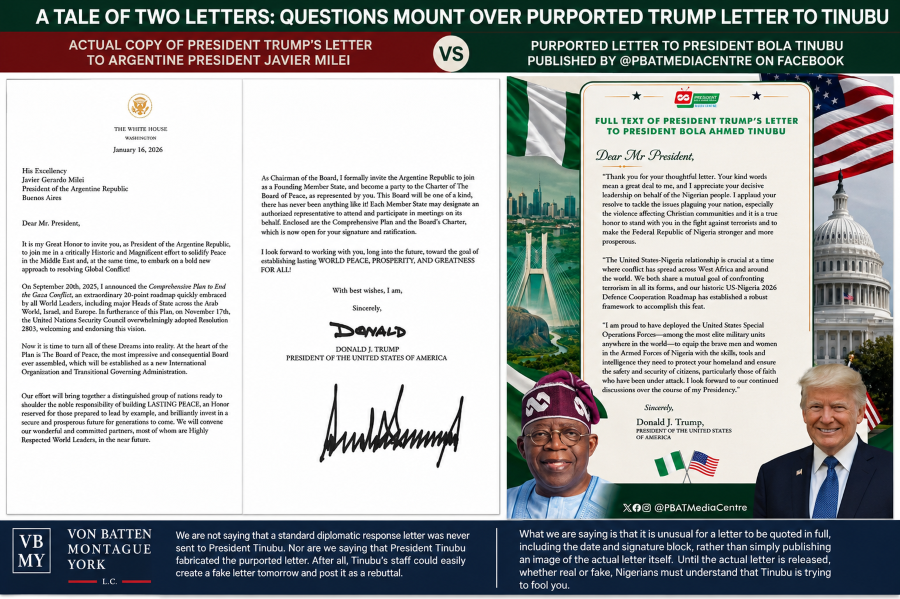

THUR JULY 23 2026-theGBJournal| Questions have emerged over the authenticity of a purported letter from U.S. President Donald Trump to Nigerian President Bola Ahmed Tinubu after a Washington-based lobbying firm challenged the manner in which the correspondence was made public, arguing that its presentation differs markedly from official White House practice.
This controversy comes against the backdrop of an escalating campaign by Von Batten-Montague-York L.C. against the Tinubu administration.
Earlier, the Washington-based lobbying firm said it is unearthing U.S. Department of Justice archives relating to President Tinubu’s historical narcotics investigation records in the United States.
Those claims remain unverified, and neither the White House nor the Nigerian Presidency has publicly responded.
The firm’s latest challenge over the authenticity of the purported presidential correspondence is likely to deepen scrutiny of the administration’s handling of sensitive diplomatic communications.
Von Batten-Montague-York L.C., circulated what it described as an authentic White House letter sent by Trump to Argentine President Javier Milei alongside the communication published by an account linked to Nigeria’s Presidency, @PBATMediaCentre, as the “full text” of Trump’s letter to Tinubu.
Rather than accusing the Nigerian government of fabrication, the lobbying firm focused on the absence of documentary evidence supporting the letter’s authenticity.
“We are not saying that a standard diplomatic response letter was never sent to President Tinubu. Nor are we saying that President Tinubu fabricated the purported letter,” the firm said.
Instead, it argued that the decision to publish only the text of the correspondence—complete with the date, salutation and signature block—without releasing an image of the original signed document was inconsistent with normal diplomatic practice.
“What we are saying is that it is unusual for a letter to be quoted in full, including the date and signature block, rather than simply publishing an image of the actual letter itself,” it added.
The comparison has quickly gained traction on social media, where users have questioned why the Presidency has not released a scanned copy of the purported White House letter bearing official stationery and Trump’s signature.
The letter attributed to Trump praises Tinubu’s leadership, commends his efforts to tackle insecurity, describes U.S.-Nigeria relations as strategically important, references a “U.S.-Nigeria 2026 Defence Cooperation Roadmap” and states that the United States has deployed Special Operations Forces to assist Nigerian troops in combating terrorism.
By contrast, the letter addressed to Argentine President Javier Milei, dated January 16, 2026, appears as a photographed White House document complete with official letterhead, formatting and Trump’s signature.
It invites Argentina to become a founding member of a proposed “Board of Peace” initiative aimed at promoting global peace and conflict resolution.
While differences in content are expected because the letters concern different subjects, the lobbying firm’s criticism centres on the format of publication rather than the substance of the messages.
The firm nevertheless ended its statement with a stronger political allegation, asserting that until the original correspondence is made public, Nigerians should remain sceptical.
That assertion, however, remains an opinion rather than evidence that the letter is forged.
Neither the Nigerian Presidency nor the White House had responded publicly to the claims at the time of publication.
The episode underscores the growing importance of authenticity in government communications at a time when digitally generated documents and manipulated images have become increasingly sophisticated.
In diplomatic circles, governments frequently publish scanned copies or photographs of correspondence exchanged between heads of state to eliminate doubts over provenance and reassure the public that the documents are genuine.
Analysts tells theG&BJournal that releasing the original White House correspondence—if one exists—would be the quickest way to settle the controversy.
”Conversely, continued reliance on a text-only reproduction is likely to fuel further speculation and political debate, particularly given heightened public scrutiny of official communications,” they argue.
For now, the available evidence supports only one conclusion: the authenticity of the purported Trump letter to President Tinubu remains unverified.
The lobbying firm’s comparison raises legitimate questions about its presentation, but it does not establish that the document is fake.
Equally, the Presidency has yet to provide documentary evidence that would conclusively confirm its authenticity.
Until either the White House or the Nigerian government releases the original signed correspondence or formally verifies it, the matter is likely to remain unresolved.
X-@theGBJournal|Facebook-the Government and Business Journal|email:gbj@govbusinessjournal.com|govandbusinessj@gmail.com