

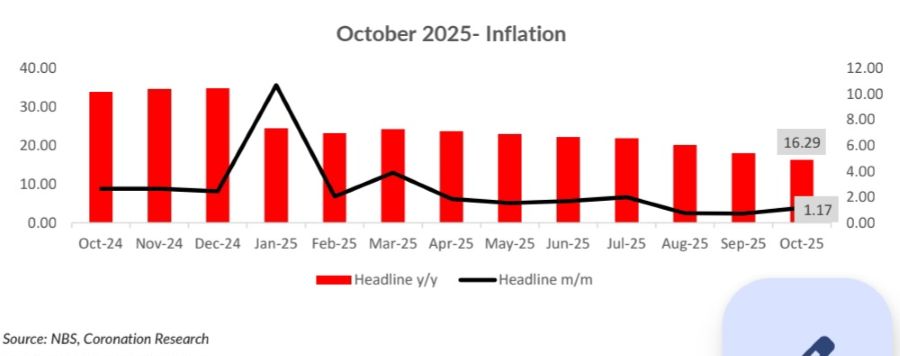

SAT NOV 15 2025-theGBJournal| Ahead of the October inflation print, we anticipate the disinflationary trend to persist, albeit at a slower pace, with headline inflation projected to ease to 16.29% y/y from 18.02% y/y in September, Coronation Research projected in their latest inflation outlook.
However, on a month-on-month basis, Coronation expects a marginal uptick to 1.17%, reflecting cost pressures in core components.
Inflationary pressures are likely to resurface, primarily driven by rising costs within the services, transport, and energy components, which may partly offset the disinflationary impact of improved food supply as the current harvest season tapers off.
Furthermore, the recent uptick in PMS and cooking gas prices, following supply disruptions linked to the PENGASSAN strike, is expected to keep monthly inflation relatively sticky.
The anticipated uptick in month-on-month headline inflation is largely driven by movements within the food and core CPI components. On the food side, increased market supply from the waning harvest season has helped ease price pressures on major staples such as grains, tubers, and vegetables.
However, the disinflationary impact of this development is being partly offset by elevated core related costs.
The core CPI is expected to record an upward movement, reflecting higher transportation fares and household energy costs, following the recent increase in PMS prices from an average of N865 to N922 per litre, and a rise in cooking gas prices from an average of N900 per kilogram to N1,300 per kilogram.
These increases, induced by temporary supply disruptions linked to the PENGASSAN strike, have filtered through to both direct energy costs and secondary price effects across the supply chain.
The exchange rate pass through effects remains moderate, as relative FX stability has helped contain imported inflation. Overall, while food inflation continues to decelerate, sticky core prices are expected to limit the pace of disinflation.
November and Policy Outlook
For November, Coronation say they expect the month-on-month uptick in headline inflation to persist, driven by increased consumer demand as traders restock ahead of the festive season, alongside the risk of artificial fuel scarcity that could trigger an upward adjustment in PMS prices, following the recent 15% levy imposed on imported fuel to discourage importation.
”Based on our inflation outlook, we expect the Monetary Policy Committee (MPC) to adopt a cautious approach toward easing at its next meeting, given the potential reversal in the month-on-month decline in August and September,” Coronation adds.
The Central Bank of Nigeria (CBN) Governor has emphasized that any decision will remain data driven, guided primarily by inflation and exchange rate dynamics.
X-@theGBJournal|Facebook-the Government and Business Journal|email:gbj@govbusinessjournal.com|govandbusinessj@gmail.com