
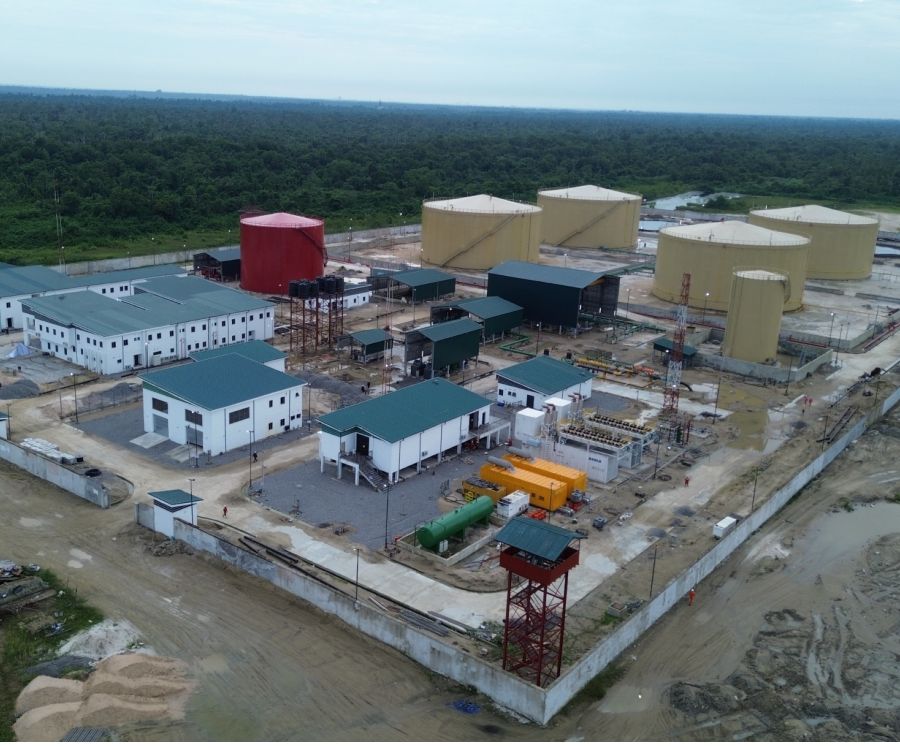

…GEIL lifted its first crude cargo from the newly-constructed Otakikpo onshore terminal facility, situated in OML 11 near Port Harcourt on June 8, 2025.
THUR JUNE 19 2025-theGBJournal| The African Energy Chamber (AEC), the voice of the African energy sector, has commended Nigerian energy company, Green Energy International (GEIL) for the development of the Otakikpo onshore terminal, situated in OML 11 near Port Harcourt.
AEC said it believes that facilities such as this will play an instrumental part in supporting marginal field production by facilitating crude exports and increasing revenue generation in Nigeria.
”GEIL is not only setting a strong benchmark for other independent operators in Nigeria but serves as a testament to the central role indigenous energy companies play in the country’s oil and gas sector,” NJ Ayuk, Executive Chairman of the AEC, said.
Ayuk notes that as Nigeria strives to produce two million barrels per day (bpd), projects of this nature will support new investments by providing a direct route from offshore fields to market.
GEIL lifted its first crude cargo from the newly-constructed Otakikpo onshore terminal facility, situated in OML 11 near Port Harcourt on June 8, 2025.
The Otakikpo onshore terminal facility is the first indigenous onshore terminal constructed in the country in five decades, and the lifting signals the start of operations at the new terminal.
The Otakikpo terminal was developed in two years, six months ahead of schedule. The company broke ground on the construction of the facility in February 2023, with the development of storage facilities and the associated pipeline advancing in February 2024.
Construction works continued to progress through May 2024, with associated infrastructure at the terminal – including offices and pump facilities – progressing in December 2024. By March 2025, the facility began injecting crude, with GEIL’s production averaging 5,000 bpd.
GEIL has since received regulatory approval from the government to boost production to 30,000 bpd under a revised field development plan.
In June 2025, the facility received its first cargo via a vessel chartered by energy major Shell. The maiden cargo transported crude from the Otakikpo marginal field – located in Rivers State and operated by GEIL – to the terminal, kickstarting a new era of efficient crude distribution in Nigeria.
The terminal itself is a state-of-the-art facility with a storage capacity of 750,000 barrels. Plans are underway to increase storage capacity to three million barrels – dependent on market demands.
The terminal is designed with an export capacity of 360,000 bpd, with crude transported via a 23-km, 20-inch pipeline connected to a single point mooring system in the Atlantic Ocean. At the site, tankers – such as Aframax chartered by Shell – can dock and load.
The terminal is expected to significantly reduce operating costs for marginal fields in OML 11, primarily through cost-effective transportation. Prior to the construction of the onshore terminal, GEIL relied on barges to transport crude. However, with the terminal, the company stands to reduce the reliance on costly offshore floating stations, reducing overall operational costs by 40%.
”For Nigeria’s marginal fields, the terminal opens new doors for greater operational efficiency,” Ayuk said.
The terminal is expected to unlock previously-stranded crude from more than 40 marginal fields across the region, with a capacity to receive up to 250,000 bpd from third-party producers.
The federal government has long-sought to revive crude production through the development of marginal fields.
A marginal field bidding round was launched in 2020 to entice indigenous operators to invest in marginal field opportunities, drawing in 591 companies seeking to develop 57 oilfields. Ultimately, 161 companies were shortlisted, most of which represented indigenous operators.
Improved fiscals introduced through Nigeria’s Petroleum Industry Act in 2021 further enticed investments by both international and regional players. Looking ahead, these foundations have seen a rise in marginal field production, with the GEIL-developed onshore terminal set to further support investments and exports.
”By establishing a domestic solution to producing, storing and exporting crude, GEIL is supporting marginal field production while laying the foundation for most efficient oil operations. The facility will play an instrumental part in supporting the country’s crude production goals,” states,” NJ Ayuk said.
X-@theGBJournal|Facebook-the Government and Business Journal|email:gbj@govbusinessjournal.com|govandbusinessj@gmail.com