


…PenCom increased the maximum allocation to ordinary shares for RSA Funds I, II, III and VI-active to 35.0%, 33.0%, 15.0% and 33.0%, from 30.0%, 25.0%, 10.0% and 25.0%, respectively
…The revision could support incremental equity inflows
By Samuel Ojerinde
THUR FEB 12 2026-theGBJournal| The National Pension Commission (PenCom) recently announced an upward revision to the permitted allocation to ordinary shares for RSA Funds I, II, III and VI-active.
The regulator cited practical implementation challenges arising from the existing limits across ordinary shares, FGN bonds and alternative assets, with the key constraint being the limited availability of qualifying alternative asset instruments.
The shortfall has hindered effective deployment into the alternative instruments asset class, resulting in an underutilisation of the alternative asset allocation, and leaving PFAs with excess liquidity.
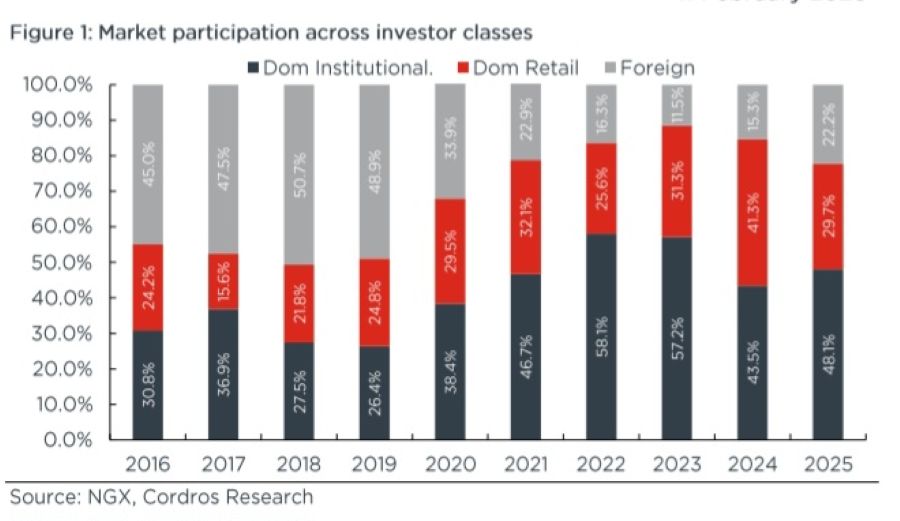
Given the importance of PFAs to domestic market liquidity, we expect the adjustment to translate into a supportive flow dynamic for Nigerian equities, strengthening the institutional bid over the near to medium term.
Higher equity ceilings across key RSA funds
PenCom increased the maximum allocation to ordinary shares for RSA Funds I, II, III and VI-active to 35.0%, 33.0%, 15.0% and 33.0%, from 30.0%, 25.0%, 10.0% and 25.0%, respectively.
The upward revision reflects a shortage of qualifying alternative asset instruments, including infrastructure funds, private equity funds and agriculture investment funds, which has constrained deployment into the alternative asset bucket, leaving excess liquidity within the system.
Thus, PenCom’s decision to widen equity limits reads as a practical release valve, creating more room for PFAs to put idle capacity to work in listed equities. Allocation limit utilisation also suggests that equity limits were increasingly binding, with RSA Fund I (25.1% of 30.0%) and RSA Fund II (22.4% of 25.0%) closing in on their respective ceilings, while RSA Fund III (10.4% of 10.0%) has already effectively maxed out its prior limit.
Portfolio allocation impact
Following the revision, we expect market flows to improve, given PFAs’ outsized influence on local institutional activity. For context, PFAs accounted for c.69.0% of domestic institutional gross market flows in 2025, positioning them as the key marginal buyer in the market.
Ultimately, the added equity headroom should support a continued tilt towards equities, particularly with valuations still attractive and the earnings outlook constructive.
As such, we estimate cumulative net inflows of NGN2.18 trillion into equities over 2026, lifting total pension equity holdings to NGN6.14 trillion by December 2026 (+55.2% y/y). Our estimates assume average monthly NAV growth of NGN411.62 billion (in line with the 2025 average growth rate) and a total equity allocation of 19.0% (2025: 14.4%).
At the fund level, our estimates factor in both incremental allocation headroom and continued NAV growth. Specifically, we expect Fund I, II, III and VI-active equity holdings to rise by 68.2% y/y, 58.2% y/y, 67.1% y/y and 109.7% y/y to N185.52 billion, N4.09 trillion, N1.22 trillion, and N74.31 billion, respectively, implying 29.3%, 29.6%, 15.0%, and 21.4% equity allocations, respectively.
Broader equity market impact and outlook
Notably, the equities market rallied in the immediate aftermath of the revision, with the NGXASI advancing by 1.6% (10 February), its strongest single day gain since 05 January 2026.
Trading activity also strengthened with total value traded reaching NGN50.43 billion, the highest single day turnover recorded in 2026YTD. The swift pickup reflects early PFA portfolio action alongside broader investor positioning around incremental pension demand.
Looking ahead, we expect domestic institutional flows to remain supportive, with the bulk of allocations gravitating towards liquid, large cap bellwethers where pension portfolios are typically concentrated. More broadly, we view the revision as a clear policy tailwind for Nigerian equities, improving the flow backdrop and reinforcing valuation support into 2026.
Samuel Ojerinde is research analyst at Cordros Research.
X-@theGBJournal|Facebook-the Government and Business Journal|email:gbj@govbusinessjournal.com|govandbusinessj@gmail.com