

By Charles IKE-OKOH
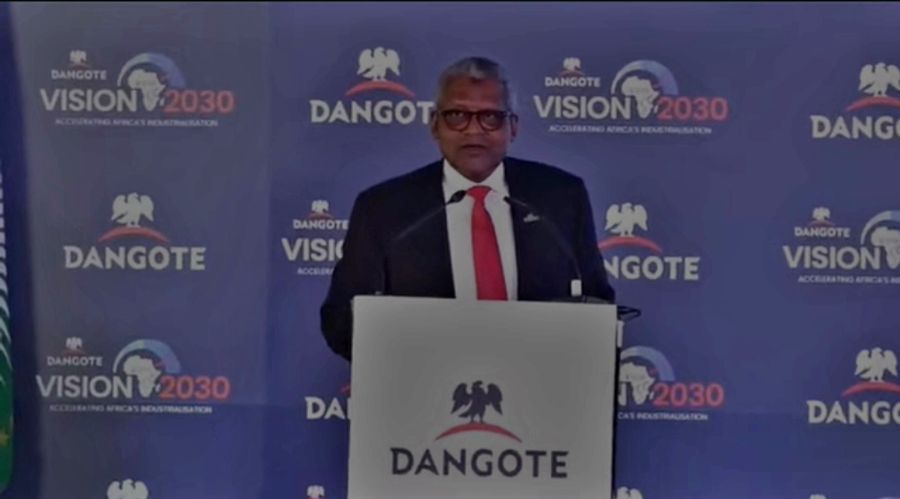
WED NOV 04 2026-theGBJournal| Nigerian billionaire Aliko Dangote has described Africa as home rather than merely an investment destination, pledging to reinvest profits and deploy additional capital across the continent as his industrial group advances plans to build an interconnected petroleum distribution network stretching across Southern and Eastern Africa.
Speaking on Wednesday at the groundbreaking ceremony for Dangote Industries Limited’s petroleum storage and regional pipeline project in Walvis Bay, Namibia, Dangote said the estimated $140 million investment would strengthen the country’s energy security while opening new trade corridors across Southern Africa.
“When we come into a country in Africa, we are coming home. We are not coming to make money and take the money away. We are going to continuously invest our profit and bring additional capital to expand the businesses we are into,” he said.
The remarks underscore Dangote’s ambition to move beyond individual investments towards building an integrated continental industrial and energy infrastructure network, linking production centres, storage facilities and distribution corridors across African markets.
The Walvis Bay project, launched alongside Namibian President Netumbo Nandi-Ndaitwah, is expected to position the country’s Atlantic port as a strategic petroleum distribution hub, connecting fuel imports and exports with landlocked economies across the region.
Dangote praised President Nandi-Ndaitwah for fulfilling her commitment to the project, saying she had made a promise and kept it.
He also acknowledged the role of African Export-Import Bank (Afreximbank) President George Elombi, crediting the institution with making a significant number of African projects possible through its financing support.
He said the bank’s philosophy reflected a broader belief that African capital could finance African projects, driven by African entrepreneurs.
For Dangote, the Namibian investment is part of a much larger infrastructure strategy rather than an isolated commercial undertaking.
“This project, taken together, this investment from Lamu to Gode, from Damerjog ($660 million fuel pipeline), to Walvis Bay are not isolated projects. They are part of the deliberate continental strategy to create connected centres of production, storage and distribution,” he said.
He added that the investments demonstrated the group’s confidence in Africa’s economic prospects and the importance of supporting regional integration with physical infrastructure.
“They demonstrate our confidence in Africa’s future and our belief that regional integration must be supported by physical infrastructure, capable of moving energy, goods and services across borders.”
The strategy spans multiple markets, including infrastructure developments in East Africa and the Horn of Africa, with the Walvis Bay project providing a strategic entry point into Southern Africa.
The wider Southern African pipeline ambition, estimated at more than $3.5 billion, envisages a network extending inland from Namibia towards Botswana and other regional markets, potentially connecting fuel distribution routes across several countries.
The Walvis Bay development reflects Dangote’s broader effort to extend the commercial reach of his $20 billion refinery in Lagos, which has an installed capacity of 650,000 barrels per day.
Rather than concentrating solely on refining capacity, the group is investing in the infrastructure required to move petroleum products efficiently across national borders, including storage terminals, pipelines and distribution facilities.
The proposed Namibian facility at the Remainder of Farm 58 will comprise two principal storage tanks for petrol and diesel, two dispensing tanks, a truck-loading facility and an approximately 16-kilometre pipeline linking the fuel jetty to the storage site.
The development is expected to support petroleum distribution towards Otjiwarongo and Rundu, with a proposed connection towards Ghanzi in Botswana.
For Namibia, the investment offers an opportunity to leverage Walvis Bay’s Atlantic coastline and port infrastructure to serve as a regional energy gateway, while reducing the logistical constraints associated with supplying landlocked markets.
Dangote said the group remained committed to environmental stewardship, safety, transparency and engagement with host communities, signalling that the expansion would be accompanied by standards governing the development and operation of its infrastructure.
“Today, our purpose here is clear. To turn this coastal location into a dependable link between fuel supply and the communities and the industries that need it,” he said.
He described the investment as an effort to connect Namibia’s Atlantic gateway with the practical energy requirements of the wider Southern African economy.
“For Namibia, this investment is about connecting the promise of its Atlantic gateway to the practical needs of Southern Africa.”
He said the ultimate objective was to deliver reliable energy for businesses, create opportunities for local enterprises and strengthen economic connections between neighbouring countries.
“Reliable energy for businesses, opportunities for local enterprise and stronger connections with our neighbours. That is the shared purpose we must carry from this ceremony into the work ahead.”
The investment signals an increasingly important dimension of Dangote’s African expansion: the development of infrastructure that could allow the continent to retain more value from its own industrial production and reduce its dependence on fragmented import and distribution networks.
For decades, many African economies have relied on imported refined petroleum products, with inland transportation costs and inadequate storage infrastructure contributing to supply vulnerabilities.
By linking refining capacity with strategically located storage and distribution assets, Dangote is seeking to establish a commercial network capable of serving multiple markets from interconnected regional hubs.
The ambition is considerable. Its success will depend not only on the construction of pipelines and storage facilities but also on cross-border agreements, regulatory coordination, financing and sustained demand across participating economies.
Yet Wednesday’s groundbreaking represents a tangible step in that direction.
For Dangote, the message was that Africa’s industrial future must be financed, built and interconnected by Africans.
And, as he told the gathering in Walvis Bay, the continent is not simply where his group does business. It is home.
X-@theGBJournal|email:gbj@govbusinessjournal.com|govandbusinessj@gmail.com