

…Electoral credibility under scrutiny as INEC opens preliminary register online after public outcry; questions mount over verification, accountability and December deadline
By Our Political Desk
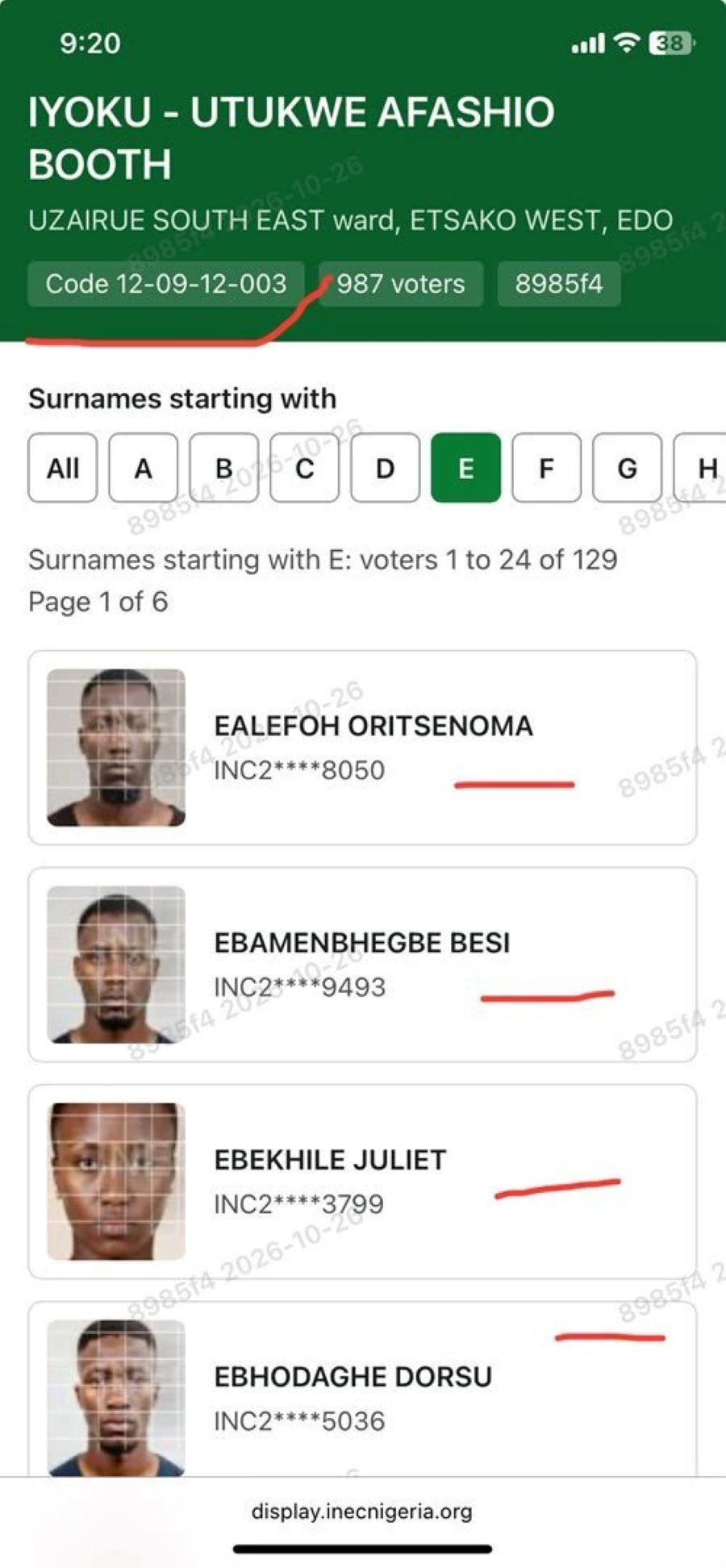
TUE OCT 27 2026-theGBJournal| The credibility of Nigeria’s 2027 general election has come under fresh scrutiny following concerns raised by political economist and public intellectual, Professor Pat Utomi, over alleged artificial intelligence-generated images in the preliminary register of voters released by the Independent National Electoral Commission (INEC).
Utomi’s intervention has brought renewed attention to a fundamental question confronting the electoral umpire ahead of the 2027 polls: how can Nigerians have confidence in an election when the integrity and accuracy of the register on which the exercise rests are being questioned?
In a warning with potentially far-reaching implications for the next general election, Utomi said INEC could not afford to be careless with the credibility of the country’s electoral process.
“INEC cannot afford to be careless with the credibility of Nigeria’s electoral process,” he said.
“The presence of AI-generated images in a register meant to support our democracy raises serious questions about verification, transparency and accountability. Our democracy is at stake here!”
His remarks have intensified the debate over the quality of the preliminary register, the effectiveness of INEC’s verification procedures and the capacity of the commission to address emerging technological threats to electoral integrity.
However, the allegation of AI-generated images must be subjected to independent technical verification. The presence of an image that appears artificial or unusual does not, by itself, establish that the person is fictitious, that a fraudulent registration occurred or that the electoral register has been compromised on a significant scale.
What is beyond dispute is that the controversy places additional pressure on INEC to explain its verification processes, investigate specific questionable entries and demonstrate that the final register will be accurate, auditable and defensible.
INEC OPENS REGISTER ONLINE AFTER CRITICISM
The controversy comes as INEC announced on Monday, October 26, that it would make the preliminary register available online following concerns over public access to the document.
In a statement issued by Mohammed Kudu Haruna, chairman of the commission’s Information and Voter Education Committee, INEC said it had conducted the physical display of the preliminary register at registration areas nationwide between October 9 and 15, 2026.
The exercise was intended to enable registered voters to inspect their particulars and submit claims and objections in accordance with the Electoral Act, 2026.
Acknowledging concerns about online accessibility, the commission said it had decided to publish the same preliminary register on its digital platform.
“Accordingly, and in furtherance of its commitment to transparency, accessibility and public confidence in the electoral process, the Commission has decided to make available on its online platform display.inecnigeria.org the same Preliminary Register of Voters earlier displayed at the Registration Areas,” Haruna stated.
INEC described the decision as an additional measure intended to widen public access, adding that it was continuing to process claims and objections ahead of the certification and publication of the final register on December 15, 2026.
The register is accessible through the commission’s official portal, INEC Preliminary Register of Voters.
But the timing of the announcement raises questions about whether Nigerians have been given adequate opportunity to scrutinise the register within the period prescribed by law.
A report by PREMIUM TIMES published on October 21 said INEC had failed to publish the preliminary register online within the statutory timetable. The newspaper reported that the commission subsequently made the register available online on October 26, after the scheduled physical display had ended.
Section 19(1) of the Electoral Act, 2026, provides for public scrutiny of the register both at registration areas and on the commission’s official website or another website established for that purpose, within the stipulated period before a general election.
The distinction is important: making a document available after the prescribed scrutiny period is not necessarily equivalent to complying with the original timetable.
The precise legal consequences of the delay, including any effect on the opportunity to submit objections, require careful examination of the statutory provisions and the circumstances of the exercise. Nevertheless, the sequence of events places the commission under pressure to demonstrate that public scrutiny will be meaningful rather than merely procedural.
WHY THE AI ALLEGATION MATTERS
The controversy goes beyond the appearance of photographs in an electoral database.
A credible voters’ register must establish that eligible citizens are registered accurately, that each registration corresponds to a genuine individual and that ineligible or duplicate entries are identified and addressed through lawful procedures.
If images in the register have been artificially generated, manipulated or incorrectly associated with voter records, the commission must determine how the problem occurred, how many records are affected and whether the irregularity compromises the reliability of any part of the register.
There are several possible explanations for a suspicious image, and they carry different implications.
An image may have been generated or altered by artificial intelligence. It may also have been affected by image-processing software, poor image quality, a technical error or an incorrect association between a photograph and a record.
These possibilities cannot responsibly be treated as interchangeable.
The critical issue is whether the image can be linked to a genuine, eligible voter and whether the registration satisfies the applicable legal and verification requirements.
If questionable images are confirmed to be part of fraudulent registrations, the implications could extend beyond an embarrassing technical failure. Such findings would demand an investigation into the source of the images, the effectiveness of biometric checks and the adequacy of the commission’s internal controls.
Conversely, if the images prove to be the product of legitimate processing or another non-fraudulent cause, the commission would need to communicate the findings clearly to prevent unsubstantiated allegations from further eroding public confidence.
Either way, silence or vague assurances would leave important questions unanswered.
THE 103 MILLION-VOTER QUESTION
The stakes are substantial because the register is the foundation of electoral administration.
INEC has reported more than 103 million registered voters. The commission also announced that its continuous voter registration exercises produced 10,772,421 new registrations, subject to completion of verification.
The scale of the register makes effective scrutiny particularly important.
A list containing millions of records cannot be adequately assessed through isolated visual inspection alone. It requires dependable identity checks, biometric deduplication, systematic quality control and accessible procedures through which citizens and political parties can report questionable entries.
INEC has previously reported completing an Automated Biometric Identification System cleanup. That process is relevant to the current controversy, but the existence of a biometric system does not, on its own, settle questions about the authenticity of every photograph or the accuracy of every record.
Biometric deduplication and image authenticity checks address related but distinct risks. A system designed to detect duplicate biometric identities may not automatically identify every synthetic image, incorrectly linked photograph or other form of data manipulation.
The commission therefore needs to explain what checks were performed, what anomalies were identified and how the results informed the preparation of the preliminary register.
It should also clarify whether the images cited by Utomi have been formally referred to the commission for investigation and whether any technical examination has commenced.
As of the material available for this report, INEC’s October 26 statement addressed online publication, public scrutiny and the processing of claims and objections. It did not specifically answer Utomi’s allegation about AI-generated images.
That distinction is essential. An announcement about access to the register is not, by itself, an answer to a question about the authenticity of its contents.
THE DECEMBER 15 DEADLINE
INEC has fixed December 15, 2026, for certification and publication of the final register.
The deadline creates a narrow window for the commission to address complaints, investigate questionable entries and demonstrate that the process has produced a reliable list of eligible voters.
The immediate concern is whether the remaining verification and objection procedures will be sufficiently rigorous and transparent to resolve material discrepancies before certification.
The commission should publish a clear explanation of how objections are submitted, how suspected fraudulent records are investigated, what evidence is required to establish an irregularity and how complainants can obtain information about the disposition of their submissions.
It should also explain how the final register will be checked against the preliminary version, including how corrections, deletions and other changes will be documented.
Where credible evidence of manipulation exists, an independent technical review could help establish the nature and extent of the problem. Such a review should preserve relevant records, protect legitimate voters’ personal information and distinguish verified findings from speculation.
The objective must be to correct genuine errors without disenfranchising eligible citizens or allowing unsupported allegations to become grounds for arbitrary exclusion.
FIVE IMPLICATIONS FOR THE 2027 ELECTION
1. Public confidence could be affected.
The credibility of an election depends not only on the accuracy of its administration but also on whether the public can examine the evidence supporting that accuracy.
Unresolved questions about voter records could deepen suspicion before campaigns and voting begin. Transparent investigation would give INEC an opportunity to address concerns with evidence rather than assurances alone.
2. The credibility of the register could become a political flashpoint.
Political parties, civil society organisations and election observers have a legitimate interest in identifying irregularities before the register is certified.
If the commission does not establish a credible process for handling complaints, disputes over individual records could develop into broader arguments about the fairness of the electoral process.
However, the existence of disputed images would not automatically establish widespread voter fraud or demonstrate that the outcome of an election had been compromised.
3. Genuine voters could face avoidable difficulties.
Errors in names, photographs, polling-unit assignments or other particulars can create confusion and potentially interfere with the exercise of voting rights.
The scrutiny process must therefore protect citizens whose records are correct while providing effective remedies for those whose particulars are missing or inaccurate.
Any response to suspected synthetic images must be evidence-based and subject to appropriate safeguards.
4. INEC’s technological safeguards will face closer scrutiny.
The controversy raises questions about whether the commission’s verification systems adequately address newer forms of digital manipulation.
INEC has announced the establishment of an artificial intelligence unit to monitor digital threats and detect deepfakes ahead of the 2027 elections. That initiative is relevant, but monitoring manipulated content circulating online is not identical to verifying the integrity of images stored in a voter database.
The commission needs to clarify how its cybersecurity, identity-verification and electoral-data systems work together to prevent, detect and investigate manipulation.
5. The dispute could shape the debate over electoral legitimacy.
Confidence in election results is influenced by the credibility of the processes that precede voting, including registration, voter accreditation, polling-unit administration and result collation.
A disputed register could become a source of litigation or political controversy if credible irregularities are left unresolved.
But the effect on the 2027 election will depend on what an investigation establishes, how INEC responds and whether the identified problems materially affect voter eligibility or electoral administration.
BEYOND THE PHOTOGRAPHS
The immediate challenge for INEC is to establish the facts.
The commission should identify the specific records or images under scrutiny, conduct an appropriate technical examination and explain whether the findings indicate isolated errors, systemic weaknesses or deliberate manipulation.
It should also make clear what corrective measures are available under the law and how the public can participate in the claims-and-objections process.
Independent experts and civil society groups can contribute by examining verifiable evidence, documenting discrepancies and directing substantiated complaints to the appropriate authorities.
At the same time, the public must distinguish between an image that looks artificial and a proven case of fraudulent voter registration.
That distinction matters because unsupported claims can damage confidence just as unresolved genuine irregularities can.
The purpose of scrutiny is not to presume guilt or to shield an institution from criticism. It is to establish whether the register meets the standards required of a democratic election.
INEC MUST ANSWER THE HARD QUESTIONS
Utomi’s warning has placed a legitimate issue before the electoral authorities: the credibility of the register must be demonstrated, not merely asserted.
The commission’s decision to publish the preliminary register online offers a wider opportunity for public scrutiny. It does not, however, resolve questions about the timing of publication, the authenticity of disputed images or the effectiveness of the verification process.
With the final register scheduled for December 15, INEC must show how it intends to investigate credible allegations, resolve objections and document the corrections made before certification.
The questions are straightforward but consequential: Were the images genuinely AI-generated? If so, how did they enter the register? How many records are affected? Did the problem bypass existing verification controls? And what independent evidence can establish that the final register is accurate?
The answers will help determine whether this controversy remains a limited data-quality problem or exposes a wider weakness requiring urgent institutional action.
Nigeria’s 2027 general election is still ahead. There is time to investigate, correct errors and strengthen safeguards, but that work must be transparent and verifiable.
For INEC, the test is whether it can turn public concern into an accountable verification process before the final register is certified.
For Nigerians, the essential demand is neither automatic acceptance nor premature condemnation. It is evidence, transparency and a credible process that protects every eligible voter.
The central issue is not simply whether artificial intelligence appears in the voters’ register. It is whether INEC can establish that every eligible voter is properly recorded, every credible objection is investigated and every final entry can withstand public scrutiny.
X-@theGBJournal|email:gbj@govbusinessjournal.com|govandbusinessj@gmail.com