
…At the launch of his re-election campaign in Kaduna, Nigeria’s president turned the spotlight on his political opponents, arguing that they helped create the economic hardship they now criticise.
…But beyond the campaign rhetoric, questions remain about the cost of living and the impact of government policies on ordinary Nigerians.
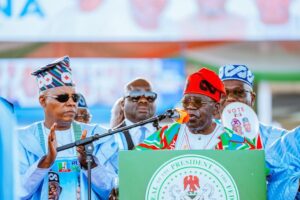
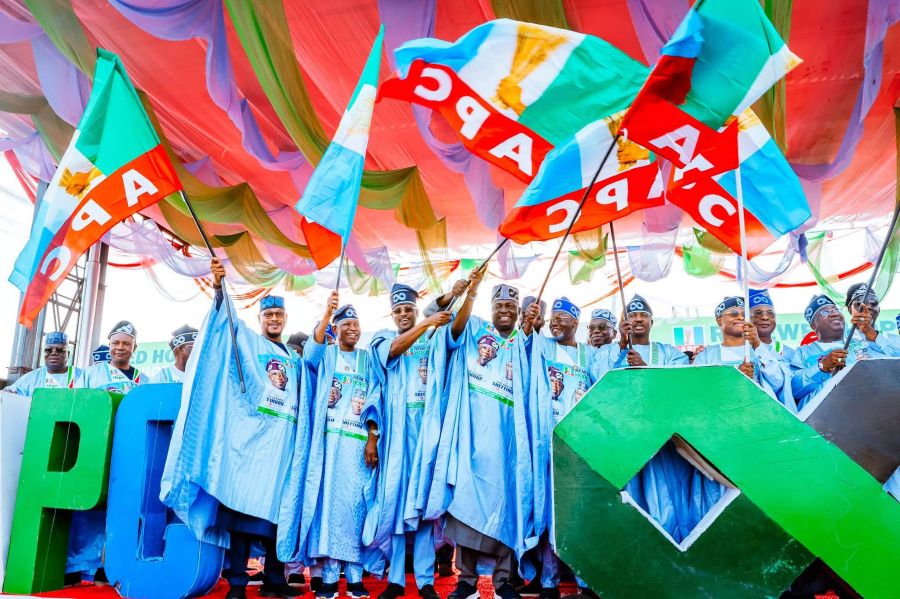
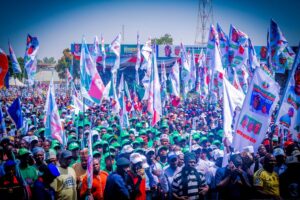
SUN OCT 25 2026-theGBJournal| When President Bola Ahmed Tinubu took to the podium at Ranchers Bees Stadium in Kaduna on Saturday, the message was about more than an election campaign.
It was also about responsibility.
With Nigeria’s economic challenges providing fertile ground for political debate ahead of the 2027 general election, the president sought to turn criticism of his administration back on his opponents.
“I hear my opponents talking about hunger and poverty. Who created it? They did,” he told supporters, according to a statement issued by the State House.
“We are trying to eradicate it.”
The accusation set the tone for an event that combined campaign mobilisation with the inauguration of an 81-kilometre section of the Abuja–Kaduna–Zaria–Kano dual carriageway.
For the president and his party, the two events served a common purpose: to present the administration’s policies and infrastructure projects as evidence of its record in office.
But the speech also raised a question that is likely to remain central to Nigeria’s political conversation: who should be held responsible for the country’s economic difficulties, and how should that responsibility be measured?
A political argument over poverty
President Tinubu’s comments appeared to be directed at opposition figures, including former Vice-President Atiku Abubakar, who served under President Olusegun Obasanjo from 1999 to 2007.
The State House statement linked the president’s criticism to the privatisation of state-owned enterprises during that period, arguing that some workers were left without their gratuities and pensions.
It also said the Tinubu administration had been paying those workers.
The historical dispute provides one way for the governing party to frame the argument over economic hardship: as a problem inherited from previous administrations rather than one that can be attributed solely to the current government.
However, poverty and hunger in Nigeria have developed over many years and reflect a range of economic, political and structural factors.
These include inflation, unemployment and underemployment, insecurity, weak productivity, infrastructure gaps and the purchasing power of households.
The president’s assertion that his opponents created the hardship is a political claim, not an established explanation for all the causes of poverty in Nigeria.
For voters, the more immediate question may be whether the government’s policies are improving their circumstances.
The highway as a symbol of delivery
The inauguration of the 81-kilometre road section offered the president a tangible project around which to build his development message.
The Abuja–Kaduna–Zaria–Kano highway is an important transport corridor linking the Federal Capital Territory with Kaduna and other major northern commercial centres.
Improved road infrastructure can reduce travel times, facilitate the movement of agricultural produce and goods, and make journeys easier for commuters and businesses.
But the benefits depend on more than a ceremonial inauguration.
Road users will ultimately judge the project by its condition, safety, accessibility and completion, as well as whether it reduces transport costs and improves connectivity.
The State House statement described the event as the inauguration of Lot 1 of the Abuja–Kaduna–Zaria–Kano dual carriageway.
It did not provide a detailed breakdown of the section’s cost, its full delivery schedule or the extent of work remaining on the wider corridor.
Those details would help establish the project’s overall progress and the scale of its expected economic benefits.
For an administration seeking another mandate, infrastructure projects offer a visible way to demonstrate activity in office. For citizens, the test is whether those investments translate into practical improvements in daily life.
Shettima’s appeal for continuity
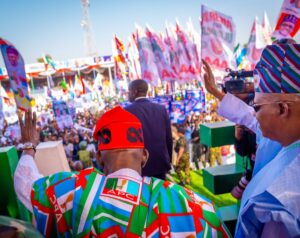
Vice-President Kashim Shettima used his address to make a case for political continuity.
He highlighted Tinubu’s previous support for northern presidential candidates, including former President Muhammadu Buhari, who won the 2015 and 2019 elections.
Shettima also referred to Tinubu’s political relationships with Atiku Abubakar and Nuhu Ribadu during earlier presidential contests.
He presented those relationships as examples of political loyalty and a commitment to national unity.
His appeal reflects the importance of regional alliances and political relationships in Nigeria’s national elections.
However, the argument for continuity must also contend with the demands of voters who want improvements in security, economic opportunity, public services and living standards.
Political alliances can help parties mobilise support, but the durability of that support also depends on public perceptions of governance and performance.
Kaduna State Governor Uba Sani, in his welcome address, praised the cooperation between the federal and state governments.
He highlighted infrastructure, agriculture and welfare programmes as areas in which collaboration could support development.
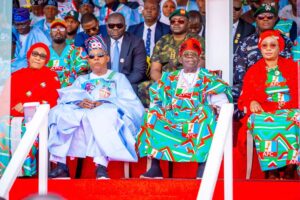
The rally was attended by APC governors, party officials and other political figures, underscoring the party’s efforts to organise around its presidential campaign.
Economic reforms under scrutiny
Abdulaziz Yari, the director-general of the APC Presidential Campaign Council, defended the administration’s economic reforms and pointed to developments in the foreign exchange market.
The argument reflects a wider challenge for the government: explaining how changes in the country’s economic framework are expected to translate into better living conditions.
Foreign exchange movements are one indicator of economic performance, but they do not tell the whole story.
Inflation, food prices, real wages, employment, business costs and household purchasing power are also important measures of how economic policies affect citizens.
A more comprehensive assessment would compare these indicators over time and consider the effects of both government policies and wider economic conditions.
For households struggling to afford food, transport, housing and other essentials, improvements in one economic indicator may offer limited relief if everyday expenses remain high.
The government’s defence of its reforms and the opposition’s criticism of their effects will therefore need to be tested against economic data rather than political assertions alone.
AI and the challenge of political information
The rally also brought another issue into focus: the role of artificial intelligence in election campaigns.
Governor Uba Sani urged APC supporters to guard against misinformation, including misleading material circulated on social media and content allegedly generated using AI.
The warning comes as digital tools make it increasingly easy to create convincing images, cloned voices, manipulated videos and fabricated statements.
During an election campaign, such material can spread rapidly, particularly when it reinforces existing political loyalties or public anxieties.
But identifying misinformation is not simply a matter of deciding whether content was produced by AI.
Authentic footage can be presented out of context, while genuine political statements can be misrepresented through selective editing. Conversely, AI-generated content may be used for legitimate purposes when it is clearly disclosed.
The challenge for political parties, journalists and voters is to establish where information originated, verify its claims and distinguish evidence from speculation.
That responsibility applies to campaign messages from all sides, not only to material circulated by political opponents.
What comes next?
The Kaduna rally offered a preview of the arguments likely to shape the political conversation as the 2027 election approaches.
The governing party is emphasising infrastructure investment, economic reforms, federal-state cooperation and the need for continuity.
Its opponents are likely to focus on the cost of living, poverty, the effects of government policies and the gap between official promises and the experiences of ordinary Nigerians.
The highway inauguration provides a concrete project against which the administration’s infrastructure claims can be assessed.
The president’s comments on poverty, meanwhile, open a much broader debate about the responsibilities of successive governments and the evidence needed to judge their economic records.
Neither a campaign speech nor a ribbon-cutting ceremony can, on its own, settle those questions.
For Nigerians deciding how to assess the competing claims, the more useful measures will be verifiable project outcomes, economic indicators and the practical effects of public policy on their lives.
As the road between Abuja and Kaduna becomes a symbol in the campaign narrative, the wider political journey towards 2027 will be shaped by another consideration: whether the promises made on the campaign trail can be matched by results.
X-@theGBJournal|email:gbj@govbusinessjournal.com|govandbusinessj@gmail.com