
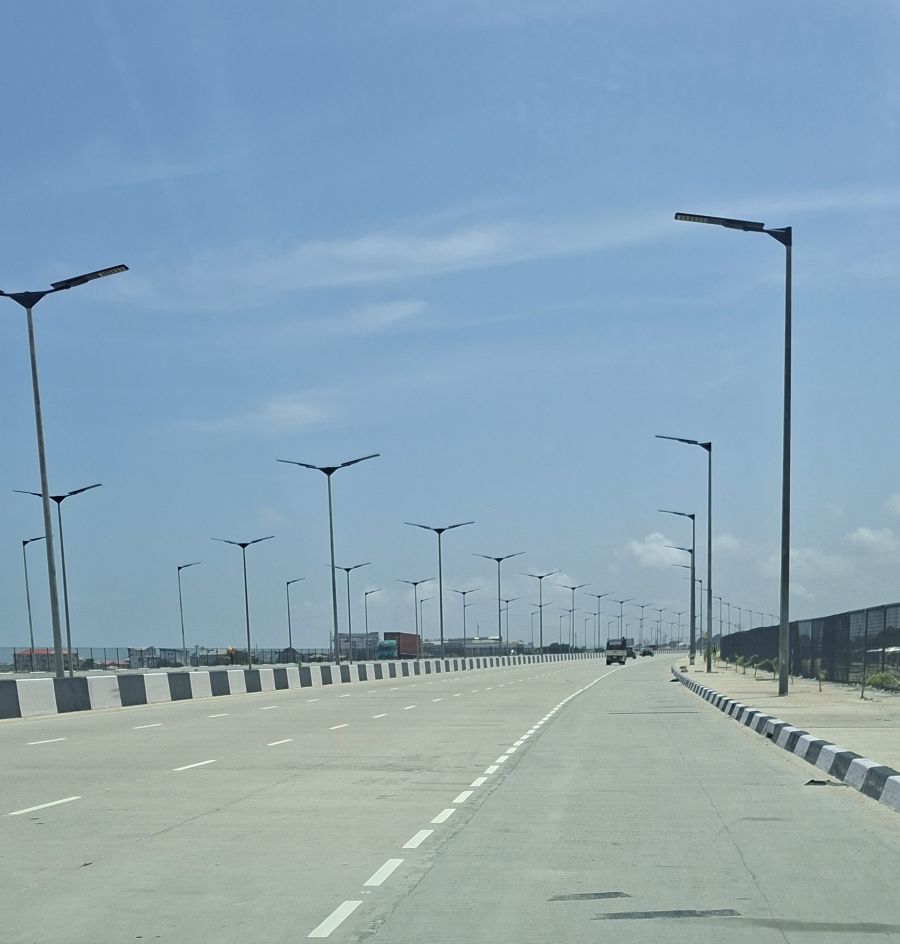

…The government says reconstruction of the East-West Road is an additional project, not a replacement for the controversial 750km coastal highway.
…Design work is still under way on several sections of the coastal route.
TUE OCT 13 2026-theGBJournal| The Federal Government has denied claims that it has abandoned or altered the original alignment of the Lagos-Calabar Coastal Highway, insisting that plans to reconstruct part of the East-West Road are intended to complement, rather than replace, the flagship coastal project.
In a clarification issued by the Federal Ministry of Works late Monday, the government said President Bola Tinubu had not ordered the coastal highway to be discontinued in favour of the East-West Road between Edo and Cross River states.
Instead, it said, the reconstruction of about 400km of the East-West Road was an additional infrastructure project that would be undertaken alongside the planned 750km dual carriageway linking Lagos to Calabar.
The statement comes amid public backlash and questions over whether the government intends to divert resources from the coastal highway or change its route.
At the heart of the government’s explanation is a distinction between two projects that it says will run concurrently.
The Lagos-Calabar Coastal Highway is the original 750km project, intended to connect Nigeria’s commercial centre in Lagos with Calabar, the capital of Cross River State.
The East-West Road, meanwhile, is a separate route that the government says requires extensive reconstruction because sections have deteriorated and are vulnerable to flooding.
According to the ministry, parts of the East-West Road between Edo and Cross River states have become badly damaged, with sections lying below flood levels as a result of changing climatic conditions.
The government argues that rebuilding this road is necessary in its own right and should not be interpreted as evidence that the coastal highway has been abandoned.
The ministry says construction is under way on several sections of the coastal highway in the Niger Delta and other parts of the route.
It identifies three groups of sections as being under construction: Sections 3A and 3B, covering 75km in Cross River and Akwa Ibom states; Sections 4A and 4B, covering 65km in Ogun and Ondo states; and Section 5, covering 62km in Akwa Ibom.
However, the government acknowledges that surveying and design work is continuing on the remaining stretches between the end of the Ondo section and the project’s connection with Section 5 in Akwa Ibom.
These stretches are expected to pass through Edo, Delta, Bayelsa and Rivers states.
The ministry says procurement and construction on the outstanding sections will begin once the survey and design work has been completed, starting from the Ondo end of the route.
The East-West Road is an important transport corridor in the Niger Delta, connecting communities and economic centres across the oil-producing region.
Its poor condition and vulnerability to flooding have long made road rehabilitation a significant infrastructure concern.
By presenting its reconstruction as an additional project, the government is seeking to reassure residents and other stakeholders that improving the East-West Road will not come at the expense of the coastal highway.
The ministry also points to another example: the expansion of the Akwanga-Jos-Bauchi-Gombe-Biu-Maiduguri road project.
According to the statement, the President approved an additional Wukari-Langtang route, increasing the planned dual carriageway network from 700km to 1,100km.
The government says the additional route has not changed the original alignment or halted work on the existing project.
Analysts say, although the ministry has sought to dispel the controversy, several practical questions remain unanswered in its statement.
”It does not provide a detailed timetable for completing the outstanding sections of the Lagos-Calabar Coastal Highway, nor does it specify when surveying and design work on those stretches will be completed.”
It also gives no detailed breakdown of how the additional East-West Road reconstruction will be funded, how the two projects will be coordinated or whether the additional work will affect their respective delivery schedules.
Those details matter because the central question is not simply whether the government intends to build both roads, but whether it has the funding, procurement arrangements and implementation plans to deliver them as promised.
The G&B Journal notes that the ministry of work’s statement also does not provide independent evidence of progress across all the sections it identifies as being under construction.
X-@theGBJournal|email:gbj@govbusinessjournal.com|govandbusinessj@gmail.com