
By Igwebuike Okoh
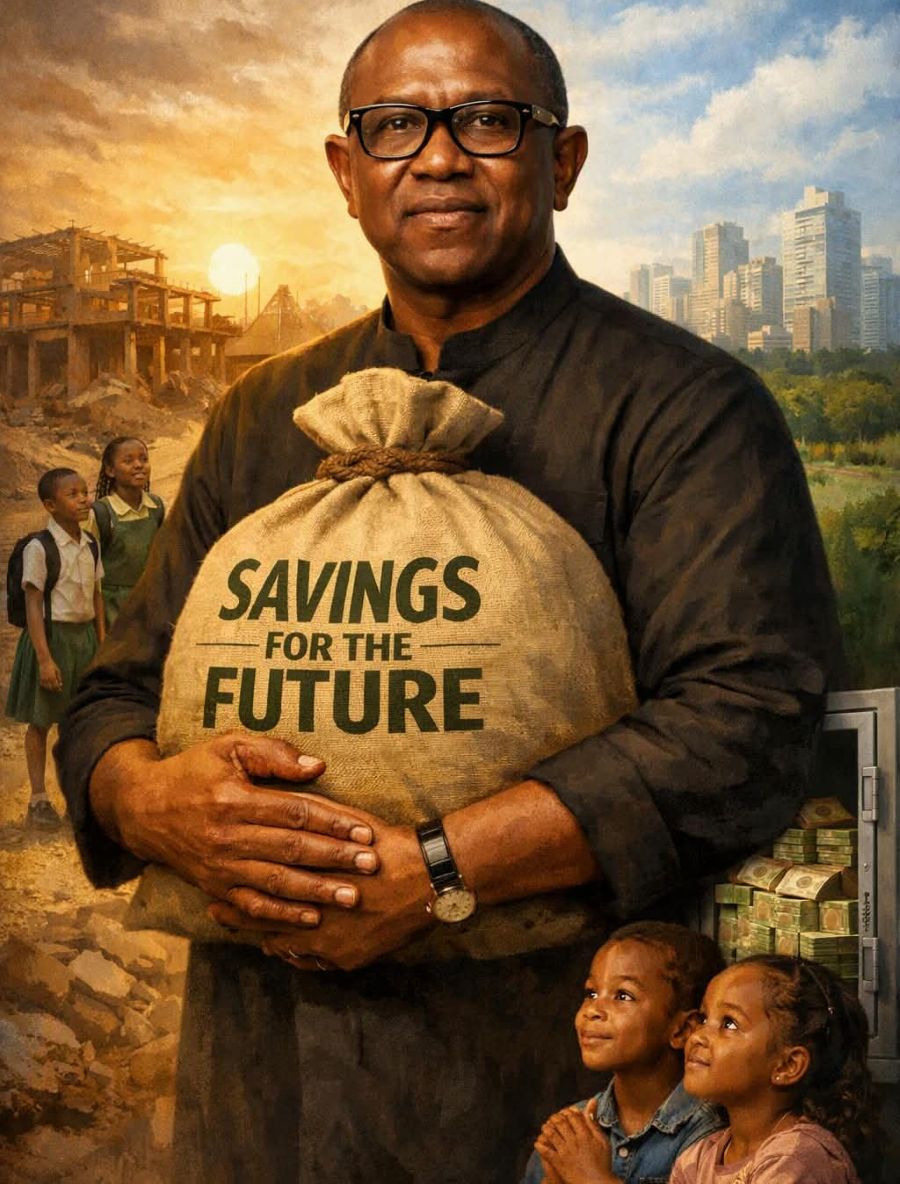
MON SEPT 21 2026-theGBJournal| There is something deeply revealing about the Nigerian argument over Peter Obi’s savings as governor of Anambra State.
Apparently, if a government leaves money in the bank, it must have failed. But if it spends billions on buildings, ceremonies, contracts and grandiose projects—whether or not those projects remain useful—the government is somehow seen as having “done something.”
That is an odd definition of development.
The obsession with spending has become one of the most damaging habits in Nigerian public life. We have repeatedly confused activity with achievement and expenditure with development.
A government announces a project, cuts a ribbon and publishes photographs. Everyone applauds. Years later, the project may be abandoned, underutilised or consuming more money than it ever generated.
But because the money was “spent,” nobody asks the harder question:
What did the people actually get?
This is why the criticism of Obi’s decision to preserve public funds deserves more than the usual political shouting. The important issue is not whether government should spend money. Of course it should. The issue is whether government has the capacity to turn expenditure into lasting value.
That distinction is particularly important in a country where institutional and technical capacity remains uneven.
Consider the temptation to build factories simply because industrialisation sounds impressive. A factory is easy to announce and relatively easy to construct.
Running it profitably is another matter entirely.
Who will manage it?
Where are the technicians?
Where is the supply chain?
Who will maintain the machinery?
Where is the market?
What happens when the government that established it leaves office?
Without answers to these questions, a factory can become little more than an expensive monument to political ambition.
The same applies to sophisticated infrastructure, technology projects and state-owned enterprises. Capital alone does not create productivity. Human capital, management, institutions and markets do.
This is where saving public money can make sense.
If a government lacks the capacity to deploy billions productively today, preserving some of those resources while strengthening education, healthcare, infrastructure and institutional capacity may be more responsible than spending simply to satisfy the public appetite for visible projects.
But there is an important caveat.
Saving money is not a development strategy by itself.
Money sitting in an account does not educate a child. It does not employ a graduate. It does not treat a patient. It does not create a factory or put food on a family’s table.
Savings become meaningful when they create fiscal space for future investment, protect the state during economic shocks and provide capital for projects that can eventually be executed effectively.
So the real question is not whether Obi saved money.
The real question is:
Was the money preserved responsibly, transparently and for a productive public purpose—and did the government spend enough to address the needs of the people at the time?
That is a legitimate debate.
What is not particularly useful is the simplistic argument that every available naira must be spent merely because it is available.
Nigeria has seen what happens when governments operate under that philosophy.
Money is allocated.
Contracts are awarded.
Projects are commissioned.
Photographs are taken.
Politicians claim achievements.
Then another administration arrives and discovers that much of what was built cannot be maintained.
The cycle begins again.
Perhaps we should try something different.
Perhaps we should judge governments by outcomes rather than expenditure.
A government that spends N100 billion and creates N20 billion worth of sustainable public value has not necessarily outperformed a government that spends N50 billion, saves N50 billion and creates N60 billion worth of sustainable value.
The arithmetic of governance is not as simple as “spend more, achieve more.”
And there is an even bigger lesson here.
A responsible government must sometimes have the courage to tell its citizens: we cannot afford to build this yet; we do not have the capacity to manage it yet; or we do not have sufficient evidence that it will deliver value.
That may be politically unpopular.
It may even look unimpressive.
But responsible government is not a popularity contest for the biggest project, the largest billboard or the longest list of commissioned buildings.
It is stewardship.
Public money is not a politician’s personal achievement fund. It is money held in trust for citizens.
So, yes, governments should invest.
They should build roads, schools, hospitals, water systems and productive infrastructure. They should invest aggressively where the economic and institutional conditions make such investments viable.
But they should also know when not to spend.
Because sometimes the most responsible thing a government can do with public money is to refuse to waste it.
And perhaps that is the uncomfortable question Nigerians should begin asking:
Do we really want governments that spend everything just to prove they have been busy—or governments capable of knowing the difference between spending money and creating value?
X-@theGBJournal|email:gbj@govbusinessjournal.com|govandbusinessj@gmail.com