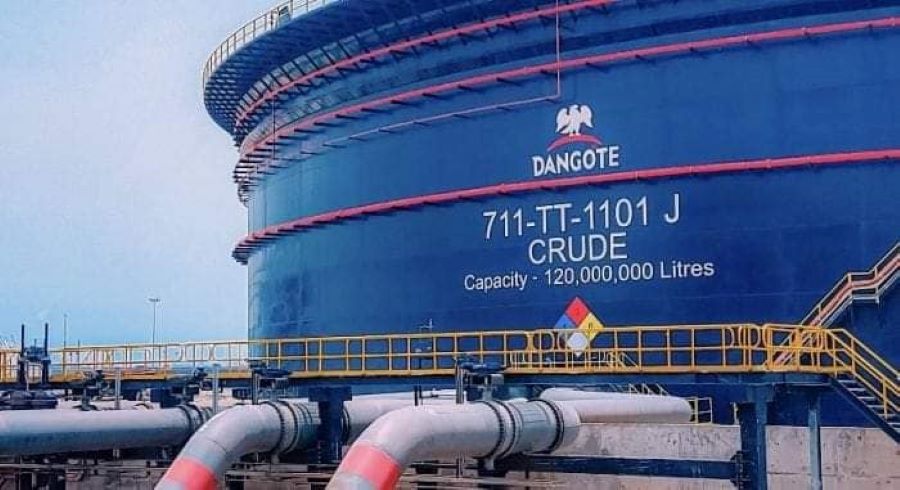

…The Dangote Refinery IPO is arriving with the kind of numbers capable of making even seasoned investors look twice.
WED SEPT 09 2026-theGBJournal| The refinery made $1.82 billion in after-tax profit in the first half of 2026, generated about $13.9 billion in revenue and $2.6 billion in EBITDA, just as its owners prepare to sell 4.1 billion shares at ₦525 each and seek about ₦2.15 trillion ($1.63 billion) from investors.
But the most important number in the offering may not be the ₦525 share price.
It is the roughly $48 billion valuation that investors are being asked to accept.
That valuation puts a very different question at the centre of Africa’s biggest planned IPO: how much of Dangote Refinery’s extraordinary earnings are sustainable, and how much reflects an unusually favourable global refining market?
The answer will determine whether the offering represents an opportunity or a premium-priced bet on continued growth.
The earnings story is compelling
On the face of it, Dangote Refinery has produced an extraordinary turnaround.
The company reported an after-tax profit of $1.82 billion in the first six months of 2026, compared with a $476 million loss for the whole of 2025.
EBITDA stood at about $2.6 billion, while first-half revenue was approximately $13.9 billion.
If the first-half earnings were simply annualised, the refinery would be running at roughly $3.64 billion in annual net profit and $5.2 billion in EBITDA.
That creates an interesting valuation picture.
Against a valuation of about $47 billion-$49 billion, annualised first-half earnings imply a forward-looking price-to-earnings multiple of approximately 13 times, while the annualised EBITDA multiple is around 9 times, before taking account of net debt and the fact that second-half earnings may differ materially from the first half.
Those multiples do not automatically make the IPO expensive.
But neither do they make it obviously cheap.
The market will therefore have to decide whether the refinery can sustain earnings at anything close to the first-half run rate.
And that is where the oil market becomes important
Dangote Refinery’s earnings have emerged during an unusually disrupted global energy market.
Conflicts involving Iran and Ukraine have damaged refining infrastructure, disrupted crude and petroleum-product flows and tightened fuel markets.
Dangote has benefited from those disruptions, including through exports of refined products to African and European markets.
That creates a valuation dilemma.
If global refining margins remain elevated, Dangote’s earnings could continue to surprise on the upside.
If refining margins normalise, investors will want to know how much of the $1.82 billion first-half profit survives.
This is why the refinery’s normalised EBITDA may ultimately be more important than its record profit.
Dangote has said it wants the business to eventually generate more than $12 billion in annual EBITDA.
That target is ambitious, particularly because the company plans to spend another $14.3 billion to double capacity to 1.4 million barrels per day by 2029.
The IPO is therefore not merely a bet on the refinery that exists today.
It is also a bet on the refinery that Dangote intends to build.
The crude problem cannot be ignored
This may be the biggest operational issue for investors.
Nigeria has crude. The problem is whether enough of it can reach Dangote at a sufficiently competitive price.
Nigeria produced about 1.505 million barrels per day of crude oil in July, plus 170,000 barrels per day of condensate, for combined production of 1.67 million barrels per day.
Against that backdrop, a refinery designed to process roughly 650,000 barrels per day represents an enormous call on the country’s crude resources.
At full nameplate capacity, Dangote’s refinery would require about 237 million barrels of crude a year.
That is roughly 43% of Nigeria’s July crude production, if the July rate were maintained throughout the year.
The calculation is stark: Nigeria’s upstream sector is producing around 1.5m barrels per day of crude, while Dangote alone has the capacity to process 650,000 barrels per day.
That does not mean all of the refinery’s crude must come from Nigeria.
Indeed, around 30%-40% of its crude has reportedly been imported, partly because of the pricing and logistics challenges associated with domestic supplies.
For investors, this is more than a national oil-policy issue.
It is a margin issue.
Every additional dollar spent securing and transporting crude is potentially a dollar taken away from refining economics.
Domestic crude supply is improving — but the economics matter
There has been a significant improvement in domestic crude deliveries.
The Nigerian Upstream Petroleum Regulatory Commission said local refineries received 53.7 million barrels of crude and condensate in the second quarter of 2026, representing 97.4% compliance with the Domestic Crude Supply Obligation.
Dangote accounted for the overwhelming majority of those deliveries, according to industry data.
That is encouraging for the refinery’s long-term operating model.
But supply volume is only half the equation.
The price of that crude, transportation costs, quality and the terms under which producers are required to supply domestic refiners will determine whether Nigerian crude is actually more economical than importing barrels.
Nigeria is already considering changes to its crude allocation and pricing arrangements to reduce those costs.
For shareholders, such reforms could be worth billions of dollars over the life of the refinery.
The IPO itself is surprisingly small relative to the valuation
There is another number investors should pay attention to.
Dangote Refinery has about 120.13 billion existing shares, while the IPO proposes 4.1 billion new shares at ₦525.
That means the primary offer represents only about 3.3% of the enlarged share capital. In return, the company expects to raise about ₦2.15 trillion, or $1.63 billion.
This is important because the IPO is not primarily a large ownership transfer.
It is a relatively small equity injection into a business with a valuation approaching $50bn. And investors should ask where the money goes.
The answer is largely expansion.
Dangote plans to spend approximately $14.3 billion to double refining capacity to 1.4m barrels per day by 2029.
The IPO proceeds therefore cover only a fraction of that expansion programme.
That raises another question: where will the remaining capital come from?
The expansion could transform the valuation — or magnify the risk
At 1.4 million barrels per day, Dangote would be operating on a scale comparable with the world’s largest refining complexes.
The strategic opportunity is enormous.
More capacity means more refined products for the Nigerian and wider African markets, greater export potential and potentially greater economies of scale.
But expansion also introduces execution risk.
Investors will have to finance today’s refinery while simultaneously paying for tomorrow’s refinery.
That could constrain dividends, increase borrowing or require additional equity.
It also raises the stakes around crude supply.
If Nigeria’s crude production remains around current levels, a 1.4m-bpd Dangote refinery would require feedstock equivalent to almost the entirety of Nigeria’s current crude output if it were to operate solely on domestic crude.
That makes imported crude, long-term supply agreements and Nigerian upstream investment central to the future economics of the refinery.
The real IPO test
This is why the Dangote Refinery IPO should not be judged simply by the size of its order book.
The more revealing test will be whether investors believe the company’s earnings can withstand a normalisation of global refining margins, higher competition, changes in crude prices and the enormous capital requirements of expansion.
At roughly $48 billion, investors are not being offered a conventional turnaround story.
They are being asked to buy into a company that has already demonstrated extraordinary earnings growth and is simultaneously promising even greater scale.
The attraction is obvious.
So is the risk.
If Dangote can sustain high utilisation, secure competitively priced crude, preserve refining margins and convert earnings into free cash flow, the current valuation could look increasingly reasonable as capacity expands.
If earnings retreat sharply once geopolitical disruptions and unusually strong refining margins fade, however, the valuation could prove demanding.
That leaves investors with a deceptively simple calculation.
At about $48 billion, how much future growth is already embedded in the price?
The answer may determine whether the Dangote Refinery IPO becomes merely Africa’s biggest share sale — or one of the continent’s most consequential tests of whether scale, industrial ambition and strong earnings can translate into long-term public-market value.
–Written by The G&B Journal analysts
X-@theGBJournal|email:gbj@govbusinessjournal.com|govandbusinessj@gmail.com