

…Import approvals must be tied transparently to verified domestic supply gaps
Central Theme
SUN AUG 30 2026-theGBJournal|The Centre for the Promotion of Private Enterprise [CPPE] believes that Petroleum-product imports should function as a transparent supply-gap instrument—not as a parallel market that displaces adequate domestic production.
Where local refiners can supply products of acceptable quality, quantity and competitive market price, indiscriminate import licensing weakens investment, jobs, foreign-exchange conservation, industrialisation and national energy security.
Prepared by the Centre for the Promotion of Private Enterprise (CPPE) | 30th August 2026.
Introduction
Nigeria’s downstream petroleum market is at an important transition point. Large-scale private refining has materially expanded domestic capacity and reduced the structural justification for petroleum-product import dependence.
Yet recent regulatory data show a sharp reversal: average PMS imports increased from 5.9 million litres per day in May 2026 to 18.1 million litres per day in June—a 206.8% increase—and rose further to 19.7 million litres per day in July. Imports consequently supplied 43.3% of July PMS receipts, compared with 12.4% in May.
The concern is not with imports required to close a genuine and independently verified shortfall. Imports remain a legitimate contingency tool for refinery outages, seasonal demand spikes, quality gaps and strategic-stock replenishment.
The policy concern arises where import permits are issued without a transparent demonstration that domestic refiners cannot meet the relevant demand at acceptable standards and competitive market terms.
This distinction is central to the Petroleum Industry Act (PIA). Sections 317(8)–(9) contemplate petroleum-product import licensing in the context of a domestic supply shortfall. Regulatory discretion should therefore be exercised transparently, predictably and consistently with the country’s domestic-refining and industrialisation objectives.
CPPE Policy Position
NMDPRA should publish a product-by-product supply-gap determination before approving material import volumes; give qualified domestic refiners a fair opportunity to meet verified demand; restrict import permits to the quantified residual gap and a defined validity period; and publish monthly permit, landing and domestic-evacuation data.
This is not a call for monopoly or blanket protection. It is a call for a systematic, rules-based regulation that makes competition fair, protects consumers and supports domestic productive capacity.
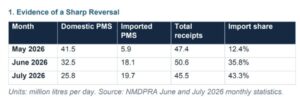
The import surge occurred alongside evidence of substantial domestic refining capability. Dangote Refinery reported a test run above 700,000 barrels per day in June, while NMDPRA had reported domestic refineries operating at 99.12% average capacity utilisation in April.
Nigeria’s seaborne petroleum-product exports have also risen strongly, indicating that aggregate refining capability is no longer the binding constraint it once was.
The Core Policy and Regulatory Concern
Imports should close gaps—not create displacement
A deregulated market does not imply regulatory indifference to the structure of supply.
The regulator must reconcile consumer protection and supply security with the PIA’s domestic-supply framework. Where domestic supply is genuinely adequate, import permits can suppress refinery offtake, weaken utilisation rates and transfer demand, income and employment abroad.
The burden of proof should be transparent
A credible supply-gap assessment should disclose projected demand, verified domestic production and inventory, committed refinery deliveries, product specifications, logistics constraints and the precise residual volume requiring imports.
Without this information, the market cannot determine whether permits address a real shortfall or merely expand import competition against available domestic output.
Regulatory commitment must be demonstrated in practice
NMDPRA’s mandate requires more than licensing and supply monitoring. It should create predictable rules that encourage investment across refining, storage, pipelines, marine logistics and distribution. Frequent or unexplained reversals in import policy increase uncertainty and raise the risk premium on downstream investment.
Why The Import Surge Matters
Foreign-exchange conservation
Every avoidable litre imported creates demand for foreign exchange for product cost, freight, insurance and associated charges. Domestic refining retains a larger share of value within Nigeria, even where some crude or specialised inputs are imported.
Jobs and domestic value chains
Refining supports direct technical employment and wider jobs in engineering, maintenance, fabrication, laboratories, haulage, storage, retail, maritime services and professional services. Imports transfer much of this multiplier abroad.
Industrialisation
Refining is a strategic anchor industry. It provides fuels and feedstocks for petrochemicals, plastics, fertiliser, pharmaceuticals, paints, packaging and other manufacturing chains. Policy that displaces viable domestic output contradicts Nigeria’s ambition to deepen industrial capacity.
Energy security
Domestic refining shortens supply chains and reduces exposure to shipping disruptions, geopolitical conflict, freight shocks and international product shortages. Diversification among several reliable domestic refiners would be more secure than either import dependence or single-refinery dependence.
Investment confidence
Refineries require large, patient and irreversible capital. If investors believe permits will admit imports irrespective of verified domestic availability, expected refinery utilisation and cash flow become less bankable.
This could delay expansions and discourage new modular and conventional refinery projects.
Fiscal and external resilience
Lower product imports can improve the trade balance, reduce pressure on reserves and strengthen the transmission of exchange-rate stability. Domestic firms also create taxable profits, payrolls and supplier activity.
4. A Balanced Policy Framework
Support for domestic refining should not become protection for inefficiency, monopoly pricing or poor service. The appropriate framework is “domestic supply first, competition always, imports only for verified gaps.” It should rest on five safeguards:
-Adequacy: refiners must demonstrate deliverable volumes—not merely nameplate capacity.
-Quality: all domestic and imported products must meet identical specifications.
-Competitive pricing: domestic supply should be benchmarked transparently to import-parity fundamentals, adjusted for avoided freight and domestic logistics.
-Plurality: policy should encourage several domestic refiners and prevent abuse of dominance.
-Consumer protection: emergency import windows should activate promptly when inventories or deliveries fall below published thresholds.
5. Recommended Regulatory Actions
1-Publish a monthly national supply-and-demand balance
NMDPRA should publish, by product, verified refinery output, domestic evacuation, inventories, consumption, exports, committed deliveries, imports landed and stock-sufficiency days.
2-Require a formal supply-gap determination
Before granting material import volumes, the Authority should publish the size, product, geography, quality specification, duration and evidence supporting the shortfall.
3-Offer domestic refiners a transparent right to respond
Qualified refiners should have a short, time-bound opportunity to commit supply against the identified gap. Unmet residual demand can then be allocated for importation.
4-Quantify and time-limit import permits
Permits should correspond to the verified residual gap, contain shipment windows and expire automatically. Open-ended or excessive approvals should be avoided.
5-Audit performance and enforce use-it-or-lose-it rules
Compare permitted, financed, shipped and landed volumes; cancel speculative permits; sanction misreporting; and prevent permit warehousing.
6-Apply equal standards and full transparency
Domestic and imported products should face equivalent quality, tax, levy and disclosure requirements. Publish permit beneficiaries, approved volumes and actual landings, subject only to legitimate commercial confidentiality.
7-Establish an emergency-import trigger
Define objective thresholds—such as minimum stock days, refinery outage duration or delivery failure—that permit accelerated imports without compromising normal domestic-supply discipline.
8-Secure crude supply for domestic refineries
Coordinate with NUPRC and producers to ensure credible domestic crude-supply obligations, commercially workable pricing and reliable delivery. Product-import restraint without feedstock security would be internally inconsistent.
9-Strengthen competition oversight
The Federal Consumer Protection and Competition Commission must be diligent in its regulatory oversight to curb monopolistic pricing tendencies and abuse of dominance power.
10-Adopt an industrialisation impact test
Major import-policy decisions should assess effects on refinery utilisation, employment, foreign exchange, investment pipelines, supplier development, consumer prices and energy security.
Conclusion
Nigeria has reached a point where downstream policy must shift decisively from managing chronic import dependence to building a competitive domestic refining ecosystem.
Allowing imports without a transparent, verified shortfall would squander an historic opportunity to conserve foreign exchange, create jobs, deepen industrial linkages and strengthen energy security.
The required policy is a rules-based regime in which efficient domestic production receives a fair opportunity to serve the Nigerian market, imports close only demonstrable gaps, consumers remain protected and competition is preserved.
The credibility of Nigeria’s industrialisation agenda will be judged partly by whether regulators align their day-to-day decisions with these national objectives.
DR Muda Yusuf is the CEO, Centre for the Promotion of Private Enterprise
X-@theGBJournal|email:gbj@govbusinessjournal.com|govandbusinessj@gmail.com
https//www.govbusinessjournal.com<Comments>Petrol Imports
The Centre for the Promotion of Private Enterprise [CPPE] believes that Petroleum-product imports should function as a transparent supply-gap instrument—not as a parallel market that displaces adequate domestic production.