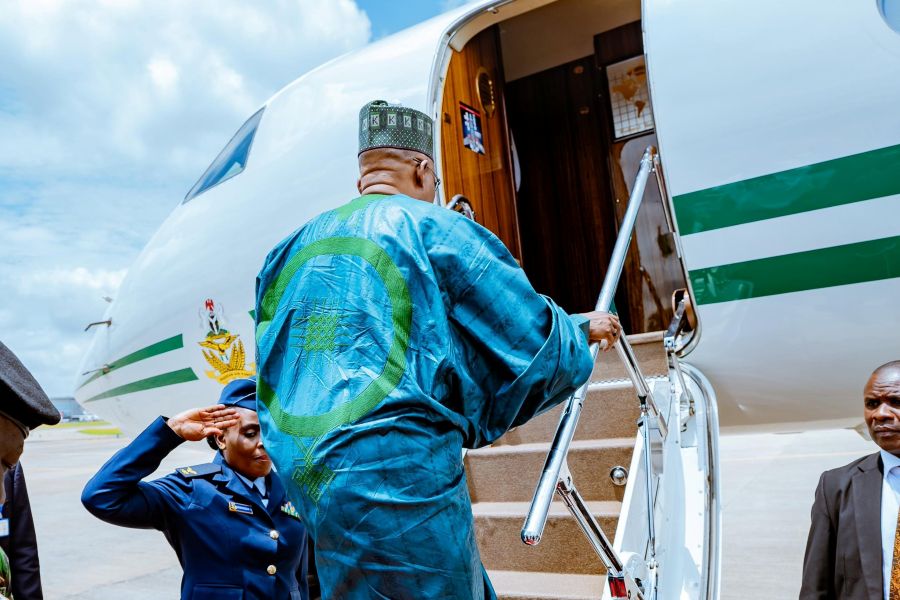

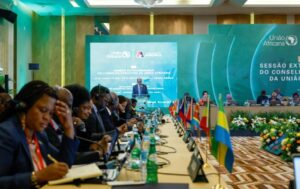
SAT AUG 29 2026-theGBJournal| Nigeria’s Vice President has departed for Angola to attend an African Union meeting on strengthening mechanisms for conflict prevention and resolution, as AU Commission Chairperson Mahmoud Ali Youssouf called for urgent reforms to address rising terrorism, violent extremism and political instability across the continent.
Senator Shettima will join African leaders and other key stakeholders converging on the Angolan capital to discuss practical solutions to regional security challenges and strengthen collective efforts towards conflict prevention and resolution.
Nigeria, which has continued to play a strategic role in peacebuilding and conflict resolution across Africa and beyond, is expected to contribute to deliberations on strengthening continental mechanisms for preventing conflicts, resolving disputes and sustaining peace.
The Vice President, who is accompanied by senior defence and security officials, will deliver President Tinubu’s address at the summit, outlining Nigeria’s position on the issues under consideration and reaffirming the country’s commitment to peace and stability across the continent.
Senator Shettima will return to Nigeria at the conclusion of his engagements in Angola.
Meanwhile, the African Union Commission Chairperson Mahmoud Ali Youssouf has called for urgent reforms to Africa’s peace and security architecture, warning that rising terrorism, violent extremism, internal conflicts and tensions between states are testing the continent’s ability to prevent and resolve crises.
Speaking at the 26th Extraordinary Session of the African Union Executive Council in Angola, Youssouf said African countries needed to strengthen early-warning systems, improve coordination among continental and regional institutions and reduce reliance on external funding for peace operations.
“Are we able to meet these challenges with the strategies, mechanisms and resources available?” Youssouf asked.
“Is the African architecture of peace and security suited to these circumstances? If the answer is no, then we need to move forward quickly on reforms.”
Youssouf said the session was taking place against a backdrop of a “fragile peace and security environment”, with terrorism and violent extremism increasing in several parts of the continent.
“In several regions, internal crises stand out due to their complexity, sometimes with high risks of expansion into neighboring countries,” he said. “Tensions between states are on the rise.”
He called for prevention and early-warning mechanisms to be strengthened through political engagement “at the highest level from the very first signs of a crisis”.
He also urged closer coordination between the African Union Commission, the AU Peace and Security Council, member states and regional economic communities.
“A holistic approach and pooling of resources are common sense in the fight against terrorism because the purely security-based approach has shown its limitations,” Youssouf said.
Dialogue alongside opposition to coups
Youssouf said the AU’s opposition to unconstitutional changes of government must remain firm, while stressing that such a position should be accompanied by dialogue.
“Firmness in the face of the unconstitutional change of government must remain the order of the day, but it also goes hand in hand with dialogue,” he said.
The remarks come as African governments continue to grapple with political instability, armed insurgencies and militant violence in several regions, placing renewed pressure on continental mechanisms designed to prevent and resolve conflicts.
Youssouf also called for changes to the financing of the AU’s “Silencing the Guns by 2030” agenda, saying the continent could no longer rely predominantly on external resources to fund its peace strategy.
“The funding of our peace strategy (silencing the guns by 2030) can no longer depend on external resources,” he said.
“We will need to rethink the functioning of the Peace Fund, raise its ceiling and at the same time put pressure on Security Council Resolution 2719.”
Implementation remains a challenge
Youssouf said the AU Executive Council and Peace and Security Council regularly take important decisions, but implementation remains a major weakness.
“Their implementation faces undeniable challenges,” he said, calling for a monitoring and evaluation matrix to track decisions and their outcomes.
“Accountability, progress made, and adjustments must be the constants of this mechanism,” he said, adding that the African Union Commission would “assume its share of responsibility”.
He said political will remained essential to ensuring that continental peace initiatives produced tangible results.
“It represents the essential condition for all effectiveness and efficiency,” Youssouf said.
The AU Commission chairperson identified four priorities for strengthening the continent’s peace efforts: prevention, coordination, financing, and monitoring and evaluation.
External shocks raise risks
Youssouf also warned that conflicts and geopolitical tensions beyond Africa were aggravating the continent’s own security challenges.
“It goes without saying that the environment of peace and security on the continent is severely impacted by exogenous shocks,” he said.
“External interference and conflicts around the world exacerbate our own difficulties.”
He urged African governments to increase vigilance and solidarity among member states while paying closer attention to changes in international geopolitics.
“I would invite you to pay particular attention to this turbulent international geopolitics and how to raise our level of preparedness for its consequences,” he said.
Youssouf expressed confidence that the deliberations in Luanda would help advance reforms and strengthen Africa’s collective resolve to change the current security landscape.
“I am convinced that your deliberations will advance this reflection and our shared determination to change the status quo,” he said.
The AU Commission chairperson opened his remarks by thanking the Angolan government and people for their welcome and commending Angola’s commitment to peace on the continent.
Convened under the leadership of H.E João Manuel Gonçalves Lourenço, President of the Republic of Angola and AU Champion for Peace and Reconciliation in Africa, the Summit will provide an opportunity for Heads of State and Government to undertake a strategic assessment of the effectiveness of existing continental mechanisms for conflict prevention and resolution.
X-@theGBJournal|email:gbj@govbusinessjournal.com|govandbusinessj@gmail.com