
…I consider myself quite privileged to be one of those seeking your mandate to deal with these challenges facing our country.
…I enter this contest with one firm conviction: Nigeria can work, and Nigeria must work.
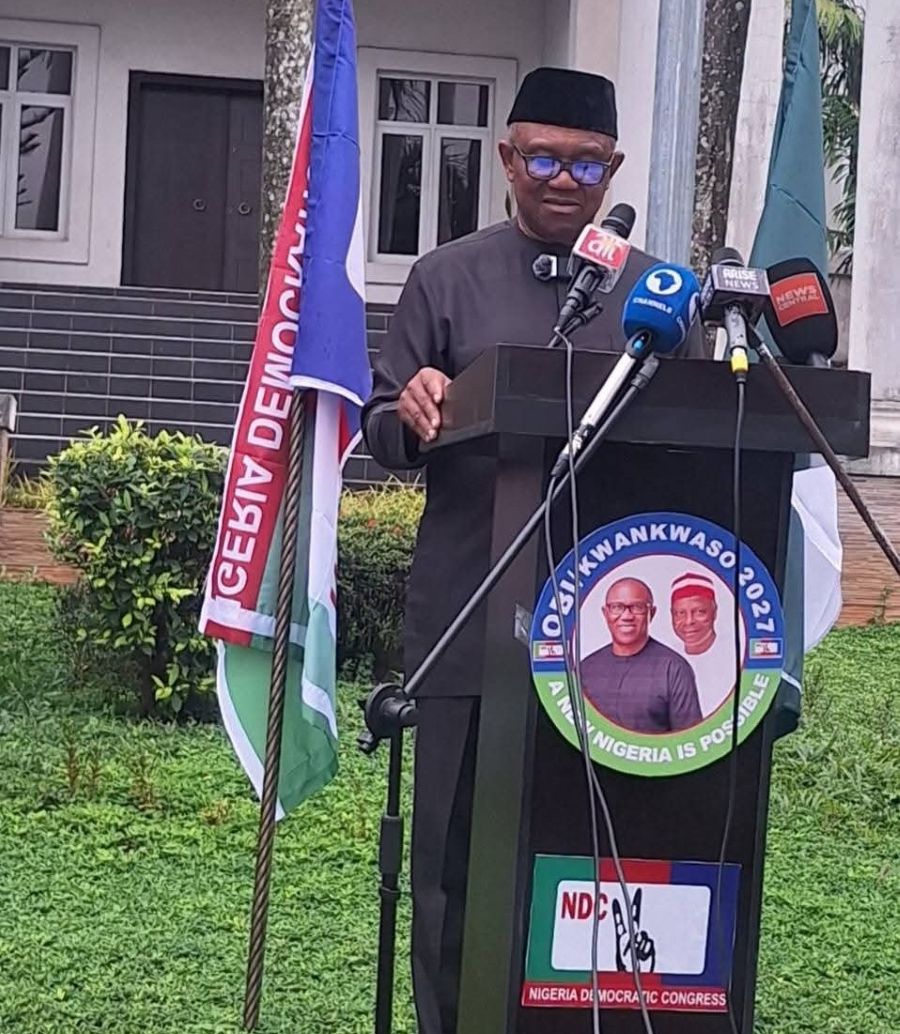
FRI AUG 21 2026-theGBJournal| Former Anambra governor Peter Obi and Presidential candidate for the Nigeria Democratic Congress (NDC) on Friday formally entered Nigeria’s 2027 presidential race, pledging to build an economy that delivers security, jobs and shared prosperity as the country grapples with poverty, insecurity, weak infrastructure and rising living costs.
In an address marking the start of the presidential and National Assembly campaign period, Obi said the election would give Nigerians a chance to judge the records and plans of those seeking power, insisting that “Nigeria can work, and Nigeria must work.”
He cited widespread poverty, food insecurity, displacement and limited opportunities for young people as evidence of the scale of the challenge, while presenting his record in Anambra and that of his running-mate, Senator Rabiu Musa Kwankwaso, as experience that could underpin a more disciplined and results-driven approach to government.
Full text of speech
Dear Compatriots,
Members of the Press,
Distinguished ladies and gentlemen,
Wednesday, 19 August 2026, marked the official start of the campaign period for the 2027 Presidential and National Assembly elections.
There is no doubt that this is a defining moment for our democracy. This moment gives Nigerians the opportunity to assess the records, ideas, and plans of those seeking their mandate to lead their country at a time of grave uncertainty in our rapidly changing world.
I consider myself quite privileged to be one of those seeking your mandate to deal with these challenges facing our country.
I enter this contest with one firm conviction: Nigeria can work, and Nigeria must work.
Nigeria faces several serious challenges. Some of them are indeed of existential proportions.
According to the IMF, 63%, or over 140 million Nigerians, live at or below the national poverty line, while humanitarian agencies estimate that 35 million people will need food assistance during the 2026 lean season.
About 3.6 million Nigerians remain internally displaced, largely because of conflict and insecurity. Each year, millions of young people enter the labour market, yet too many struggle to find productive opportunities.
Weak infrastructure, unreliable power, insecurity, and the excessive cost of doing business continue to burden households and constrain enterprise.
These are more than statistics. They reflect the daily realities of Nigerian families, farmers, workers, students, and businesses.
Yet I do not believe Nigeria lacks the ability to overcome these challenges. We have the people, resources, market, talent, and enterprise. What we must do now is turn these strengths into security, productivity, and shared prosperity.
LEADERSHIP MUST DELIVER RESULTS
My successful private-sector experience, studies in institutions of repute on policy and business matters, and my service as Governor of Anambra State have shaped my understanding of public leadership. Government must manage resources responsibly, set clear priorities, and measure the outcomes of its decisions. Public office is not a reward; it is a responsibility to the people.
In Anambra, I prioritised the foundations of long-term development: education, healthcare, infrastructure, fiscal discipline, and institutional capacity. I do not present that record as perfect, but as an experience from which Nigerians can draw their own conclusions.
Senator Rabiu Musa Kwankwaso brings a different but complementary governing experience.
As Governor of Kano State, he focused strongly on education, technical training, scholarships, infrastructure, and human-capital development. His administration’s investments in education and skills showed an understanding that the people are a state’s most important long-term resource.
Our experiences are different, but our conclusion is the same: Nigeria must invest in its people and manage public resources with discipline.
BUILDING AN ECONOMY THAT WORKS
Nigeria needs more than reactive reforms. We must focus on the questions that matter:
Are Nigerians better off than they were four years ago? Can they afford food, education, and healthcare? Can businesses produce, expand, and create jobs? Can young people find productive work? Can farmers work safely and get their produce to market?
X-@theGBJournal|email:gbj@govbusinessjournal.com|govandbusinessj@gmail.com