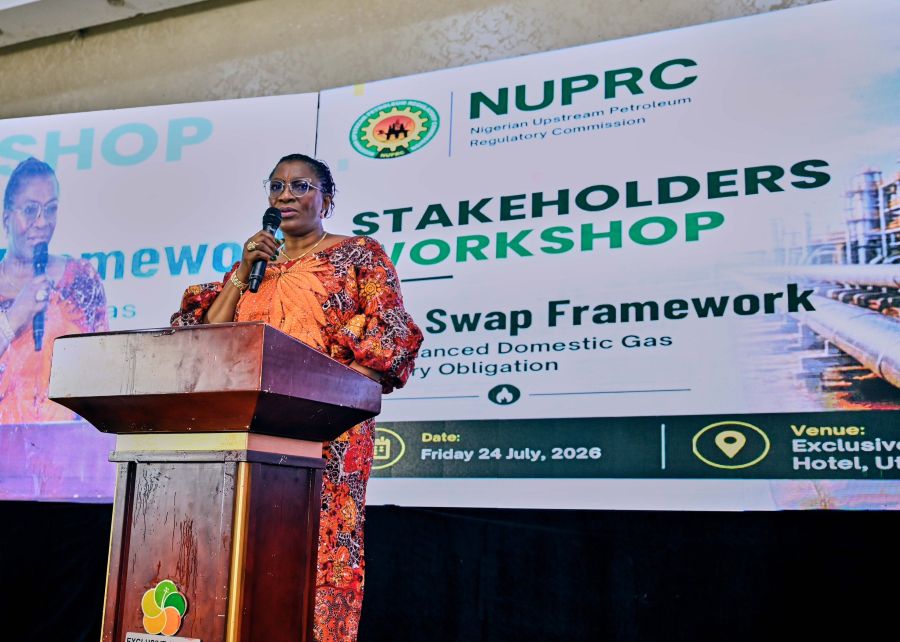

MON AUG 03 2026-theGBJournal| Nigeria’s average Domestic Gas Delivery Obligations performance rose to 2.05 billion cubic feet (Bcf) daily year-to-date ending June 2026, the Commission Chief Executive of the NUPRC, Mrs. Oritsemeyiwa Eyesan, has said.
The comparable average domestic gas delivery for the period January to June 2025 was 1.92 Bcf/d, while the corresponding figure for January to June 2026 increased to 2.05 Bcf/d.
This represents an increase of approximately 0.13 Bcf/d, equivalent to a 6.8% growth in domestic gas deliveries.
The CCE disclosed this at the recently concluded stakeholders’ workshop on Gas Swap Framework for Domestic Gas Delivery Obligation (DGDO), held in Abuja.
The workshop was arganised to deepen stakeholders understanding of the proposed Gas Swap Framework as a practical mechanism to support compliance to DGDO and obtain stakeholders input.
In her keynote address, the NUPRC boss emphaised that the DGDO remains one of the most important instrument for ensuring that gas produced in Nigeria supports the Nigerian economy.
The CCE, in her update, disclosed that out of about 63 producing companies, 27 were allocated DGDO, but only 23 of those allottees were actively supplying gas to domestic customers.
Eyesan revealed further that over the same period, average domestic gas delivery stood at 2.05 Bcf/d against 7CI DGDO allocation of 3.16 Bcf/d, representing about 65% performance.
She said the, ”the YTD June 2026 data, however, shows that a broader allocation base does not automatically translate into actual delivery. This delivery gap underscores the need for practical, innovative, and market-responsive solutions that protect the integrity of the obligation while enabling real physical delivery of gas to domestic users. It is in this context that the proposed Gas Swap Framework becomes especially important”
The Commission boss maintained that the Gas Swap Framework provides a practical ways for operators whose gas is stranded or difficult to evacuate to still meet their domestic deliver gas where it is needed
She added, “with the right commitment and implementation, the framework will help turn obligation into actual supply, make better use of existing assets, support gas-to-power delivery, and build greater confidence in Nigeria’s domestic gas market.”
Journal|email:gbj@govbusinessjournal.com|govandbusinessj@gmail.com