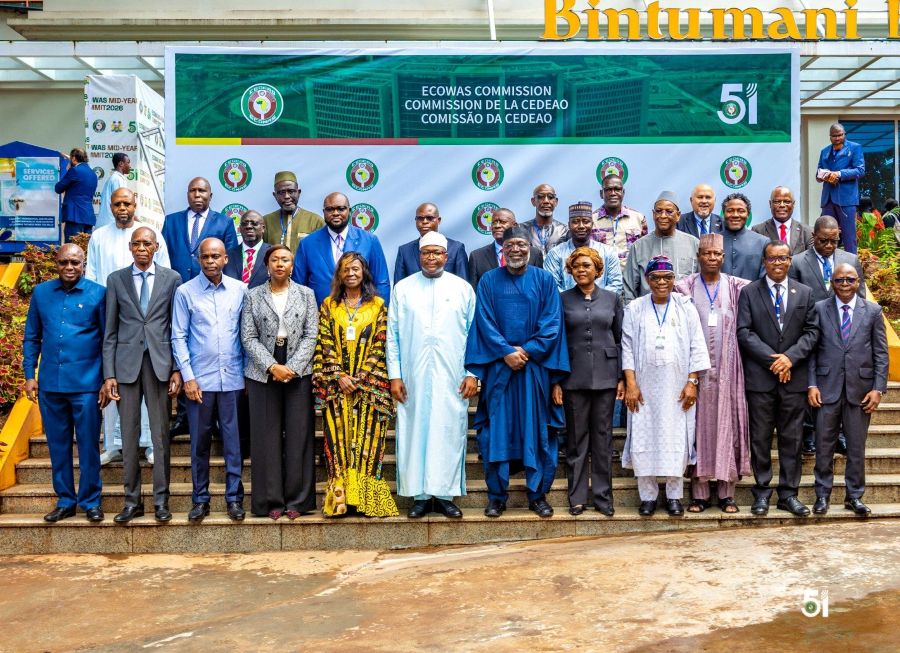

SAT JULY 18 2026-theGBJournal| ECOWAS Council of Ministers gathered in Sierra Leone this week as the 15-member regional bloc grapples with persistent violent extremism, political instability, climate-related pressures and rising unemployment.
The Meeting served as a precursor to the summit of the ECOWAS Authority of Heads of State and Government scheduled for July 19.
Over the two-day session, ministers reviewed the Community’s financial position and examined memoranda covering the security and political situation across the region, reflecting growing concern over conflicts that continue to threaten stability and economic development in West Africa.
The Council also considered an action plan for 2027–2030 on the return of cultural property to their countries of origin, underscoring renewed efforts to preserve the region’s heritage and advance restitution initiatives.
Ministers further discussed the operationalisation of the ECOWAS-ECOSOCC framework, aimed at strengthening engagement between the regional organisation and civil society.
The deliberations are expected to shape recommendations for regional leaders as ECOWAS seeks to bolster cooperation on security, governance and economic integration while navigating the geopolitical and developmental challenges confronting West Africa.
The departure of Burkina Faso, Mali and Niger from ECOWAS still dominates discussions in the region because it represents the most serious institutional crisis in the bloc’s 50-year history.
Their withdrawal, following military coups and the formation of the Alliance of Sahel States (AES), has fundamentally altered West Africa’s political and security landscape, weakening one of Africa’s most established regional organisations.
The exit of the three junta-led states has stripped ECOWAS of roughly 76 million people and a vast geographical area stretching across the central Sahel.
More significantly, it has exposed divisions over how the bloc responds to unconstitutional changes of government.
ECOWAS initially adopted a hardline stance after the coups in Mali (2020 and 2021), Burkina Faso (2022) and Niger (2023), imposing sanctions and, in Niger’s case, even threatening military intervention.
Rather than restoring constitutional rule, however, the measures accelerated political estrangement, with the three countries accusing ECOWAS of acting under external influence before formally withdrawing and creating the Alliance of Sahel States (AES).
For ECOWAS leaders, the challenge is now twofold: preserving the bloc’s credibility while preventing the political split from becoming a permanent economic and security fracture.
The regional divide comes as militant violence linked to Islamic State and al-Qaeda affiliates spreads beyond the Sahel into coastal West Africa.
Burkina Faso, Mali and Niger remain the epicentre of insurgent activity, but attacks have increasingly spilled into Benin, Togo and northern Ghana, while Nigeria continues to battle Boko Haram and Islamic State West Africa Province (ISWAP) in the northeast and expanding banditry in the northwest.
Analysts warn that fragmented regional security cooperation risks creating operational gaps that extremist groups could exploit.
Intelligence sharing, joint border patrols and coordinated military operations have become more difficult as relations between ECOWAS and the AES have deteriorated.
The growing insecurity has also fuelled humanitarian crises, displaced millions of people, disrupted agriculture and trade, and intensified food insecurity across West Africa.
The split also carries significant economic implications.
The three landlocked Sahel countries rely heavily on transport corridors through ECOWAS members such as Côte d’Ivoire, Ghana, Togo, Benin and Senegal to access international markets.
While both ECOWAS and AES leaders have expressed a desire to maintain free movement of people and goods, uncertainty remains over customs arrangements, regional investment, migration policies and implementation of trade protocols.
Businesses are increasingly concerned that prolonged political tensions could discourage investment and raise logistics costs across the region.
While no dramatic breakthrough is expected, the meeting is likely to lay the groundwork for a more pragmatic ECOWAS strategy centred on engagement rather than confrontation.
The Freetown meeting therefore represents more than a routine ministerial gathering.
It is an opportunity for ECOWAS to demonstrate that it can adapt to a rapidly changing geopolitical landscape while remaining the principal platform for regional cooperation in West Africa.
X-@theGBJournal|Facebook-the Government and Business Journal|email:gbj@govbusinessjournal.com|govandbusinessj@gmail.com