
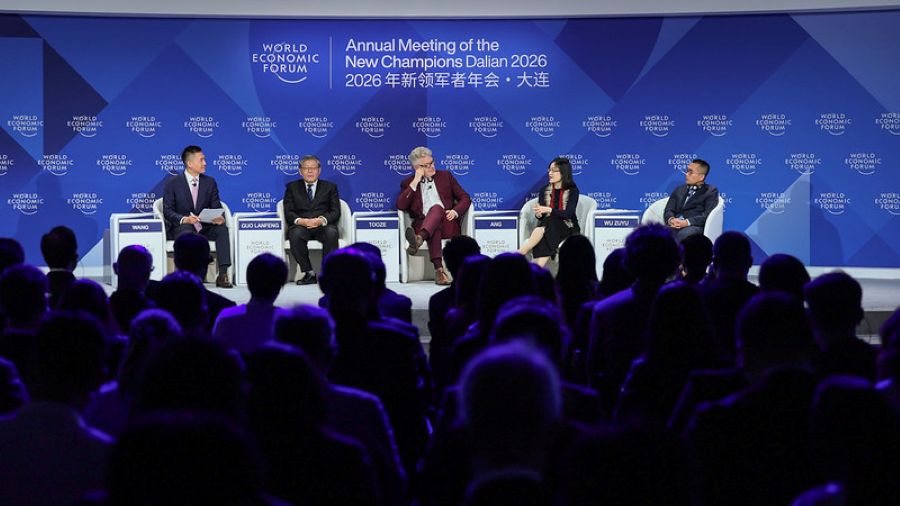

…Panelists say the China’s 15th Five-Year Plan (2026–2030) prioritises innovation, consumption, industrial upgrading, green energy and continued opening to the world.
…Session speakers describe a shift towards high-quality growth, with stronger domestic consumption central to a more balanced model.
THUR JUNE 25 2026-theGBJournal| China’s 15th Five-Year Plan aims to help shape the country’s next phase of development, with priorities spanning innovation, domestic consumption, industrial upgrading, green energy and continued opening to the global economy, distinguished speakers said today at the World Economic Forum’s 17th Annual Meeting of the New Champions.
The session titled 15th Five-Year Plan, Unpacked, explored how China’s next planning cycle, covering 2026–2030, could guide economic growth at a time of rapid technological change, demographic shifts and evolving global supply chains. Speakers explained that the plan should be understood not only as an economic framework, but also as a signal of policy direction for business, investors and international partners.
Guo Lanfeng, President, China Society of Economic Reform, said China would continue to centre its work on economic development, with quality development, reform and innovation as key drivers.
He identified three areas requiring sustained attention: consolidating the foundations of growth, responding to demographic change and adapting to a complex international environment. China’s advantages, he said, include its large market, comprehensive industrial system, innovation capacity and commitment to reform and opening-up.
Adam Tooze, Director, European Institute, Columbia University, reflected on the level of international attention the planning cycle had drawn. “Here we are in 2026 discussing the 15th Five-Year Plan of the People’s Republic of China – and that is not how many of us expected the 21st century to work out,” he said, adding that he could not recall a five-year plan watched as closely as this one.
He described China’s five-year plans as evolving instruments of governance rather than static planning documents, and said the country’s industrial development and export strength would remain closely watched by the rest of the world.
Yuen Yuen Ang, Alfred Chandler Chair of Political Economy, Johns Hopkins University, framed the 14th and 15th Five-Year Plans as part of China’s transition from an earlier growth model based on investment, exports and construction towards one focused on high-quality growth.
She said China is seeking to strengthen “0 to 1” foundational innovation while also ensuring that innovation supports employment, commercialization and domestic consumption.
Wu Zuyu, Chairman, HiTHIUM, said new energy storage is entering an accelerated phase of development, moving from policy-driven growth towards market-driven expansion. He said falling costs in solar, wind and energy storage could make green power increasingly competitive over the coming five years, while contributing to energy security and the wider green transition.
Speakers also discussed the importance of domestic demand in China’s next development phase. Guo said boosting household consumption requires higher-quality employment, stronger social protection, broader channels for household income and a better consumer environment.
“If we really want to stimulate household consumption, we first need to ensure people have money to spend,” he said. Ang added that stronger domestic demand would help absorb China’s advanced manufacturing capacity and support a more balanced growth model.
The panel also considered how Chinese companies can expand internationally while deepening local partnerships. Wu said companies with competitive advantages will need to build more localized operations, cooperate with partners abroad and contribute to host-country development.
“Cooperation holds the key,” he said. Guo said China’s opening-up would continue to adapt to changing global conditions, combining inward and outward flows of investment, technology and enterprise.
The discussion reflected the Annual Meeting of the New Champions`s 2026 theme, “Innovating at Scale”, by focusing on how innovation can be translated into broad-based growth, industrial transformation and new opportunities for cooperation.
X-@theGBJournal|Facebook-the Government and Business Journal|email:gbj@govbusinessjournal.com|govandbusinessj@gmail.com