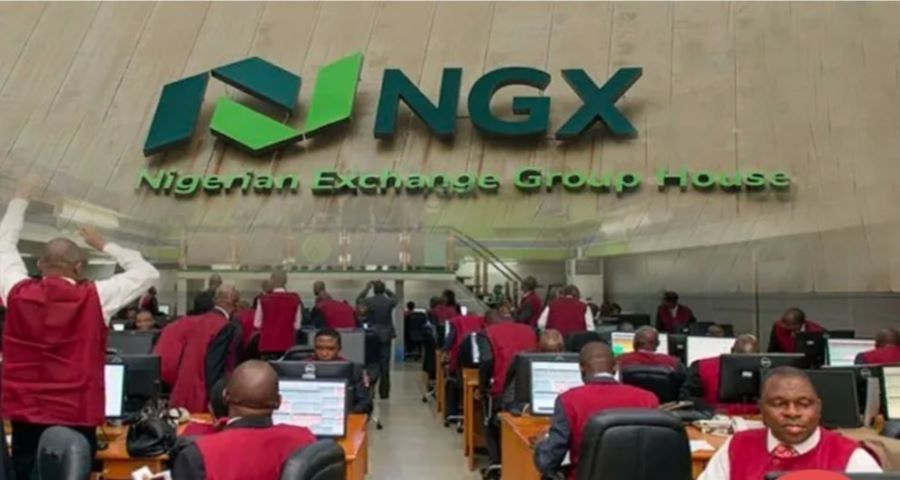

MON MAY 18 2026-theGBJournal| Nigerian equities market fell on Monday as investors sold positions in key heavyweight stocks, while in contrast the naira firmed against the U.S. dollar which struggled against a range of major currencies.
The NGX All-Share Index (ASI) ended the day 1bp down to 250,311.33 points, dragging overall market capitalization marginally down to N160.362 trillion from last Friday’s tops of N160.44 trillion.
Sell pressures were seen in SEPLAT (-1.0%), WAPCO (-0.6%) and DANGSUGAR (-2.8%) stocks which offset demand for OANDO (+10.0%), TRANSCORP (+2.2%), and ZENITHBANK (+0.8%).
As a result, the All-Share Index declined by 1bp to 250,311.33 points, causing the Month-to-Date and Year-to-Date returns to moderate to 3.3% and +60.9%, respectively.
The total volume traded declined by 26.2% to 800.37 million units, valued at N37.02 billion, and exchanged in 86,934 deals.
UBA was the most traded stock by volume at 64.97 million units, while ARADEL was the most traded stock by value at NGN6.15 billion.
On Sectors, the Consumer Goods (-0.3%), Insurance (-0.2%) and Industrial Goods (-0.1%) indices declined while the Oil and Gas (+0.4%) and Banking (+0.2%) indices closed higher.
As measured by market breadth, market sentiment was negative (0.9x), as 32 tickers gained relative to 36 losers. NCR (-10.0%) and ZICHIS (-10.0%) led the laggards, while OANDO (+10.0%) and UPL (+10.0%) recorded the most significant gains of the day.
At the currency market, the official FX rate rose 0.1% to NGN1,371.25/USD.
Meanwhile, Nigeria’s external reserves sustained their upward trajectory from last week, rising further by 0.06% to $48.57 billion. The continued increase in reserves was largely supported by improved foreign exchange inflows and renewed investor confidence driven by ongoing monetary and FX market reforms by the Central Bank of Nigeria.
Meanwhile, The week opened with an improvement in system liquidity, which settled at a net negative position of ₦3.32 trillion. This development eased funding conditions among banks, leading to a 10bps decline in the Overnight (O/N) rate.
Meanwhile, in fixed income market, the Nigerian Overnight Financing Rate (NOFR) and the Open Repo Rate remained unchanged at 22.00%.
In the FGN bond market, trading was mixed, with the average yield closing marginally higher at 16.12%, compared to 16.11% at the end of the previous week.
The NTB market sustained its mild bullish sentiment. Yields at the short end declined by 2bps, while the mid and long ends recorded dips of 1 basis point and 3bps, respectively. Overall, the average yield inched 2.1bps lower to close at 17.44%, down from 17.47%.
Nigeria’s Eurobonds continued its bearish trajectory, with the average yield rising marginally by 2.1bps to close at 6.97%, up from 6.95%.
Across global markets, investor sentiment remained pessimistic, driven by rising inflationary pressures following higher-than-expected core and headline inflation prints in the United States.
Consequently, longer-dated U.S. Treasury yields surged as markets priced in expectations of tighter monetary policy.
X-@theGBJournal|Facebook-the Government and Business Journal|email:gbj@govbusinessjournal.com|govandbusinessj@gmail.com