
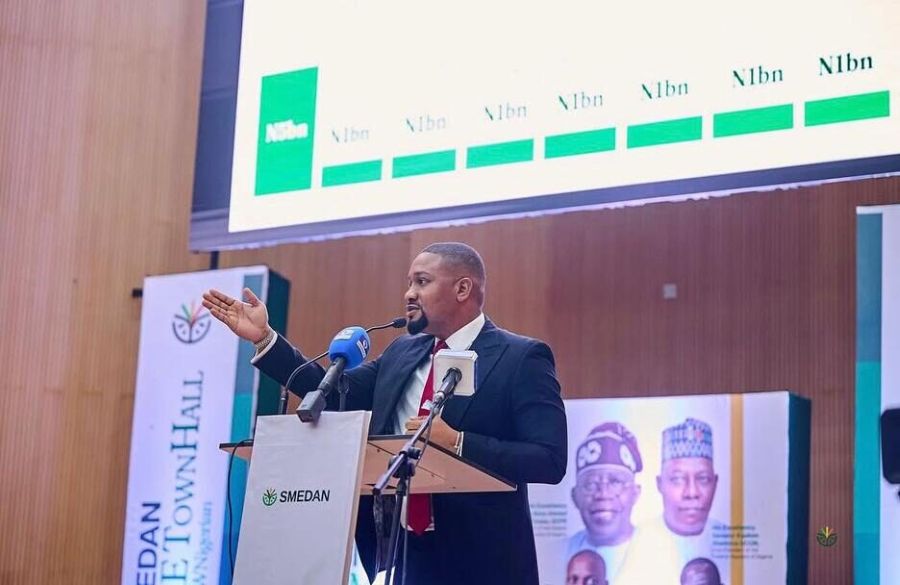

…With small businesses accounting for 96% of all businesses in Nigeria and employing almost 85% of the workforce, they are the backbone of the country’s economy.
…Despite their high numbers, Nigerian small and medium-sized enterprises (SMEs) face numerous challenges, which leads over 50% of them to give up their endeavours after one year and 95% within five years, with limited access to finance being one of their biggest hurdles to overcome.
…The Small and Medium Enterprises Development Agency of Nigeria (SMEDAN) has been mandated by the government to change that – offering not only mediation services with financial institutions but also offering capital themselves.
…Evelyn Seltier of Trade Forum talked with SMEDAN’s Director General Charles Odii to find out how the agency’s approach will help unlock millions of US dollars for SMEs.
WED MAY 13 2026-theGBJournal| Q: For more than 20 years, SMEDAN has been actively working to support SMEs, and recently has placed an even stronger focus on addressing their finance gap. What does this imply?
We are mandated by the Nigerian Government to strengthen local businesses, which includes improving access to finance and fostering innovation. We help to create jobs and industrialize rural areas, all while acting as a mediator between small businesses and enterprises. We are also mandated to provide financing for businesses inside and outside of Nigeria.
We make sure that access to finance is more widely available: First, we unlock finance from financial institutions, and second, we also provide financing for businesses themselves. Capital for any start-up is very expensive; we help with accessibility and affordability, for instance by offering single-digit interest loans.
We are very grateful for the President. He offered N200 billion ($145 million) for enterprises in Nigeria at single interest rates for small businesses, with N50 billion ($37 million) provided as grants for nano businesses (businesses with less than three entrepreneurs).
Moreover, we are negotiating with different stakeholders to match our fund agreements, which so far has unlocked another N12 billion (over $8 million) in funding – for example, we signed a partnership agreement with Sterling Bank for over N5 billion (over $3 million).
Q: You offer various loan schemes, including schemes with a focus on women. What is your most successful plan in terms of the impact you have seen?
The most successful plan has been building the capacity of women before they even ask to access finance.
The “GROW” programme facilitates this: G stands for guidance, as we provide expert advice and mentorship. R stands for resources as we equip SMEs with tools, funding, technology and the necessary infrastructure for their operations. O stands for opportunities, creating platforms, networks and market access. And finally, W stands for workforce support, as we offer training and resources to build the skills of the businesses’ employees.
Our guidance for women has had tremendous success. It is a phenomenal programme because we increase the women’s capacity to unlock finance themselves.
The training asks them to provide a business plan, which they can pitch during one of our competitions and win up to N10 million (over $7,000) to grow their business. I even know of someone who received our training and then went ahead herself to find an investor, unlocking N40 million (almost $29,000) in finance.
The most effective approach is to provide training first before introducing entrepreneurs to potential funders. Of course, we also support experienced businesses, bust most are nano businesses so they are just starting out.
Beyond that, the businesses are becoming wiser over time, turning their ideas into sustainable business operations, and then they don’t need our funding anymore.
Q: What more needs to be done to create a systemic shift that resolves the market failures that contribute to limited access to finance for SMEs?
For me, this would be capacity building. When you go to the banks, they have the funding, but it is a challenge for firms to then receive that funding. To counter that, we have developed a curriculum which will revolutionize financing, of that I am sure: The Inspire, Create, Start, and Scale (ICSS) curriculum, supported by GIZ, equips Nigerian entrepreneurs with skills to structure businesses and access single-digit loans (N250,000–N5 million).
It attacks the problem head-on: it focuses on business plan development, cash flow management, and financial literacy to bridge the gap between their capacity and financing requirements. Currently 6,000 entrepreneurs are joining this programme.
Q: What do partnerships mean for your success?
There are 40 million small businesses in Nigeria if you count the informal economy. And we have barely 400 employees at SMEDAN. We can’t do it alone.
Our arms are always open. We are not only looking for financial partnerships. Technical partnerships that can help look at policies to serve the ecosystem are important too, as are market partnerships that amplify our eyes and ears, execution partnerships and partnerships for monitoring and evaluation.
We appreciate, for instance, any guidance that ITC can give small businesses so they can better compete with others within and outside of the country, from standards to exports, and identifying value chains that we want to support.
Q: What are your lessons learned so far?
So far, what has worked very well for us was cooperative lending: we map out a group of small businesses and clusters, and once they are ready for a cooperative, we give them zero-interest loans and financing.
They can use those grants to increase their working capital to trade or procure work spaces or buy tools. We would like to scale this approach and expand it across the African Continental Free Trade Area, with the support of other SME agencies across the continent.
Q: Which long-term goals do you have when it comes to financing SMEs?
Since I accepted this post a couple of years ago, we have raised N500 billion in investment raised from development enablers, financial institutions and our government. Currently N150 billion (around $109 million) are allocated in equity funding for SMEs in Nigeria, and it is our goal to allocate N800 billion (over $577 million) to high-potential business.
Also, by Q1 of 2027 I hope that we will have linked 350,000 SMEs directly to various financing opportunities; formalized another 250,000 informal businesses (which includes migrants and returnees); established a micro-finance institution to directly disburse funds to small businesses, especially cooperatives; and a portfolio of partners that give loans to SMEs worth over N150 billion.
These are high targets and I know that we can achieve them. The International Finance Corporation estimates that Nigerian SMEs face a significant financing gap of over $32 trillion (and that figure is from a few years ago so it might be higher by now).
These numbers might sound intimidating, but I know that SMEDAN is set to help small businesses with enough funding so they can build sustainable futures for themselves.-
NOTE: This article was originally published by the International Trade Centre
X-@theGBJournal|Facebook-the Government and Business Journal|email:gbj@govbusinessjournal.com|govandbusinessj@gmail.com