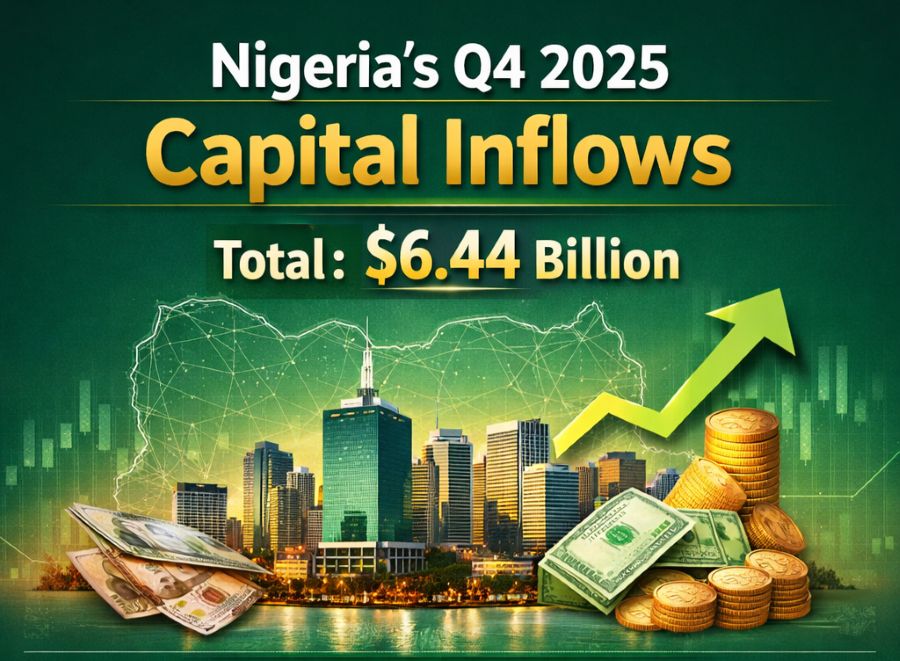

FRI MAR 27 2026-theGBJournal| Nigeria recorded a strong bounce in capital inflows in the fourth quarter of 2025, with total importation rising to $6.44 billion, marking a 26.61% year-on-year increase from $5.09 billion posted in the same period of 2024.
The uptick underscores renewed investor interest in Africa’s largest economy, amid improving macroeconomic signals and policy adjustments aimed at stabilising the financial system.
On a quarter-on-quarter basis, capital importation also advanced by 7.13% from $6.01 billion in Q3 2025, suggesting sustained momentum in foreign inflows despite lingering global uncertainties.
The steady rise reflects a combination of attractive yields in Nigeria’s fixed income market and gradual confidence rebuilding among offshore investors.
A breakdown of the inflows shows that Portfolio Investment overwhelmingly dominated, accounting for $5.49 billion or 85.14% of total capital importation.
This highlights a continued preference for short-term financial instruments, as investors seek to capitalise on high returns while remaining cautious about long-term commitments.
In contrast, Other Investments contributed $599.65 million (9.31%), while Foreign Direct Investment lagged significantly at $357.80 million, representing just 5.55% of total inflows.
The subdued FDI performance points to persistent structural challenges, reinforcing concerns about the economy’s ability to attract stable, long-term capital needed to drive sustainable growth.
In terms of distribution by sector, the Banking sector recorded the highest inflow with US$3,850.14 million, representing 59.75% of total capital imported in Q4 2025, followed by the Financing sector, valued at US$1,942.44 million (30.15%), and the Production/Manufacturing sector with US$308.93 million (4.79%).
Capital Importation during the reference period originated largely from the United Kingdom with US$3,733.37 million, representing 57.94% of the total capital imported.
This was followed by the United States with US$837.91 million (13.00%) and the Republic of South Africa with US$516.96 million (8.02%).
In addition, Stanbic IBTC Bank Plc received the highest capital importation during the reference period with US$2,228.34 million (34.58%), followed by Standard Chartered Bank Nigeria Ltd with US$1,852.43 million (28.75%), and CitiBank Nigeria Ltd with US$840.72 million (13.05%).
X-@theGBJournal|Facebook-the Government and Business Journal|email:gbj@govbusinessjournal.com|govandbusinessj@gmail.com