

By theG&BJounal
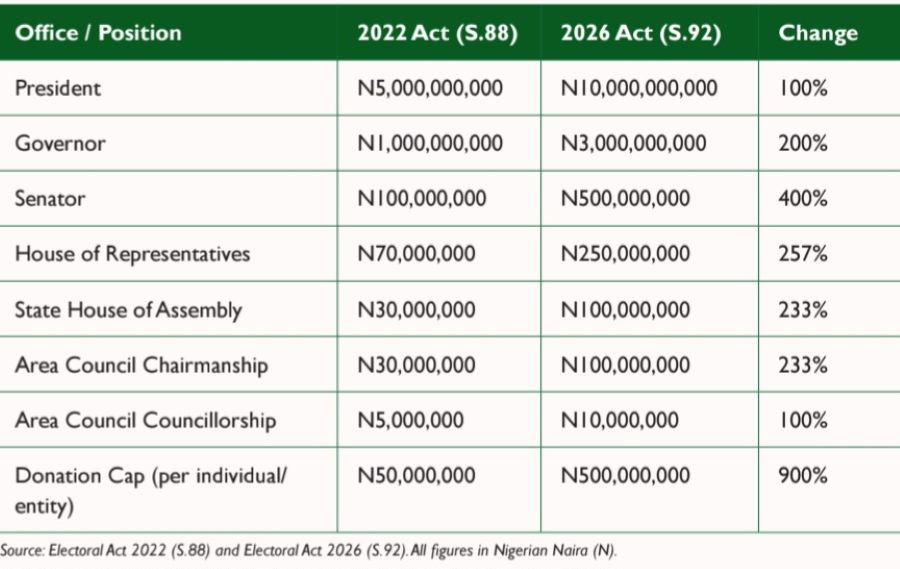
MON FEB 23 2026-theGBJournal| The Policy and Legal Advocacy Centre (PLAC) has reported that Nigeria’s Electoral Act 2026 has significantly driven up campaign spending, with projected costs soaring by as much as 400 percent compared to previous election cycles.
The report paints a sobering picture of the financial demands now placed on political parties and candidates as they prepare for upcoming polls.
The most consequential changes, PLAC says, are the increased spending limits across all elective offices, ranging from 100% to 400%, and a tenfold rise in the individual donation cap, from N50 million to N500 million.
”The donation cap has risen 900%, changes that go well beyond inflation adjustment,” PLAC said in its latest report: Campaign Finance and Spending Limits Under the Electoral Act 2026.
PLAC adds that the tenfold increase in the individual donation cap (from N50 million to N500 million) significantly increases the influence of donors on candidates.
”Without robust enforcement of disclosure requirements under Section 93, this risks accelerating the monetisation of elections under a veneer of legality.”
According to PLAC, revised compliance requirements, expanded campaign structures, and heightened media engagement obligations are among the key drivers behind the sharp rise in expenditure.
The group notes that while the reforms were designed to strengthen transparency and accountability, they have also introduced new layers of operational and financial complexity for political actors.
PLAC argues that without stronger enforcement of spending limits and clearer monitoring mechanisms, the new law risks deepening inequality in Nigeria’s electoral process rather than promoting fairer competition.
According to PLAC, the increments have been framed within the context of naira depreciation and current economic realities.
”However, they significantly outpace inflation and raise concerns about structural barriers for grassroots candidates, including women, youth and persons living with disabilities (PWDs), and the growing role of elite financial networks in political competition.
This will increase the reliance of candidates on spend, rather than ideological positions to generate support and contributes to the continued monetisation of Nigerian elections.
Beyond candidate access, higher spending limits may contribute to inflationary and foreign exchange pressures ahead of the 2027 elections. Collectively, these changes suggest a system in which financial capacity could increasingly shape electoral outcomes, while expanding the risk of vote-buying.”
Stakeholders are already warning that the spike in campaign costs could narrow the political playing field, tilting advantage toward well-funded candidates and established parties.
X-@theGBJournal|Facebook-the Government and Business Journal|email:gbj@govbusinessjournal.com|govandbusinessj@gmail.com