

…The rebound signals that policy stabilisation efforts are beginning to influence investor behaviour positively
…However, the structure of inflows — heavily portfolio-driven, financially concentrated, and weakly linked to productive sectors — underscores the need for urgent structural reforms
By CPPE
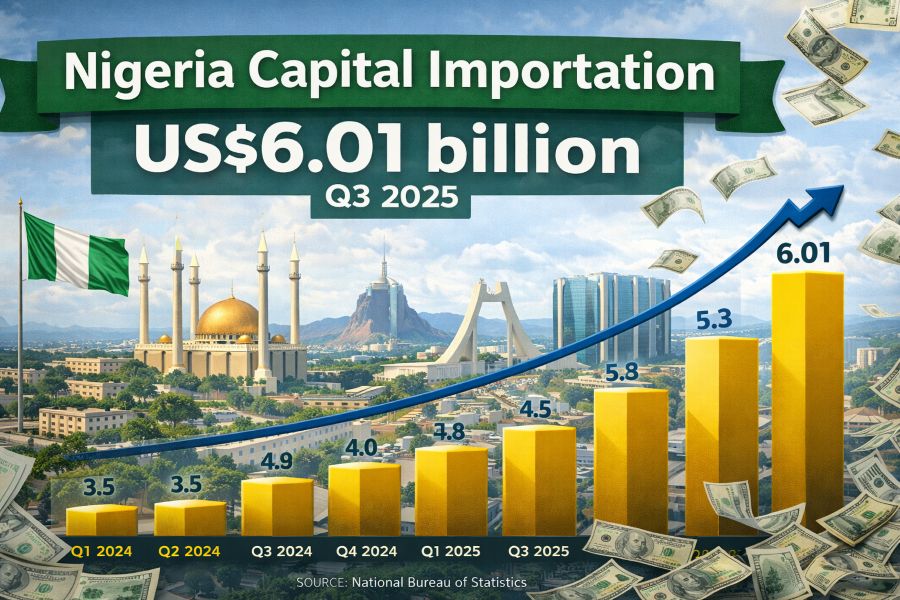
MON FEB 23 2026-theGBJournal| The Centre for the Promotion of Private Enterprise (CPPE) notes the significant rebound in Nigeria’s capital importation in the third quarter of 2025. Total inflows rose to US$6.01 billion, representing a remarkable 380 percent year-on-year increase and a 17 percent quarter-on-quarter growth.
This development reflects a gradual restoration of investor confidence following recent macroeconomic reforms — particularly foreign-exchange market liberalisation, tighter monetary policy, and improved liquidity conditions in the domestic financial system.
The rebound signals that policy stabilisation efforts are beginning to influence investor behaviour positively.
However, while the headline numbers are encouraging, a deeper examination of the structure and distribution of inflows reveals underlying vulnerabilities that must be addressed to ensure durability and long-term economic transformation.
Portfolio Dominance: A Recovery Driven by Short-Term Capital
The resurgence in capital importation is overwhelmingly portfolio-led. More than 80 percent of total inflows in Q3 2025 were portfolio investments, while foreign direct investment (FDI) accounted for less than five percent.
This composition raises important concerns. Portfolio flows, by nature, are highly sensitive to global interest-rate movements, risk sentiment, and policy credibility.
They provide liquidity support and can help stabilise financial markets in the short term, but they are volatile and prone to sudden reversals.
Sustainable economic growth, job creation, and export expansion depend not on short-term capital but on stable, long-horizon FDI tied to production, infrastructure, manufacturing, and technology transfer.
The current structure therefore reflects cyclical financial recovery rather than structural economic transformation.
Weak Transmission to the Real Economy
Sectoral analysis shows that the bulk of inflows went into the banking and financial sectors, with only marginal allocation to manufacturing, infrastructure, and other productive activities.
This pattern underscores a persistent structural weakness: rising capital importation is not yet translating into meaningful expansion of productive capacity.
Without stronger capital flows into industry, agro-processing, logistics, energy, and export-oriented manufacturing, the broader economy will see limited gains in employment, productivity, and inclusive growth.
Financial deepening without real-sector expansion risks creating a liquidity-driven recovery that does not fundamentally alter Nigeria’s productive base.
Geographic and Institutional Concentration Risks
Foreign inflows remain heavily concentrated among a small number of countries — notably the United Kingdom, the United States, and South Africa.
Such concentration exposes Nigeria to policy shifts, monetary tightening cycles, and investor sentiment changes within a limited set of jurisdictions.
In addition, a substantial share of capital inflows is intermediated through a small group of banks, including Standard Chartered, Stanbic IBTC, and Citibank Nigeria.
While this reflects established global banking relationships, it also introduces concentration and transmission risks in the event of changes in correspondent banking dynamics or global liquidity conditions.
A more resilient capital-flow structure requires both geographic diversification and broader financial intermediation channels.
Key Vulnerabilities
The current capital-flow structure exposes the economy to several risks:
-Sudden portfolio reversals, which could destabilise exchange rates and external reserves.
-Persistently weak FDI, reflecting unresolved structural constraints in power supply, infrastructure, logistics efficiency, and regulatory predictability.
-External concentration risks, increasing exposure to global financial tightening and geopolitical uncertainty.
-Financial-system transmission risks, due to heavy reliance on a limited number of intermediary institutions.
Unless structural reforms accelerate, the present rebound may prove fragile.
Policy Imperatives: Converting Liquidity into Transformation
The current recovery provides an opportunity. The critical policy challenge is to convert portfolio-driven inflows into FDI-led industrial expansion.
Macroeconomic stabilisation must now transition into deep structural competitiveness reforms. Reliable electricity supply, efficient transport and logistics systems, predictable regulatory frameworks, and improved contract enforcement mechanisms are indispensable to attracting durable productive investment.
Government must also deliberately incentivise capital flows into export-oriented manufacturing, agro-processing, mineral beneficiation, industrial parks, and infrastructure development. Without such policy direction, foreign capital will remain concentrated in short-term financial instruments rather than real economic assets.
Diversification of capital sources is equally important. Strategic engagement with Gulf sovereign wealth funds, Asian institutional investors, and intra-African investment flows under the AfCFTA framework would broaden Nigeria’s capital base and reduce vulnerability to Western financial-cycle volatility.
Finally, increased inflows into the banking system must translate into long-term credit for infrastructure, SMEs, and manufacturing enterprises. Financial-sector gains must support real economic transformation.
Investment Outlook
In the short term, Nigeria offers attractive yield opportunities in fixed-income and money-market instruments, supported by tight monetary policy, high interest rates and improved FX liquidity. However, investors should remain cautious about global risk repricing and policy-continuity risks.
Over the medium to long term, subdued FDI presents early-entry opportunities in reform-sensitive sectors such as power and energy infrastructure, agro-processing, logistics, digital financial services, and export-oriented manufacturing.
Sustained macroeconomic stability will be the decisive factor in converting financial inflows into durable real-sector returns.
Conclusion
Nigeria’s Q3 2025 capital-importation rebound is a welcome development and a positive signal of improving investor sentiment.
However, the structure of inflows — heavily portfolio-driven, financially concentrated, and weakly linked to productive sectors — underscores the need for urgent structural reforms.
The central task before policymakers is clear: move from liquidity-driven recovery to investment-led transformation.
Only by converting short-term capital inflows into long-term productive investment can Nigeria achieve sustainable growth, employment expansion, export diversification, and macroeconomic resilience.

X-@theGBJournal|Facebook-the Government and Business Journal|email:gbj@govbusinessjournal.com|govandbusinessj@gmail.com