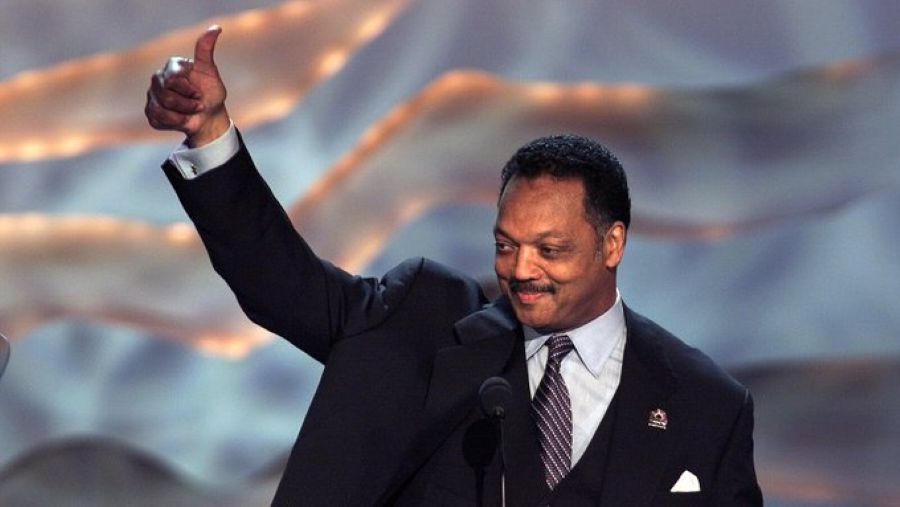

TUE FEB 17 2026-theGBJournal| Rev. Jesse Jackson, one of America’s most prominent civil rights leaders, political activists and Baptist ministers, has died at the age of 84, closing a defining chapter in the struggle for racial justice and equality in the United States.
Jackson, who rose to national prominence in the 1960s as a close associate of Martin Luther King Jr., spent more than five decades at the forefront of social and political advocacy. From marching in the streets during the civil rights movement to running historic presidential campaigns, he remained a towering and often polarizing figure in American public life.
Born on October 8, 1941, in Greenville, South Carolina, Jackson grew up in the segregated South, an experience that shaped his lifelong commitment to fighting discrimination and expanding opportunities for African Americans and other marginalized communities.
He attended North Carolina A&T State University and later studied at the Chicago Theological Seminary, where he deepened his religious and social convictions.
Jackson first came to national attention as an organizer for the Southern Christian Leadership Conference (SCLC), working alongside King in campaigns for voting rights, economic justice and desegregation.
He was present in Memphis in April 1968 when King was assassinated, an event that profoundly influenced his subsequent activism.
In 1971, Jackson founded Operation PUSH (People United to Save Humanity), an organization aimed at improving economic conditions for Black Americans through corporate accountability, voter registration and education initiatives.
He later established the Rainbow Coalition, which sought to unite African Americans, Latinos, labor groups, farmers and other constituencies into a broad-based political movement.
The organization would eventually become the Rainbow PUSH Coalition, a platform through which Jackson continued to advocate for social justice causes well into the 21st century.
Jackson made history in 1984 when he became the second African American to mount a serious campaign for the U.S. presidency, following Shirley Chisholm’s earlier run. Four years later, in 1988, he ran again, winning several state primaries and caucuses and finishing second in the Democratic nomination contest.
His campaigns broke new ground, registering millions of new voters and expanding the role of minority communities in national politics.
Though he never secured the nomination, Jackson’s presidential bids were widely credited with reshaping the Democratic Party’s coalition and paving the way for future leaders, including Barack Obama, who would become the first Black president of the United States two decades later.
Beyond electoral politics, Jackson served as a diplomatic envoy in several high-profile international crises. He negotiated the release of American hostages in Syria in the 1980s and intervened in cases involving political prisoners abroad. His activism also extended to economic boycotts, corporate diversity campaigns and anti-apartheid efforts targeting South Africa.
Over the years, Jackson remained an outspoken advocate on issues ranging from police reform and voting rights to healthcare access and poverty alleviation. He frequently appeared at protests and on television, lending his voice to emerging movements and mentoring younger activists.
In 2017, Jackson revealed that he had been diagnosed with Parkinson’s disease, a progressive neurological disorder. Despite health challenges, he continued to participate in public events and civil rights gatherings, though his appearances became less frequent in later years.
Tributes poured in from across the political spectrum following news of his death. Civil rights leaders hailed him as a bridge between generations of activism, while political figures credited him with broadening the scope of American democracy.
President Joe Biden described Jackson as “a relentless champion for justice who helped bend the arc of history toward equality,” noting his role in expanding voter participation and challenging systemic discrimination. Former President Obama said Jackson’s campaigns “opened doors and inspired millions to believe that their voices mattered.”
Critics, however, often viewed Jackson as a controversial figure, pointing to inflammatory remarks he made at times and questioning some of his tactics. Yet even detractors acknowledged his undeniable impact on American politics and civil rights advocacy.
Throughout his life, Jackson framed his mission in moral and spiritual terms. As a Baptist minister, he frequently invoked scripture and the language of faith in his speeches.
His signature phrase, “Keep hope alive,” became a rallying cry during his 1988 presidential campaign and endured as a symbol of resilience and perseverance.
Historians say Jackson’s greatest legacy may lie in his ability to connect grassroots activism with national political strategy. He championed voter registration drives, corporate boardroom diversity and coalition-building long before such efforts became mainstream priorities.
“Rev. Jackson stood at the crossroads of protest and politics,” said one civil rights scholar. “He understood that change required both moral persuasion and institutional power.”
He is survived by his wife, Jacqueline Jackson, and their children, as well as a vast network of political allies, activists and supporters who were shaped by his leadership.
As the nation reflects on his life, many see Jackson as a figure who embodied both the triumphs and tensions of modern civil rights activism — a man who carried forward the unfinished work of the movement he inherited.
With his passing, the United States loses one of its most recognizable voices for justice, equality and hope. Yet the causes he championed — voting rights, economic empowerment and multiracial coalition-building — remain central to the country’s ongoing quest to fulfill its democratic promise.
X-@theGBJournal|Facebook-the Government and Business Journal|email:gbj@govbusinessjournal.com|govandbusinessj@gmail.com