
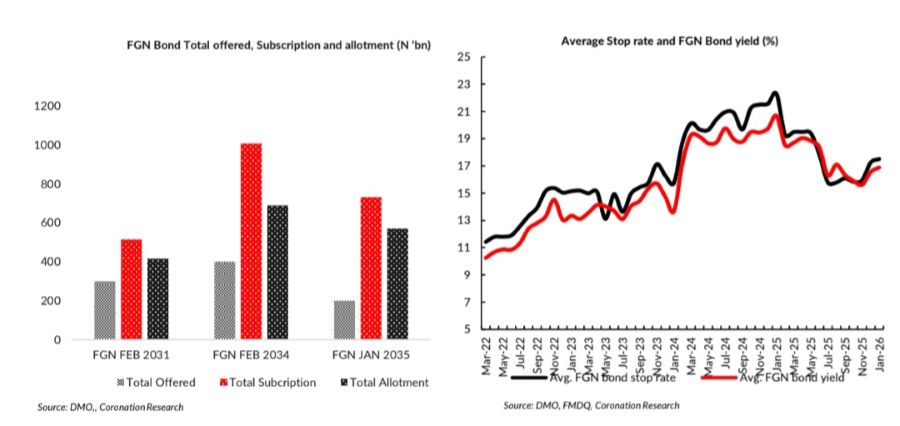

WED JAN 28 2026-theGBJournal|The Debt Management Office (DMO) conducted its first FGN bonds auction of 2026 on 26th January 2026. It offered N900.00bn (vs. N460.00bn at the last auction) through the reopening of the 18.50% FGN FEB 2031 (7-year), 19.00% FGN FEB 2034, and 22.60% FGN JAN 2035 instruments.
The subscription reached approximately N2.25 trillion, translating to a bid-to-cover ratio of about 2.5x, highlighting strong demand across all tenors.
The DMO allotted N1.68 trillion, (including the non-competitive allotments)
reflecting a final bid-to-cover ratio of 1.34x.
The instruments cleared at marginal rates of 17.62% (vs. 17.30%), 17.50% and 17.52% respectively.
Investor’s demand was stronger at the longer end of the curve, with the FEB 2034 and JAN 2035 bonds recording significant oversubscription.
This reflects continued preference for duration by institutional investors, likely driven by expectations of moderating inflation (currently at 15.15%) and potential monetary policy easing in the near term.
The upward repricing at the 7-year point suggests rising pressure on mid-curve yields, while longer end yields mirrored trading activities in the secondary market.
In the FGN bond secondary market, sentiment was more bearish than at the last auction, as average yields edged higher by 26bps to 16.89% pa. as of 26th January 2026. The bearish tone was broad-based, with yields rising across the yield curve.
The midpoint recorded the largest rise, up 40 bps to 16.74% pa, while short- and long-term yields expanded by 25 bps and 6 bps to close at 17.23% pa and 15.36% pa, respectively.
The observed selloffs could be a result of the perceived signals of increased borrowing in future issuances to fund the large deficit.
We expect near-term yield pressure to persist, However, going into H2 2026, we anticipate gradual yield moderation, as easing inflation dynamics create scope for the Monetary Policy Committee to begin a measured policy easing cycle, providing support for fixed income valuations assuming the deficit funding requirement does not increase significantly.
From Coronation Economic Note by Coronation Research
X-@theGBJournal|Facebook-the Government and Business Journal|email:gbj@govbusinessjournal.com|govandbusinessj@gmail.com