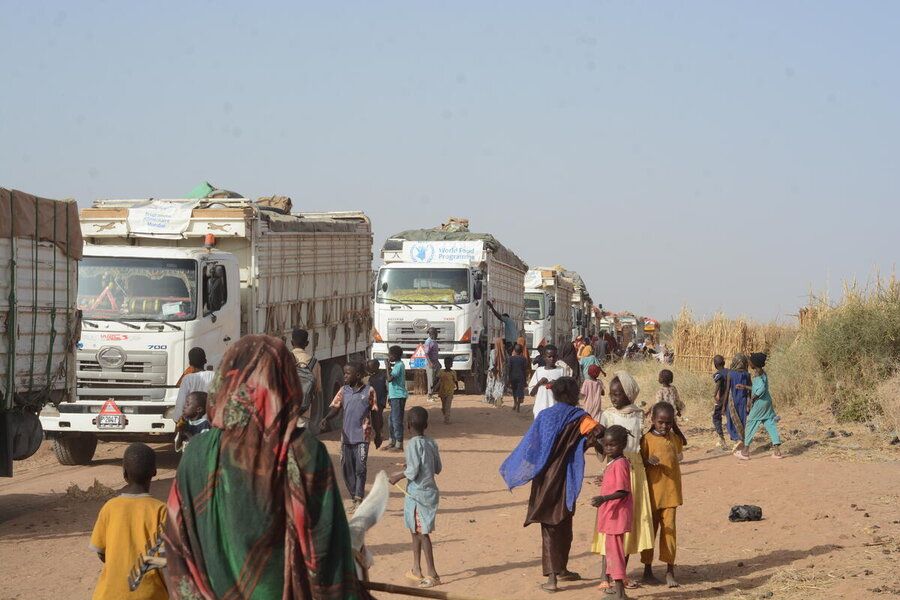

…9.3 million internally displaced
…The global crisis in humanitarian funding has impacted the UN’s work and that of its partners in Sudan, with only 36 per cent of the $4.2 billion requested last year finally funded by donors
MON JAN 12 2026-theGBJournal| UN agencies warn that nearly three years of sustained violence, restricted humanitarian access and shrinking funding have pushed Sudan into what they describe as the largest humanitarian emergency in the world.
An estimated 33.7 million people – around two thirds of the population – are expected to need humanitarian assistance in 2026. More than 20 million people now require health assistance, while 21 million face acute food insecurity.
Devastating impact
The conflict erupted in April 2023 following a power struggle between the Sudanese Armed Forces (SAF) and the paramilitary Rapid Support Forces (RSF), plunging the country into a civil war that has spread from the capital Khartoum to Darfur, Kordofan and other regions.
The fighting has devastated infrastructure, fractured state institutions and left civilians exposed to widespread violence, displacement and deprivation.
Latest UN data indicates that 9.3 million people have been uprooted by conflict across the country and more than 4.3 million have fled across borders, placing immense strain on neighbouring countries.
More than 21 million people are also believed to be acutely food insecure across the country.
Although many of those displaced have returned to the capital, Khartoum, massive challenges and dangers for civilians remain there, including from unexploded weapons. Elsewhere, fighting is continuing “across multiple fronts in Kordofan” further west, OCHA spokesperson Jens Laerke said.
Speaking to journalists in Geneva, he noted that sieges have cut off the towns of Kadugli – capital of South Kordofan state – and Dilling – a town to the north of Kadugli – restricting food, healthcare and access to farms and markets.
Repeated ceasefire efforts have failed, and large swathes of the country remain inaccessible to humanitarian actors due to insecurity, bureaucratic constraints and ongoing hostilities.
A health system on the brink
According to the World Health Organization (WHO), Sudan’s health system has been pushed close to collapse by ongoing fighting, mass displacement and repeated attacks on medical facilities. More than one third of health facilities nationwide are non-functional, cutting millions off from essential and lifesaving care.
Since the conflict began, WHO has verified 201 attacks on healthcare, resulting in 1,858 deaths and 490 injuries. Such attacks violate international humanitarian law and place patients, caregivers and health workers at grave risk.
“One thousand days of conflict in Sudan have driven the health system to the brink of collapse,” said Shible Sahbani, WHO Representative in Sudan. “Under the strain of disease, hunger and lack of access to basic services, people face a devastating situation.”
Despite insecurity and access constraints, WHO continues to support lifesaving services, having delivered more than 3,300 metric tonnes of medicines and medical supplies worth around $40 million. It also supported cholera vaccination campaigns and helped millions access care through hospitals, primary health centres and mobile clinics.
Mass displacement
Sudan is also the world’s largest displacement crisis, with an estimated 13.6 million people uprooted by the fighting – around 9.3 million internally displaced and a further 4.3 million seeking refuge in neighbouring countries.
Overcrowded living conditions, poor sanitation and disrupted services have fuelled outbreaks of cholera, malaria, dengue and measles across much of the country.
Children bearing the heaviest burden
Children make up about half of those expected to need humanitarian assistance in 2026, according to the UN Children’s Fund (UNICEF).
“Children continue to be killed and injured,” said UNICEF Regional Director for the Middle East and North Africa Edouard Beigbeder, noting that eight children were reportedly killed in a single attack in North Kordofan this week alone.
In North Darfur alone, nearly 85,000 children suffering from severe acute malnutrition were treated between January and November 2025 – roughly one child every six minutes – underscoring the scale of the crisis.
Daily drone, missile strikes
In Darfur, meanwhile, “fighting on the ground and drone attacks from the sky continue”, while long-range strikes on civilian infrastructure have also been recorded far beyond the front lines, Mr. Laerke added.
Children continue to be killed and injured amid ongoing clashes between the Sudanese Armed Forces and paramilitary Rapid Support Forces, with eight children reportedly killed in an attack in Al Obeid, North Kordofan, earlier this week.
According to the UN Children’s Fund (UNICEF), a staggering 5,000 youngsters have been displaced every day since the conflict began in April 2023. “Many have been displaced not once but repeatedly, with violence following them wherever they flee,” said UNICEF spokesperson Ricardo Pires.
He warned that millions of children are also at risk of rape with survivors including babies. “Behind every one of these numbers is a child, frightened, hungry, sick and wondering why the world has not come to help,” Mr. Pires added.
Sexual attacks scourge
Women are also victims of “rampant” sexual violence and abuse, with some 12 million people – mostly women and girls – at risk of gender-based violence, according to OCHA. “Female-headed households are now three times more likely to be food insecure and three-quarters of these households report not having enough to eat,” said Mr. Laerke.
The global crisis in humanitarian funding has impacted the UN’s work and that of its partners in Sudan, with only 36 per cent of the $4.2 billion requested last year finally funded by donors.
In light of this reduced financial support, for 2026, OCHA aims to assist 20 million people out of the nearly 34 million people believed to be in need of humanitarian support in Sudan. The plan has been costed at $2.9 billion.
“Today our call is urgent: first, an immediate cessation of hostilities and real steps towards a lasting peace,” Mr. Laerke said. “Second, adherence to international humanitarian law with access facilitated across conflict lines and protection of civilians including aid workers and civilian infrastructure.”
Calls for peace and access
Both WHO and UNICEF stress that humanitarian action, while lifesaving, cannot substitute for peace.
“To meet the mounting needs and prevent the crisis from spiralling out of hand, WHO and humanitarian partners require safe and unimpeded access to all areas of Sudan, and increased financial resources,” Dr. Sahbani said.
For children, UNICEF warns, only an end to the fighting can halt the erosion of safety, health and hope.
“All parties must uphold their obligations under international humanitarian law: protect civilians, stop attacks on infrastructure, and allow safe, sustained and unimpeded humanitarian access,” Mr. Beigbeder said.
X-@theGBJournal|Facebook-the Government and Business Journal|email:gbj@govbusinessjournal.com|govandbusinessj@gmail.com