
…By anchoring projections to a lower oil price assumption, policymakers are implicitly reducing the risk of over-optimistic revenue forecasts
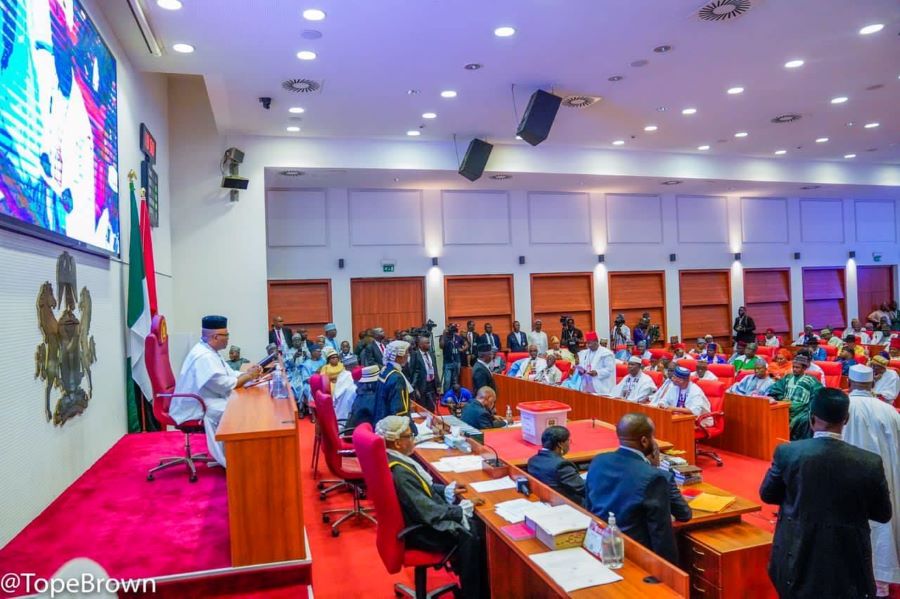
WED DEC 17 2025-theGBJournal| The Nigerian Senate on Tuesday approved the 2026–2028 Medium Term Expenditure Framework and Fiscal Strategy Paper (MTEF/FSP), following the presentation and consideration of a report by Sani Musa (APC, Niger East), the Chairman of the Senate Committee on Finance.
Nigeria’s crude oil benchmark in the approved MTEF/FSP, was cut to $60 per barrel for 2026 in a move lawmakers said was aimed at shielding the economy from global volatility.
The Presidency’s proposed oil price benchmarks of $64.85, $64.30 and $65.50 per barrel for 2026, 2027 and 2028 were cut to $60 for 2026, $65 for 2027 and $70 for 2028.
Sani Musa while making the presentation, said the committee reviewed the Federal Government’s oil price assumptions against prevailing global risks, the downward adjustment became necessary ”in recognition of the global geopolitical tensions in Europe and the Middle East and the sensitivity of global crude oil prices.”
Analysts view the crude oil benchmark cut as conservative and credibility-enhancing signal for markets, reflecting a more cautious fiscal stance amid elevated global geopolitical risks and oil price volatility.
By anchoring projections to a lower oil price assumption, policymakers are implicitly reducing the risk of over-optimistic revenue forecasts and large mid-year fiscal adjustments.
The key implication is lower fiscal slippage risk, but also tighter fiscal space. A $60 benchmark limits upside to oil revenue assumptions, which may constrain spending growth and increase reliance on non-oil revenues, borrowing, or FX inflows if actual prices underperform.
Meanwhile, the Senate retained key macroeconomic assumptions, including exchange rate projects of N,512/U$ for 2026, N1,432.15/US$ for 2027 and N1,383.18/US$ for 2028.
Inflation is projected at to ease to 9% in 2028.
Federal Government expenditure is pegged at N54.46 trillion for 2026 with retained revenue estimated at N34.33 trillion, and fiscal deficit at N20.13 trillion.
Similarly, capital expenditure (exclusive of transfers) was retained at N20.13 trillion, while total recurrent (non-debt) expenditure was estimated at N15.27 trillion, with special intervention funds of N200 billion for recurrent spending and N14 billion for capital projects.
X-@theGBJournal|Facebook-the Government and Business Journal|email:gbj@govbusinessjournal.com|govandbusinessj@gmail.com