
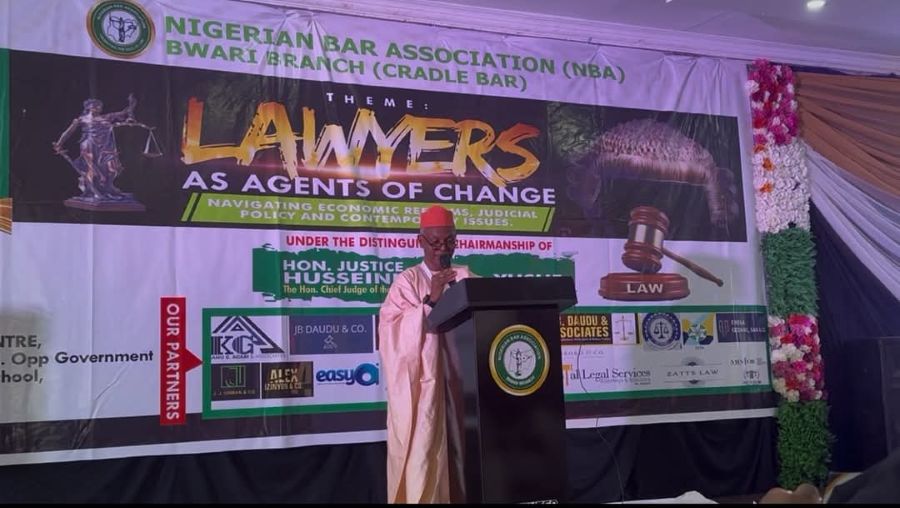

By Nasir Ahmad El-Rufai
…I would suggest that we must build a culture where lawyers are not only seen advocating in courts or pontificating on television. They must also be seen in classrooms, community halls, policy dialogues
…We must speak out—not only when the Bench errs but also when the Bar fails. After all, every member of the Bench was once a member of the Bar. We must support judicial independence while demanding judicial accountability
MON MAY 19 2025-theGBJournal| It is a singular privilege and honour to stand before you today to deliver the keynote address at this year’s Law Week of the esteemed Bwari Branch of the Nigerian Bar Association.
I thank the leadership of the NBA Bwari Branch for the kind invitation and for choosing such a timely and powerful theme – “Lawyers as Agents of Change: Navigating Economic Reforms, Judicial Policy and Contemporary Issues.” In Alkamawa v. Bello & Anor (1998) 6 SCNJ 127, the Supreme Court of Nigeria emphasised the importance of adapting legal principles to societal changes, holding that “the law must be dynamic and responsive to the needs of the society it serves.”
As you know, a Supreme Court is not just the final court of the land, but a public policy court.
This pronouncement by the Justice Uwais-led Supreme Court, even if ‘’obiter’ is a policy directive to all Nigerian lawyers – in the Bar and the Bench – to champion the interpretation, evolution, and amendment of our laws to enable our society to make social and economic progress.
As legal practitioners, you must have surely recognised this. The theme of this keynote therefore calls for much thoughtful consideration, not only as professionals within a legal tradition but as citizens of a nation in transition even as it is challenged literally from all corners.
I. The Nigerian Context: A nation at another crossroads
Every nation faces several crossroads – but there is always one amongst them that Nobel laureates Daron Acemoglu and James Robinson referred to as a ‘critical juncture’ due to its historical social and economic significance.
It is my humble opinion that the last one our nation experienced (and squandered) was in 2007 when Nigeria was largely free of foreign debt, had more than $40bn as net (not gross) foreign reserves, and nearly $30bn in the Excess Crude Account! Our nation was ready to take off to attain its manifest destiny of being the leading African nation and the pride of the Black Race.
Tragically, Obasanjo’s hand-picked successors were unable to manage what was bequeathed to them and it has been mostly downhill since then.
I believe that Nigeria is once again at another critical inflection point in its history. As we struggle, beset by economic turbulence, social upheaval, and institutionalised distrust, particularly between the government and the governed, the challenge before us is to consider the enduring role of the legal profession in building a society governed by law, reason, and reform-minded leadership.
Amidst economic recalibration on a path marked by subsidy removals, exchange rate unification, and fiscal adjustments, Nigerians are being asked to endure hardship in the promise of long-term gain.
But as any seasoned reformer knows, the impetus for economic reform and transformation is rooted in politics; and, as we all know, politics without trust, is mere chicanery. Therefore, for reform to succeed, there must be trust between the Reformer and the People.
In parallel, our judiciary—meant to be the bedrock of fairness and order—is under intense scrutiny. Concerns about delayed justice, procedural inefficiencies, and in some cases, judicial compromise (to put the matter delicately), erode public confidence.
The rise in “forum shopping,” the weaponisation of ex parte orders in political matters, and the growing perception that justice is for sale and available only to the rich and the powerful would cause the perceptive observer to conclude that what Nigerian Courts do is the administration of law and not the administration of justice. In Nigeria, there is a seemingly unbridgeable gulf between law and justice.
Not only is justice wanting but the law that is administered seems to be according to the wishes of the Executive. The demand on you, as practitioners in the Temple of Justice is a sober introspection as you contemplate whether indeed Justitia is blind and whether she holds the scales of justice in fine balance.
In Okocha v. The State (1995) 1 NWLR (Pt. 372) 382, the Court of Appeal highlighted the necessity for the judiciary to maintain public trust: “The judiciary must not only be independent but must be seen to be independent to inspire confidence in the administration of justice.”
Across the oceans, in India, the Bangalore Principles of Judicial Conduct emphasise that “a judiciary of undisputed integrity is the bedrock institution essential for ensuring compliance with democracy and the rule of law.” In moment such as this, therefore, lawyers—more than any other group—must stand as custodians of conscience and agents of accountable change.
The Uwais-led Supreme Court between 2006 and 2007 discharged this responsibility by reversing the impeachment of Governors Joshua Dariye and Peter Obi and severely restricting the powers of the President when a ‘state of emergency’ is lawfully declared in any state of the Federation.
All eyes are now on the Kekere-Ekun court on the action of the current president to remove elected executives and legislators due to the declaration of a state of emergency. Many informed Nigerians are also curious to know whether two-thirds of all the members of the National Assembly can be decided without a division and physical count – but through voice votes as the Akpabio and Abbas-led chambers did with such arrogant disregard for common sense!
II. Lawyers and Economic Reform: Beyond the Courtroom
When people think of economic reform, they often think of economists and technocrats. But lawyers are indispensable in making reform legally durable and socially legitimate. Let me cite three examples. As Minister of the Federal Capital Territory in 2003-2007, I discovered that the FCT was not being administered as required under its enabling legislation.
The FCT is not a federating unit. It is not a State. Rather, it is a territory established under the Federal Capital Territory (FCT) Act, which is quite explicit and crystal clear about how it is to be lawfully administered.
The FCT’s administrative and development needs are placed in the hands of the FCDA but before my tenure, over the years, the bureaucrats of the Federal Government had set up a Ministry of the Federal Capital Territory (MFCT) to mirror the functions of the FCDA, supervise it as a parastatal, and often override it.
It took a comprehensive review of the FCT Act undertaken by lawyers and an Executive Order, comprehensively drafted by lawyers like Eyo Ekpo and Jimi Lawal, and signed by President Olusegun Obasanjo to sweep away the Ministry, create the Federal Capital Territory Administration (FCTA), and restore the FCDA to its rightful position.
The Executive Order created five, slim functional secretariats headed by secretaries appointed by the President as equivalent of state commissioners. It was only after receiving a proper legal warrant from Mr. President under the FCT Act, that my team and I were able to undertake the decent work that we did back then.
However, the powerful role that law can play in shaping political and administrative reforms is exemplified in the way in which the FCT Act was deployed to create an appropriate structure to soundly manage the FCT and its agencies. We must insist on fidelity to the Act and the subsisting Executive Order of 2004 to ensure that it is not turned into an inefficient and sprawling bureaucracy.
Before my stint as Minister of the FCT, however, I had the privilege of being the Director-General of the Bureau of Public Enterprises.
The BPE back then was the engine room of some of the major economic reforms implemented by the Administration of President Olusegun Obasanjo. Three are worthy of mention – reform of the telecommunications, pensions and electricity sectors of the economy.
Two of these – in telecoms and pensions – were duly implemented between 1999 and 2003 with outstanding success. The jury is still out on the third in the electricity supply industry, but I can say that none of them would have been attempted without the instrumentality of a raft of carefully considered new policies and laws prepared by multidisciplinary teams of social scientists, finance experts and, of course, lawyers.
Implementation too would have been impossible without them. I recall with satisfaction the roles played by Abdulkareem Adesokan, a thoughtful economist and administrator, Eyo Ekpo, a lawyer we brought from the private sector, and the then Honourable (and later Senator and Minister) Idris Umar who was chair of the House of Representative Committee on Electric Power.
These brilliant public servants worked closely with Cameron McKenna, Arthur Andersen, and our Nigerian law firms to draft what became the Electric Power Sector Reform Act.
Staying a little longer on electricity, the one sector in which we as a country are still very much lacking, we may observe that the latest reforms in the sector under the Electricity Act, 2023 were preceded by the amendment of the Paragraph 14b, Part II, Second Schedule to the 1999 Constitution, via the astute removal of a single word from that paragraph which gave it the more expansive and federalism-oriented interpretation it now has.
Once it was clear in 2022 that the Constitution would be amended, attention turned to the Electricity Bill which at that time existed only as a Senate version. Reading through the Senate Bill, it became obvious that the provisions of this version ran contrary to the letter and spirit of the separation of responsibilities in the sector between the Federal and State Governments.
Rather than a time-wasting wholesale re-write of the Senate Bill, a team of lawyers instead came up with the idea of adding Section 2 subsection (2)(c), the qualifying phrase “Without prejudice to the powers of the States” that precedes Section 67 subsection (1) and Section 230 subsections (2) to (9) to the Bill, which was then passed by the National Assembly as the Electricity Bill 2023.
Learned Gentlemen of the Bar, the Fifth Alteration to the 1999 Constitution and the Electricity Act, 2023, read together, present a case study of how a comprehensive understanding of constitutional law and adroit skills of legal drafting and statutory interpretation are vital when undertaking any kind of political-economic reforms, since there can be no reform without often-complex legislative drafting.
These achievements would not have been achieved without the incisive application of political will and commitment to constitutional reform by, believe it or not, the 2019-2023 Class of Governors.
The 36 States coordinated to give approval to the constitutional amendment and some of the governors lobbied hard to pass the Electricity Act, 2023 in April 2023, giving enough time for the Act to be assented to by Mr. President in one of his first official acts on 6th June 2023.
All these speak to a powerful truth – that lasting and effective reforms of any kind are utterly impossible without the application of firm, incisive, sustained and, above all, selfless political will, and leadership. This is what has been lacking with many of our failed or poorly performing reforms in Nigeria.
Nevertheless, we need more reforms in Nigeria. Lawyers must also use their advocacy skills to push for reforms in public procurement, land titling and tax administration. Nigeria’s complex legal architecture can be a tool for investment or a trap of frustration.
It depends on how it is navigated—and who is guiding the ship. Our courts too must evolve. Commercial judges must be trained to understand emerging areas like fintech, climate change, energy transition and digital trade. Alternative dispute resolution must be given teeth, not just as an afterthought but as a credible avenue for obtaining a fair and timely resolution of disputes.
Resolving the backlog of cases in the dockets of our judges requires that the Bench and Bar should design a framework for clearing them and enabling our legal system to offer an assurance of adjudication within a shorter timeframe. Law reform commissions must be revitalised and populated across the country with practical minds, not just mere theorists. As agents of economic reform, lawyers must think systemically and act institutionally.
III. The Legal Profession and the crisis of judicial trust
The Judiciary has historically served as the stabilising or moderating institution against extremist tendencies in military administrations.
We may recall the Supreme Court’s decision in Lakanmi v. Attorney-General, Federation in which the doctrine of “covering the field” was established whereby when both Federal and State laws exist on the same subject, the Federal law prevails, rendering the State law void to the extent of the inconsistency.
The Supreme Court, in this case, also determined that Decree No. 45 of 1968, which contained an ouster clause, was unconstitutional as it amounted to a usurpation of judicial power, thus violating the principles of separation of powers and the rule of law. The Court was emphatic that even under a military regime, laws could not be enacted to override the Constitution without necessity.
This decision reaffirmed the supremacy of the Constitution and the judiciary’s role in upholding the rule of law, even during periods of military rule. It established that even military governments are bound by constitutional principles and cannot arbitrarily enact laws that infringe upon individual rights without just cause.
Looking back to our constitutional history, it is remarkable but true to say that the golden years of the Supreme Court, what became known as its years of judicial activism, occurred during military rule and were driven by names like Chief Justice of Nigeria Sir Adetokunbo Ademola who presided over the Lakanmi case; Justice Chukwunweike Idigbe, who while not overtly controversial, expressed judicial opinions that reflected deep his deep concern for constitutional order and legal certainty, even in the uncertain environment of military rule.
We also had Mr. Justice Kayode Eso, regarded as the greatest of the judicial activists who was revered for his insistence on judicial independence and fundamental rights, who was reputed to have made the famous statement about judicial courage, to wit, that “the court must not be seen to be an errand boy of the executive.”
Last but most certainly not least is Justice Chukwudifu Akunne Oputa, the philosophical, moral voice of the Supreme Court whose jurisprudence reflected a deep understanding of the human rights implications of laws and the sanctity of the Judicial Branch.
Listen to him: “If the legislature is corrupt, you go to the judiciary for redress. If the executive is corrupt, you go to the judiciary for remedy. If the judiciary itself is corrupt, where do you go from there?”
Today, after 26 unbroken years of civilian governance, very sad to say, it is quite hard to mention names of jurists who we can all agree remind us of days gone recently past. Faith in the impartiality of our courts is being steadily undermined. Not by the Constitution or by law, but by the conduct of the those conferred with the high privilege of sitting on the Bench.
If we must be honest, we must admit that the perception of a high level of judicial corruption is now mainstream. This is not helped by the opacity of judicial appointments, inconsistent rulings on electoral matters, the inexplicable delays in critical judgments and the slap on the wrists meted to notoriously bad Judges by the National Judicial Council which, I would respectfully say, has not succeeded in its mission and is now itself desperately in need of reform and restructuring.
Once upon a time ordinary citizens tiptoed past the homes of Judges. Not any longer. Now Judges are abused and maligned with almost reckless abandon. They are physically and mentally assaulted, sometimes roundly disrespected by the ordinary citizenry. How indeed are the mighty fallen.
But we must also resist simplistic narratives. Practically all judicial officers work under immense pressure, while being poorly resourced and poorly protected. The problem is not merely one of bad actors—it is also one of weak institutions and, dare I say it here, a lack of courageous leadership within the Bar. If the judiciary is to regain its moral authority, lawyers must lead the way there.
We must speak out—not only when the Bench errs but also when the Bar fails. After all, every member of the Bench was once a member of the Bar. We must support judicial independence while demanding judicial accountability.
We must advocate for reforms to the National Judicial Council, to the funding mechanisms of the judiciary. We must insist and ensure that the criteria for elevation to the Bench and the appellate courts must be raised and made devoid of even the slightest hint of opacity. Also, the discipline of erring judicial officers must be very firmly and strictly enforced. Recent comments on this issue by Vice President Prof Yemi Osinbajo SAN bear witness to the gravity of the situation.
Clearly, the time has come for lawyers to stop being mere litigators of symptoms and to become architects of institutional health.
IV. The Role of young lawyers and regional Bars
Let me especially address young lawyers and local branches such as yours here in Bwari. Too often, the conversation about reform is centralised—and is all too often dominated by the “learned silks”.
But change often bubbles from below. In Nigerian Bar Association v. Attorney-General of the Federation (2015) 15 NWLR (Pt. 1481) 1, the Supreme Court recognized the importance of the Nigerian Bar Association in promoting the rule of law and legal development across the country, stating that “the NBA plays a crucial role in ensuring that legal services are accessible and that the rule of law is upheld throughout the Federation.”
Similarly, in a sister common law jurisdiction, South Africa, in Du Plessis v. De Klerk (1996) 3 SA 850 (CC), the South African Constitutional Court acknowledged the role of legal practitioners in advancing constitutional values, emphasising that “the legal profession has a duty to promote the values of the Constitution and ensure access to justice for all.”
It is at the grassroots—at the area courts, magistrate’s courts, and customary courts—that most Nigerians first encounter the law. And it is in branches like yours that legal ethics, community service and public interest litigation can find expression beyond the elitism that sometimes makes the law appear to be beyond the reach of the citizenry.
I would suggest that we must build a culture where lawyers are not only seen advocating in courts or pontificating on television. They must also be seen in classrooms, community halls, policy dialogues and before regulators—educating citizens, scrutinising local budgets, monitoring elections, defending the voiceless and advocating for hapless consumers.
The latter area, consumer protection, is especially one in which young, public-spirited lawyers can work actively. Consumer protection is neither in the Exclusive nor the Concurrent Legislative Lists.
Elementary constitutional law tells us that for this reason it is on the notional Residual Legislative List and therefore a matter exclusively for the State Houses of Assembly to legislate upon.
Even though there is established by the Federal Government a Federal Competition and Consumer Protection Commission, even if we argue that the National Assembly did have the constitutional power to confer consumer protection duties on the Commission, it is, of course, physically impossible for a body sitting in Abuja, with a few zonal offices, to successfully undertake the consumer protection and education functions that our citizenry desperately need to shield them from the effects of poor customer service and the countless fake and substandard goods that litter our land.
In other words, the true test of our commitment to the cause of Justice lies not merely in the prestige that the profession of law bestows on us. Rather, it is in the proximity we maintain to justice at the margins.
V. Contemporary Issues: Technology, free speech and national security
A keynote address at such an august gathering as this would be incomplete without taking a view of the intersection of law, technology, and civil liberties.
We live in an age where a tweet can spark a protest, where misinformation moves infinitely faster than the due process of law and where surveillance has become more comprehensive, more pervasive and more intrusive. In such a landscape, the legal profession must reimagine itself and its obligations to itself and to society.
What does the right to free speech mean in the age of AI? How do we balance the legitimate demands of national security with the protection of privacy, especially digital privacy and the right to freedom of expression? What rights do citizens have against arbitrary bans, internet shutdowns, or unlawful arrests on the basis of one’s rights stopping where the rights of others begin?
These are not abstract questions. They go to the heart of a democratic society. And lawyers—especially human rights advocates and constitutional scholars—must lead the public conversation, informed by principle, not partisan interest.
Perhaps this was why the Court of Appeal in Director of State Security Service v. Olisa Agbakoba (1999) 3 NWLR (Pt. 595) 314, sought to address the very delicate balance between national security and individual rights, asserting that “while national security is paramount, it must not be used as a cloak to infringe upon fundamental human rights.”
We can and we must nurture a culture of informed discourse and courteous disagreement, reject falsehood and incitement while respecting free speech.
VI. The NBA and the challenge of Moral Leadership
Permit me, also, to say something that may be uncomfortable but necessary. The NBA must look in the mirror. We cannot demand integrity in public life while tolerating mediocrity or malpractice within our own ranks. We cannot lament the erosion of justice if we allow our own internal regulatory and disciplinary bodies to be toothless.
We cannot continue to demand a clean electoral process while profiting regularly from the shenanigans that have infected election petitions.
In Chief Gani Fawehinmi v. Nigerian Bar Association (No.2) (1989) 2 NWLR (Pt. 105) 558, the Supreme Court highlighted the responsibility of the NBA in maintaining professional ethics: “The NBA must ensure that its members adhere to the highest standards of professional conduct to maintain public confidence in the legal profession.”
It is time to renew the moral foundations of our Association—not through slogans, but through structure and deliberate and well-considered action. Let us revisit our ethical codes, our continuing legal education programs, our pro bono culture, and our internal democracy.
Let us invest not just in the glamour of conferences but in the grit of reform. Let us not be a profession that is feared but not respected, visible but not trusted, numerous but not impactful. May it not be too late.
VII. A call to purpose
Learned Gentlemen, the Bar is not merely a career, or a source of daily bread obtained by any means possible or necessary. No! It is a vocation. It is a calling, a calling that is first and above all about uberrimae fides, utmost good faith, integrity and conscience.
Whether you draft laws, argue cases, or advise clients, you carry the weight of justice on your shoulders. You are not just service providers—you are standard bearers. You are not just interpreters of the law—you are defenders of the social contract.
I call on you not to be passive observers of Nigeria’s dysfunction. Let us be bold participants in its rebirth. Let us shape policies, not just plead cases. Let us challenge bad laws, not just comply with them. Let us uphold the Constitution, even when it is inconvenient to do so.
And in all things, let us remember: the power of the law lies just not in its text, but in the integrity of those who wield, plead and interpret it.
Conclusion
As we celebrate Law Week, may it not be just a ritual of robes and rhetoric. Let it be a time of reflection, rededication, and reform. I believe in the power of the Nigerian lawyer. For the past 40-plus years, particularly in the last 27, I have worked very closely with many of you—privately and at the very highest levels of Nigerian Federal and State Governments, in the courts, in think tanks, and in the trenches of reform. I have seen brilliance, courage, and vision. So much so that I too went to study for and obtain a law degree.
But I also know that our country needs more. It needs not just brilliant minds, but brave hearts. It needs not just professionals, but patriots.
May you, the lawyers of Bwari and beyond, rise to that challenge. May the Rule of Law prevail. “Fiat Justitia. Nil Tremefacit.” Or to use the language of our streets: “Let Justice Reign. No Shaking.” Thank you.
Speech delivered by Nasir Ahmad El-Rufai, at the Law Week of the Nigerian Bar Association, Bwari Branch
X-@theGBJournal|Facebook-the Government and Business Journal|email:gbj@govbusinessjournal.com|govandbusinessj@gmail.com